A good affordable tire inflator does not need premium pricing to handle everyday tire maintenance. For most drivers, the important features are dependable inflation, an easy-to-read pressure gauge, automatic shutoff, adequate cord reach, and a compact design that can stay in the vehicle.
My first choice is the AstroAI AIRUN H Tire Inflator Portable Air Compressor. I like its combination of simple digital controls, preset pressure, automatic shutoff, useful cable reach, and compact size. It offers the best balance for ordinary cars and routine tire top-offs.
The EPAuto 12V DC Portable Air Compressor Pump is another dependable option. Its straightforward 12V design, digital gauge, automatic cutoff, LED flashlight, and overheat protection make it especially appealing for drivers who want a proven basic inflator.
I would also consider the VacLife VL701 Air Compressor Tire Inflator when compact storage and simple operation matter most. It provides digital pressure control, automatic shutoff, and an integrated light without adding unnecessary complexity.
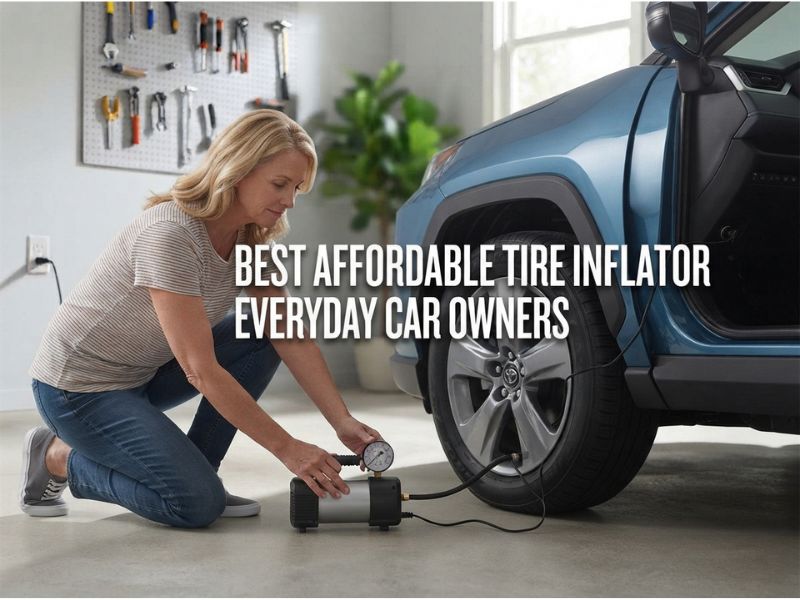
Best Affordable Tire Inflator
| Image | Product Name | Check Price |
|---|---|---|
Best Choice | AstroAI AIRUN H Tire Inflator Portable Air Compressor | Check Price |
Second Best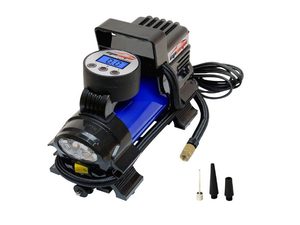 | EPAuto 12V DC Portable Air Compressor Pump | Check Price |
Third Choice | TEROMAS Tire Inflator Portable Air Compressor | Check Price |
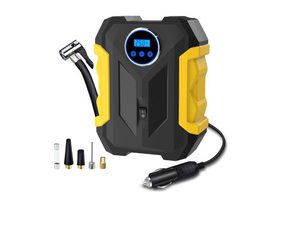 | CARSUN Digital Air Compressor for Car | Check Price |
1. AstroAI AIRUN H Tire Inflator Portable Air Compressor – Best Overall Affordable Pick

Key Features
- 12V DC corded power
- Up to 100 PSI
- Approximately 9.8-foot power cord
- Digital pressure display
- Programmable pressure setting
- Automatic shutoff
- Backlit display
- Integrated LED light
- Compact trunk-friendly design
Detailed Review
The AstroAI AIRUN H is the model I would buy for a typical passenger car because it focuses on the features that matter during actual tire maintenance rather than adding expensive extras.
Power comes directly from a vehicle’s 12V accessory outlet, which has an important advantage over rechargeable inflators: you do not have to remember to charge an internal battery. If the unit has been sitting in your trunk for several months, you can still plug it into the vehicle and use it.
The digital pressure control is also very convenient. Once the hose is connected, you can choose the desired pressure and allow the inflator to stop automatically. For someone topping up four tires after a cold-weather pressure drop, that is far easier than repeatedly stopping the compressor to check pressure manually.
Its approximately 9.8-foot cord provides reasonable reach for regular-size cars and crossovers. Cable length is easy to overlook when shopping, but a short power lead can become frustrating when trying to reach a rear tire from a front-mounted accessory socket.
The 100 PSI capability is more than sufficient for ordinary passenger-car applications. Most car tires operate far below that pressure, so there is little practical reason to chase inflated maximum-PSI claims if your primary goal is maintaining a sedan or crossover.
AstroAI also includes a backlit screen and LED light. Neither feature increases inflation speed, but both improve usability during a nighttime roadside stop.
The compact housing makes storage simple. It can stay in a trunk, cargo compartment, or emergency kit without requiring the space of a traditional compressor tank.
What I Like
I like the balance of features most. The AIRUN H gives you a digital gauge, preset pressure, auto shutoff, LED illumination, and useful cord length without turning into a bulky or expensive machine.
It is particularly well suited to routine pressure corrections. If your tires should be at 35 PSI and one has dropped to 29 PSI, this is exactly the kind of job the AstroAI handles well.
What I Do Not Like
It is still a compact compressor, so it is not the right tool for repeatedly filling oversized off-road or heavy truck tires.
It also requires access to a 12V vehicle outlet, which means it does not offer the completely cordless convenience of a battery-powered model.
Verdict
The AstroAI AIRUN H is my top recommendation for shoppers looking for the best affordable tire inflator for ordinary car ownership. It is simple, compact, well equipped, and appropriately designed for common roadside and home tire-pressure maintenance.
2. EPAuto 12V DC Portable Air Compressor Pump – Best Proven Budget Choice

Key Features
- 12V DC vehicle power
- 120-watt rated power
- Approximately 1.06 CFM inflation speed
- Maximum working pressure around 70 PSI
- Digital pressure gauge
- PSI, KPA, BAR, and KG/CM display modes
- Automatic shutoff
- LED flashlight
- Overheat protection
- Multiple inflation adapters
Detailed Review
EPAuto takes a more traditional approach than many newer handheld inflators, and that simplicity is part of its appeal.
You plug the compressor into a 12V accessory socket, connect it to the tire valve, select the target pressure, and switch it on. The compressor shuts off when it reaches the selected pressure.
Its maximum working pressure is lower than the triple-digit marketing numbers attached to many inexpensive inflators, but this should not concern normal car owners. Most passenger-car tires require nowhere near 70 PSI.
What matters more is whether the compressor can deliver enough airflow for the intended tire size, and the EPAuto is specifically positioned for cars, bicycles, sedans, and midsize SUVs rather than truck tires.
The approximately 1.06 CFM listed inflation speed gives it useful capability for routine pressure corrections.
Another feature I appreciate is overheating protection. Compact compressors generate heat quickly because a relatively small motor and cylinder are doing a demanding job. Thermal protection adds an additional safeguard when the compressor becomes overloaded or excessively hot.
The four pressure units also make the display versatile. U.S. drivers will usually use PSI, but BAR and KPA support can be useful for motorcycles, bicycles, imported equipment, and international specifications.
EPAuto also includes adapters for sports balls and compatible recreational inflatables. That makes it more useful than a single-purpose car accessory.
What I Like
The main advantage is straightforward reliability. There is no internal battery that needs maintenance, and the controls are easy to understand.
I also like the automatic pressure cutoff and thermal protection. Those are meaningful functional features rather than cosmetic additions.
What I Do Not Like
EPAuto specifically is not intended for truck tires. Owners of pickups running large LT tires should choose a higher-volume compressor designed for those applications.
The screw-on valve connection can also release a small amount of air while being removed, although this is common with many compact inflators.
Verdict
The EPAuto 12V DC Portable Air Compressor Pump is a strong affordable option for drivers who prioritize a proven, no-nonsense design. It is particularly suitable for sedans, compact cars, bicycles, and many midsize passenger vehicles.
3. VacLife VL701 Air Compressor Tire Inflator – Best Compact Value
Key Features
- 12V DC operation
- Digital pressure gauge
- Preset pressure control
- Automatic shutoff
- Integrated LED light
- Compact portable design
- Multiple inflation nozzles
- Suitable for cars, motorcycles, bicycles, and sports equipment
Detailed Review
The VacLife VL701 is a good match for buyers who want inexpensive tire-maintenance equipment that does not occupy much trunk space.
It uses vehicle power rather than relying on a rechargeable internal battery. For an emergency tool that may spend months sitting unused, this can be a major advantage.
The preset pressure function is one of its most useful features. After selecting a target, the pump automatically stops once the chosen pressure is reached. That makes it easier for inexperienced users to perform routine pressure adjustments confidently.
The digital display also makes pressure readings easier to understand than the tiny analog gauges commonly found on older bargain inflators.
VacLife includes LED illumination for low-light operation. If a TPMS warning appears during an evening trip or you notice a low tire in a dark parking area, having an integrated light makes locating the valve and watching the compressor easier.
The compact housing is another strength. A tire inflator is most useful when you actually have it with you, and smaller equipment is easier to leave permanently inside the vehicle.
The VL701 is better suited to cars, motorcycles, bicycles, and similar applications than very large vehicle tires. That limitation is normal for this price and size class.
What I Like
The VacLife is easy to operate and easy to store.
Its digital gauge, auto-stop system, and LED light cover the everyday functions most drivers need without making the interface complicated.
What I Do Not Like
It is not designed for high-volume heavy-duty tire inflation.
Like most small compressors, it can also generate significant heat during extended operation, so proper cooling intervals are important.
Verdict
The VacLife VL701 is a good affordable choice for drivers who want a compact inflator primarily for tire top-offs and emergency pressure corrections. Its small size makes it particularly convenient for compact cars with limited cargo space.
4. TEROMAS Tire Inflator Portable Air Compressor – Best Affordable AC/DC Option

Key Features
- 12V DC vehicle power
- 110/120V AC household power
- Rated pressure capability up to 120 PSI for suitable applications
- Digital pressure gauge
- Programmable inflation
- Automatic shutoff
- Backlit LCD
- Built-in LED light
- Approximately 10.5-foot power cord
- Multiple adapters
Detailed Review
The TEROMAS is different from the first three products because it can work from both a vehicle and a household electrical outlet.
That AC/DC versatility makes it particularly useful for someone who wants one compressor for the garage and the trunk.
At home, you can plug it into a regular outlet while checking tire pressure in the driveway. On a trip, you can use the vehicle’s 12V outlet instead.
That flexibility eliminates one of the common inconveniences of basic 12V pumps: needing to position the vehicle or route a cord from the accessory socket every time you want to add a little air at home.
Like the other digital models in this guide, TEROMAS allows the user to preset a target pressure. The compressor then stops automatically once that pressure is reached.
The backlit display is readable in low-light conditions, while the built-in LED provides additional illumination around the tire.
Its approximately 10.5-foot power cord provides useful reach around many passenger vehicles.
TEROMAS also includes adapters for bicycles, sports equipment, and other compatible inflatables, increasing its usefulness around the home.
However, this is still a compact inflator rather than a heavy-duty truck compressor. Large truck, tractor, and oversized tire applications require more airflow and a stronger duty cycle.
What I Like
The biggest advantage is unquestionably dual power.
Someone who regularly checks tire pressure both at home and on the road can get much more use from TEROMAS than from a 12V-only compressor.
I also like the preset pressure system and relatively tidy cord-storage design.
What I Do Not Like
The dual-power system makes the unit slightly less minimal than a basic corded pump.
It is also designed primarily for common passenger-vehicle and household inflation tasks rather than demanding truck use.
Verdict
Choose the TEROMAS Tire Inflator if AC/DC flexibility matters more than having the absolute smallest compressor. It offers unusually useful versatility while remaining accessible to budget-minded buyers.
5. CARSUN Digital Air Compressor for Car – Best Affordable High-Pressure Pick

Key Features
- 12V DC corded operation
- Up to 150 PSI
- Approximately 35 L/min airflow
- Digital pressure display
- Automatic shutoff
- Built-in LED light
- Approximately 10-foot power cord
- Multiple nozzle adapters
- Suitable for cars, bicycles, motorcycles, and common inflatables
Detailed Review
CARSUN provides a strong specification set for a relatively simple 12V inflator.
The advertised 35 L/min airflow is useful for ordinary car tires, especially when you need more than a tiny one- or two-PSI adjustment.
It can also be preset to a desired tire pressure and stopped automatically once that target is reached. This is one of the features I would prioritize on any inexpensive digital inflator because it reduces the amount of manual monitoring required.
The 150 PSI rating is higher than most passenger vehicles will ever require. That extra pressure ceiling can be useful for certain bicycle applications, but it should not be interpreted as proof that the unit is appropriate for large truck tires.
Air volume and duty cycle are just as important as maximum pressure.
CARSUN includes an approximately 10-foot power cord, helping it reach wheels around compact and midsize vehicles.
The LED light and large display improve visibility when working after dark.
Multiple supplied adapters extend its usefulness to bicycles, balls, and compatible household inflatables.
What I Like
The combination of 35 L/min airflow, digital controls, auto shutoff, and a long power cord is appealing for the money.
It also provides a relatively high pressure ceiling for buyers who occasionally inflate bicycle tires in addition to car tires.
What I Do Not Like
The recommended continuous operating period is limited, so it should be allowed to cool during demanding jobs.
I also would not select it specifically for pickup trucks with oversized tires simply because it carries a 150 PSI rating.
Verdict
The CARSUN Digital Air Compressor is a useful affordable option for ordinary passenger-car maintenance. Its combination of good airflow, long cord reach, preset inflation, and a digital gauge gives it solid everyday value.
Affordable Tire Inflator Comparison
| Product | Power Source | Rated Pressure | Digital Gauge | Auto Shutoff | LED Light | Power/Cord Advantage | Best For |
| AstroAI AIRUN H | 12V DC | 100 PSI | Yes | Yes | Yes | 9.8-ft cord | Best overall everyday car use |
| EPAuto Portable Compressor | 12V DC | 70 PSI working pressure | Yes | Yes | Yes | Thermal protection | Proven passenger-car reliability |
| VacLife VL701 | 12V DC | High-pressure compact design | Yes | Yes | Yes | Compact storage | Small cars and routine top-offs |
| TEROMAS Tire Inflator | 12V DC + 110/120V AC | Up to 120 PSI for suitable uses | Yes | Yes | Yes | Dual AC/DC operation | Garage and roadside use |
| CARSUN Digital Air Compressor | 12V DC | 150 PSI | Yes | Yes | Yes | About 10-ft cord | Strong airflow on a budget |
The AstroAI AIRUN H offers the strongest overall combination for the typical driver because its features are well matched to routine passenger-car maintenance.
EPAuto is a good alternative if you prefer a long-established, straightforward compressor with overheating protection. VacLife emphasizes portability, while TEROMAS is the clear choice when household AC power matters.
CARSUN is particularly attractive if you want relatively strong airflow and a high pressure ceiling while staying with a simple 12V setup.
How to Choose the Best Affordable Tire Inflator
Price matters, but buying the cheapest inflator without considering tire size, airflow, pressure control, and power source can result in a tool that is frustrating to use.
A good budget inflator should still match your vehicle and expected workload.
Start With Your Vehicle Type
A compact car and a pickup truck can require dramatically different amounts of air.
Standard passenger-car tires normally work well with compact 12V compressors. Sedans, hatchbacks, compact crossovers, motorcycles, and many midsize vehicles do not require a massive compressor for routine pressure adjustments.
Large pickup tires, high-volume off-road tires, and LT-rated tires are different.
Those applications are better served by high-flow compressors that connect directly to the battery and are designed for longer operating cycles.
Buying a small inflator because its packaging says 150 PSI can lead to disappointment if you expect it to fill oversized tires rapidly.
Maximum PSI Is Not the Most Important Number
One of the biggest mistakes buyers make is treating maximum PSI as the primary measurement of compressor performance.
It is not.
Most passenger vehicles specify cold tire pressures somewhere around the general 30–40 PSI range, although the correct value depends entirely on the vehicle.
A compressor capable of 100 PSI therefore already has substantially more pressure capability than most passenger-car tires require.
A 150 PSI compressor is not necessarily faster than a 100 PSI compressor.
Airflow, motor performance, and duty cycle determine how effectively the compressor can move air into the tire.
Pay Attention to Airflow
Airflow is commonly expressed in liters per minute (L/min) or cubic feet per minute (CFM).
Higher airflow usually means faster tire inflation, although manufacturer measurements are not always performed under identical conditions.
For ordinary top-offs, moderate airflow is perfectly adequate.
If a tire drops from 35 PSI to 30 PSI, you are adding a relatively small quantity of air.
A nearly flat tire requires considerably more work. That is where differences between compressors become much more noticeable.
Automatic Shutoff Is Worth Having
One feature I would actively look for even in an inexpensive inflator is automatic shutoff.
With a preset system, you choose the desired pressure before inflation.
The compressor monitors tire pressure as it runs and shuts off once the target is reached.
This allows you to focus on positioning the compressor and keeping the hose and cord clear rather than staring continuously at a gauge.
It can also reduce accidental overinflation.
Digital Displays Make Budget Inflators Easier to Use
Digital tire inflators have become inexpensive enough that there is little reason for most shoppers to settle for a difficult-to-read tiny analog gauge.
A digital screen can provide a clear numerical pressure reading and often supports multiple pressure units.
Many also include backlighting for nighttime use.
A separate quality tire-pressure gauge is still useful for periodic verification, but the integrated digital gauge makes everyday maintenance easier.
Corded vs. Cordless Inflators
Cordless pumps are convenient, but the battery adds cost.
For shoppers focused specifically on affordability, a 12V corded tire inflator often provides better value.
It draws power directly from the vehicle, meaning there is no internal battery that needs to remain charged.
That is particularly useful for emergency equipment.
A cordless pump that has been sitting in a trunk for months may have limited charge when you finally need it.
The disadvantage is obvious: a corded inflator must remain connected to the vehicle.
For many drivers, that tradeoff is worthwhile.
Consider AC/DC Models for Home Use
A dual-power compressor can make sense if you regularly check tires at home.
The TEROMAS in this guide can operate from both household AC and vehicle DC power.
That allows one inflator to serve as both a garage tool and an emergency trunk compressor.
If you expect to use the inflator almost exclusively beside your vehicle, however, paying extra for AC compatibility may not provide much additional value.
Check Power-Cord Reach
Before choosing a compressor, think about the distance from your 12V outlet to the rear wheels.
A power cord around 9–10 feet works for many passenger vehicles, but vehicle layouts differ.
Minivans, three-row SUVs, and longer vehicles may require additional reach.
You should not need to pull aggressively on a cable to connect the compressor to a rear tire.
Understand Duty Cycle
Compact compressors generate heat.
The duty cycle or recommended maximum operating period tells you how long the motor can run before needing to cool.
This is extremely important when inflating a tire from very low pressure.
A five-PSI top-off may place minimal stress on the compressor. Filling multiple nearly empty tires can keep the motor running long enough to generate substantial heat.
Follow the operating-time and cooling recommendations for your specific inflator.
Look for Thermal Protection
Overheating protection is another useful feature, particularly on compact pumps.
EPAuto, for example, incorporates an overheat cutoff.
Thermal protection is not a reason to ignore operating limits, but it provides another layer of protection when internal temperatures rise excessively.
Check the Valve Connection
Most affordable inflators use either a screw-on connector or a lever-style chuck.
A screw-on connector often provides a secure seal but takes slightly longer to install and remove.
A lever chuck can be faster to attach but must clamp securely to avoid air leakage.
Neither system is universally better.
Ease of use and a reliable seal matter more.
Consider Storage
An affordable inflator should be easy enough to store permanently in your vehicle.
A compressor sitting in your garage will not help if you discover a low tire during a road trip.
Look for:
- Compact housing
- Cable-storage channels
- Hose-storage compartments
- A carrying bag or case
- Secure adapter storage
Good cord management can make a noticeable difference in daily convenience.
Do You Need an LED Light?
An LED does not affect compressor performance, but it is useful in real-world roadside situations.
A tire-pressure problem can happen after dark.
Integrated lighting helps you locate the valve stem, see the digital display, and keep track of the hose and cable without holding a separate flashlight.
For an emergency-focused inflator, I consider this a worthwhile feature.
Affordable Tire Inflator vs. Expensive Tire Inflator
Spending more can provide faster inflation, larger batteries, better cooling, higher airflow, improved construction, and more flexible power options.
But many drivers do not actually need those capabilities.
If you primarily maintain passenger-car tires and rarely need more than a few PSI of additional air, a good inexpensive compressor can perform the job perfectly well.
Premium equipment becomes more valuable when you have:
- Large SUV or truck tires
- Off-road tires
- Multiple vehicles
- Frequent inflation requirements
- Commercial use
- Repeated airing down and airing up
- A need for very fast inflation
The important goal is not buying the most expensive compressor.
It is buying enough compressor for the job.
Why Every Car Should Have a Tire Inflator
Modern vehicles commonly include a tire pressure monitoring system, but TPMS only warns you that pressure is low.
It cannot correct the problem.
A portable compressor allows you to respond immediately instead of searching for a working public air pump.
This becomes especially useful during seasonal temperature changes.
As outside temperature falls, tire pressure typically decreases. A healthy tire can therefore trigger a low-pressure warning even when it has no puncture.
A compact inflator lets you restore the pressure recommended by the vehicle manufacturer before continuing your trip.
Proper tire pressure supports predictable handling, tread wear, and fuel efficiency.
Severely underinflated tires can generate excess heat and should not simply be ignored.
Where to Find the Correct Tire Pressure
Never assume the number printed on the tire sidewall is your normal inflation target.
The sidewall generally shows information related to the tire’s limits, not necessarily the pressure recommended for your specific vehicle.
For most passenger cars, the correct cold tire pressure is listed on a placard located around the driver’s door jamb.
You may also find it in the owner’s manual.
Front and rear tire pressures can differ, so check the actual vehicle specification.
Measure tires when they are cold whenever possible because driving generates heat and temporarily increases pressure.
Can a Cheap Tire Inflator Handle a Flat Tire?
It depends on what caused the tire to become flat.
A compressor can replace missing air, but it cannot repair structural damage.
If the tire has a small puncture and still holds pressure reasonably well, an inflator may help temporarily while you arrange a proper repair.
If the tire has a large sidewall cut, damaged bead, exposed cords, severe bulging, or other structural damage, adding air may be unsafe.
A tire that has been driven while completely flat can also suffer internal damage that is not immediately visible.
Think of a portable inflator as a pressure-maintenance and emergency-support tool, not a complete tire-repair system.
Is a Budget Tire Inflator Accurate Enough?
Most digital inflators are sufficiently accurate for ordinary maintenance when functioning correctly.
However, built-in gauges can differ slightly from one another.
For that reason, keeping a separate quality tire-pressure gauge can be useful.
If the compressor repeatedly reads 35 PSI while a trusted gauge consistently shows 32 PSI, you know the inflator should be checked or compensated for appropriately.
Consistency matters.
A driver who routinely checks pressure with the same reliable gauge is far better protected than someone who ignores tires until they appear visibly low.
Frequently Asked Questions
What is the best affordable tire inflator?
The AstroAI AIRUN H is my top affordable choice for most passenger-car owners.
It provides a useful combination of 12V power, a digital pressure gauge, programmable inflation, automatic shutoff, an LED light, and enough cord reach for typical vehicles. EPAuto is another strong option if thermal protection and a traditional compressor layout are priorities.
How much should I spend on a tire inflator?
You do not need an expensive inflator for routine passenger-car tire maintenance.
Basic corded models can provide excellent value because they avoid the cost of large rechargeable batteries. Spend more only when faster airflow, cordless operation, large-tire capability, or professional durability is important to you.
Are cheap tire inflators worth buying?
Yes, if the inflator matches your tire size and expected workload.
An inexpensive 12V compressor can be excellent for topping up sedan and crossover tires. Problems occur when a small budget pump is expected to perform the work of a heavy-duty compressor.
Is a 12V tire inflator powerful enough?
A quality 12V inflator is generally sufficient for ordinary passenger-car tire top-offs.
It is particularly useful when a tire is only several PSI below specification. Large truck tires and oversized off-road tires typically benefit from higher-airflow battery-clamp compressors.
Is 150 PSI necessary for car tires?
No, most passenger-car tires require far less than 150 PSI.
The correct pressure is determined by the vehicle manufacturer. Maximum compressor pressure is therefore less important than airflow, reliability, duty cycle, and pressure accuracy.
Which is better, a corded or cordless tire inflator?
Corded inflators offer better emergency readiness, while cordless models offer better mobility.
A corded 12V inflator receives power directly from the vehicle, so you do not have to maintain its battery charge. Cordless units are more convenient to carry around but require periodic charging.
Can a portable tire inflator overinflate a tire?
Yes, but automatic shutoff reduces the risk when the correct pressure is preset.
Always enter the vehicle manufacturer’s recommended pressure rather than guessing. If your compressor does not provide auto-stop functionality, monitor pressure closely while inflating.
Can I use a tire inflator while the car is running?
Follow the instructions supplied with both the inflator and your vehicle.
Many 12V compressors recommend having adequate vehicle electrical power available during operation. Always ensure the accessory circuit can handle the compressor’s current requirements.
Why does a tire inflator get hot?
Compressing air naturally creates heat, and small compressors have limited cooling capacity.
Follow the specified maximum operating period and cooling interval. Continued operation while the compressor is excessively hot can shorten its life.
Can an affordable inflator handle SUV tires?
Most can handle many compact and midsize SUV tires during normal top-offs.
Tire dimensions matter more than the vehicle’s SUV label. Large truck-based SUVs with high-volume LT tires may need a heavier-duty compressor.
Can these inflators be used for bicycle tires?
Yes, provided the valve and pressure requirements are compatible.
Some bicycles may require a Presta adapter. Always check the tire’s recommended pressure before inflation, especially with high-pressure road-bike tires.
Should I keep a tire inflator in my trunk?
Yes, a compact inflator is one of the most practical vehicle emergency tools.
Keep it stored securely with its hose, power cable, and adapters. Inspect the equipment periodically so you know the cable and fuse remain in usable condition.
Does a tire inflator repair punctures?
No, an inflator adds air but does not permanently repair a puncture.
A tire that repeatedly loses pressure should be inspected and properly repaired or replaced as appropriate.
How often should I check tire pressure?
Checking at least monthly and before long trips is a sensible routine.
Pressure can change with temperature and gradual air loss. Checking regularly also helps identify a slow leak before it becomes a larger roadside problem.
Final Thoughts
The AstroAI AIRUN H Tire Inflator Portable Air Compressor is my first choice for most buyers looking for an affordable, practical inflator. Its digital pressure control, automatic shutoff, compact design, and straightforward 12V operation provide the features most passenger-car owners actually need.
The EPAuto 12V DC Portable Air Compressor Pump is another dependable option, especially if you value a conventional compressor design and overheat protection.
The VacLife VL701 works particularly well when compact storage and simple operation are priorities.
For users who want both household and vehicle power, the TEROMAS Tire Inflator Portable Air Compressor provides the most useful flexibility.
Finally, the CARSUN Digital Air Compressor offers a strong combination of airflow, pressure capability, cord reach, and automatic control for everyday car maintenance.
The best affordable tire inflator is ultimately the one correctly matched to your vehicle. For ordinary sedans, compact cars, motorcycles, and many crossovers, you do not need an expensive heavy-duty compressor. A well-designed budget model with reliable pressure control and sufficient airflow can be all you need for regular tire top-offs and roadside peace of mind.