The best cordless motorcycle tire inflator should be small enough to carry on the bike, powerful enough for motorcycle tires, and accurate enough to make pressure adjustments without guesswork. For most riders, a rechargeable model with automatic shutoff, digital pressure monitoring, USB charging, and a secure valve connection offers the most useful balance.
My first choice is the Airmoto Tire Inflator Portable Air Compressor. Its compact shape, 120 PSI capability, automatic shutoff, rechargeable battery, and motorcycle-friendly accessories make it particularly well suited to riders who want an inflator that does not consume much luggage space.
The AVID POWER Cordless Tire Inflator Portable Air Compressor is the stronger choice when inflation speed and power flexibility matter more than minimum size. Its removable 20V battery and 12V backup supply make it particularly useful for garages, touring bikes, and households that use the same compressor for multiple vehicles.
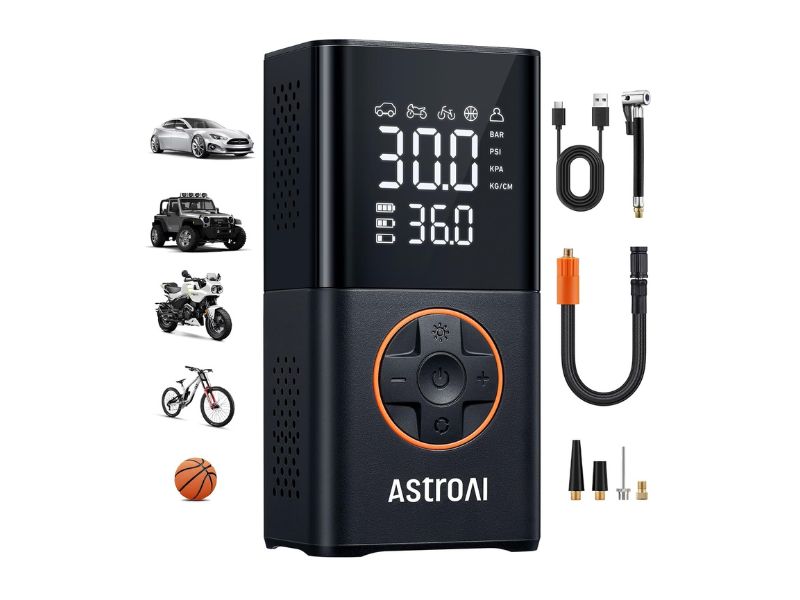
I also like the AstroAI L7 Tire Inflator Portable Air Compressor for riders who want a compact rechargeable pump with a clear digital display, 150 PSI capability, automatic shutoff, and a lightweight design that is easier to carry than larger tool-battery inflators.
5 Best Cordless Motorcycle Tire Inflator
| Image | Product Name | Check Price |
|---|---|---|
Best Choice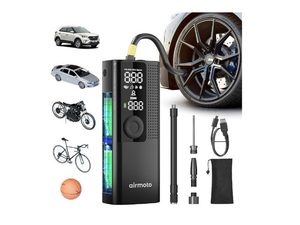 | Airmoto Tire Inflator Portable Air Compressor | Check Price |
Second Best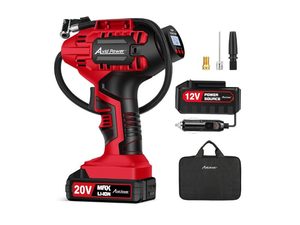 | AVID POWER Cordless Tire Inflator Portable Air Compressor | Check Price |
Third Choice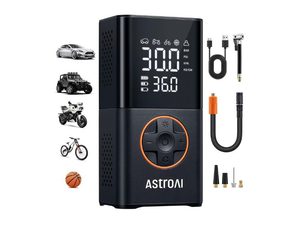 | AstroAI L7 Tire Inflator Portable Air Compressor | Check Price |
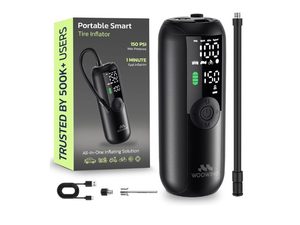 | Woowind LP1 Cordless Tire Inflator | Check Price |
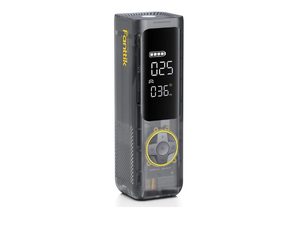 | Fanttik X8 APEX Tire Inflator Portable Air Compressor | Check Price |
Why a Cordless Tire Inflator Makes Sense for Motorcycles
Motorcycles place slightly different demands on an inflator than passenger cars.
Tire volume is smaller, so you usually do not need a huge compressor. At the same time, motorcycle tire pressure matters greatly because the contact patches supporting the bike are relatively small.
A few PSI can noticeably change handling, steering feel, tire temperature, braking behavior, and tread wear.
A compact cordless inflator is therefore an excellent motorcycle accessory.
You can keep one in a pannier, top case, backpack, under-seat compartment when space permits, or garage tool cabinet. When tire pressure drops because of temperature changes or a slow leak, you can correct it without searching for an electrical outlet or service-station compressor.
Cordless operation is especially useful on motorcycles because there is no long power cord to route around hot exhaust components, fairings, wheels, or luggage.
The key is choosing an inflator with sufficient pressure capability, good battery endurance, an accurate gauge, and a hose arrangement that works comfortably around motorcycle wheels.
Best Cordless Motorcycle Tire Inflator
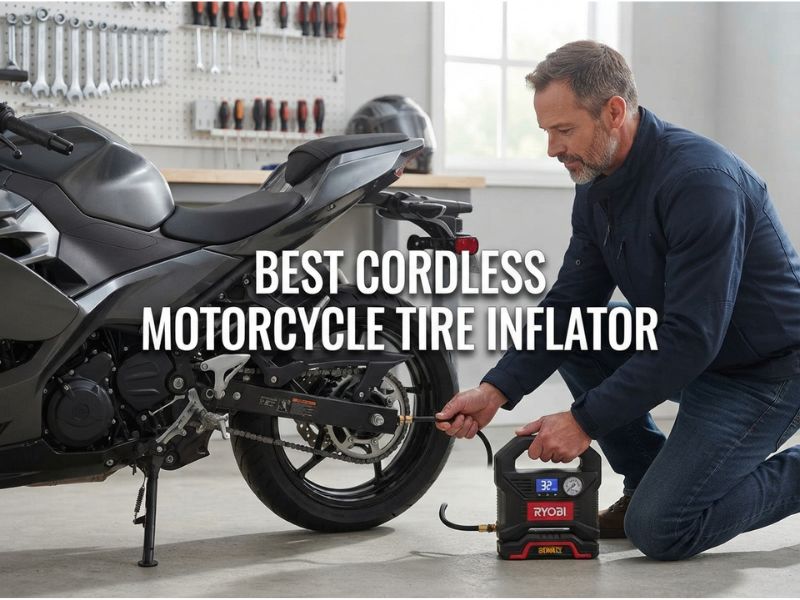
1. Airmoto Tire Inflator Portable Air Compressor – Best Overall
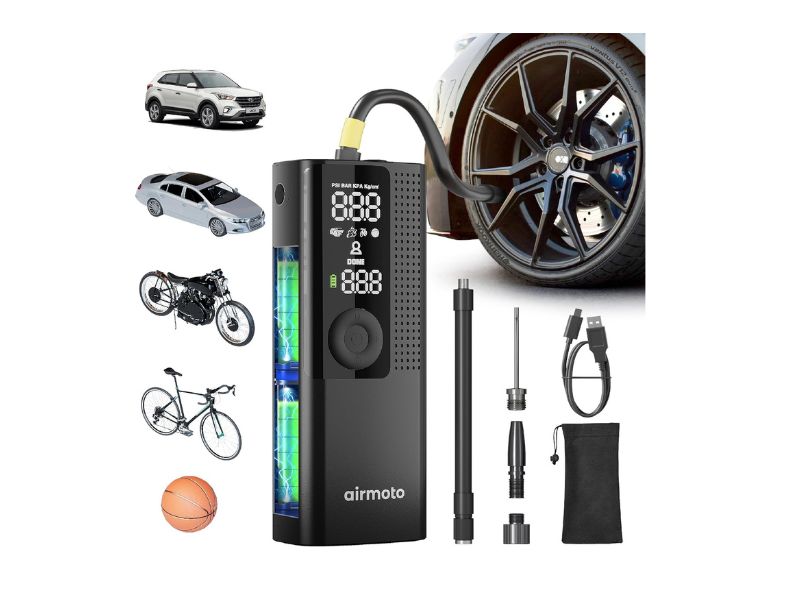
Key Features
- Rechargeable cordless operation
- Maximum pressure up to 120 PSI
- Approximately 20 L/min airflow
- 2,000mAh lithium-ion battery
- Digital pressure display
- Automatic shutoff
- Multiple pressure units
- Built-in LED light
- Schrader connection
- Presta adapter included
- USB-C charging
- Compact storage pouch
- Approximately 1.2-pound weight
Detailed Review
The Airmoto earns my top position because its size and operating style make particularly good sense for motorcycle owners.
Many cordless inflators are technically portable but are still bulky enough that riders would hesitate to carry them regularly. The Airmoto takes a more travel-friendly approach.
Its narrow body is roughly six inches long, and the complete unit weighs only around 1.2 pounds. That makes it much easier to fit into motorcycle luggage than a drill-style inflator with a large removable battery.
Despite the compact dimensions, the compressor can produce up to 120 PSI, which provides more pressure capacity than practically any normal street motorcycle requires.
The real advantage is not the maximum PSI number, however.
The Airmoto combines a digital gauge with a preset pressure function. Set your desired PSI, start the compressor, and it automatically stops once the target pressure is reached.
For motorcycles, that is a genuinely useful feature.
Suppose your front tire should be 36 PSI and the rear 42 PSI. Instead of repeatedly switching between a separate gauge and compressor, you can program each target and let the inflator manage the stopping point.
The built-in display supports several common pressure units, including PSI, BAR, KPA, and KG/CM².
American riders will generally use PSI, while the other options can be convenient when working with specifications from different markets.
Another strong feature is USB-C charging.
That is particularly useful for touring riders who already carry USB charging equipment for a phone, helmet communicator, GPS unit, camera, or power bank. You do not necessarily need to dedicate luggage space to a proprietary charging brick.
The Airmoto also includes an LED light.
A flashlight should never be the main reason to choose a compressor, but it is useful when checking a rear valve stem in a dark parking area or dealing with a tire issue after sunset.
For normal pressure maintenance, the 2,000mAh battery is adequate.
The limitation appears when you ask a very small compressor to perform a large inflation job. Repeatedly filling completely flat automotive tires would consume battery capacity rapidly and generate heat.
Motorcycle tires contain considerably less air, which makes the Airmoto a much more natural match for them.
It is therefore best viewed as a motorcycle tire maintenance and emergency inflation tool, not a substitute for a high-volume workshop compressor.
What I Like
Portability is the biggest advantage.
The inflator is compact enough that riders are far more likely to actually carry it. Emergency tools only help if they are with you when a problem occurs.
I also like the automatic pressure cutoff. It simplifies both front and rear tire adjustments and makes routine pressure checks less tedious.
USB-C charging is another major advantage for motorcycle travel because many riders already have compatible charging equipment.
What I Do Not Like
The battery is relatively small compared with larger cordless inflators.
The unit can also become warm during extended operation, which is normal for compact compressors but reinforces that it is better suited to motorcycle tires and pressure top-ups than sustained high-volume work.
Verdict
The Airmoto is my top recommendation for riders who want the best combination of compact size, straightforward operation, digital pressure control, and true cordless portability.
It is especially well suited to street motorcycles, sport bikes, cruisers, scooters, lightweight ADV bikes, and touring riders who need to conserve luggage space.
2. AVID POWER Cordless Tire Inflator Portable Air Compressor – Best Dual-Power Pick
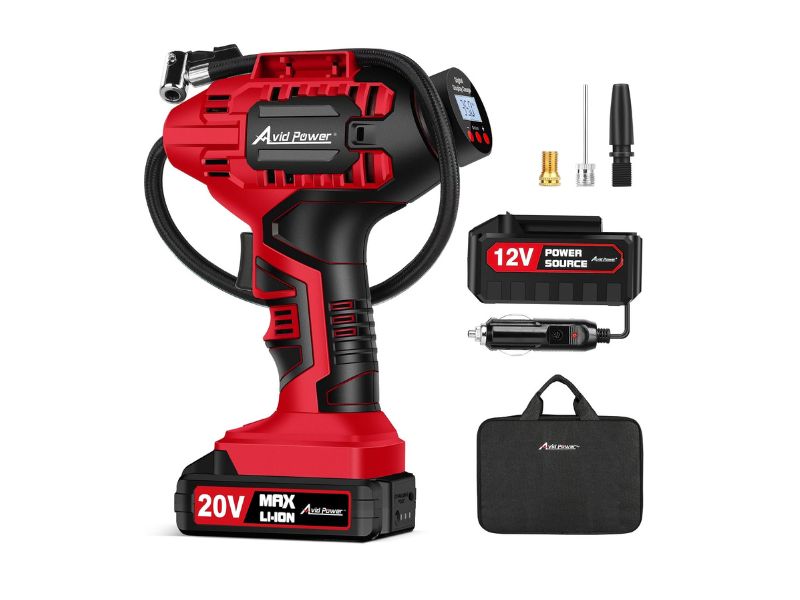
Key Features
- 20V rechargeable lithium-ion battery
- Removable battery design
- 12V vehicle-power backup adapter
- Approximately 30 L/min airflow
- Digital pressure gauge
- Preset pressure setting
- Automatic shutoff
- LED work light
- Multiple valve adapters
- Storage bag included
- Pistol-grip design
- Suitable for motorcycles, cars, and bicycles
Detailed Review
The AVID POWER takes a much different approach from the ultra-compact Airmoto.
Instead of minimizing dimensions at all costs, it uses a 20V removable battery and a larger compressor assembly. The result is a more substantial machine with stronger airflow and better versatility.
For a motorcycle rider who primarily wants something tiny enough to disappear inside a small tail bag, this is probably more inflator than necessary.
For riders with touring luggage, a garage workspace, multiple vehicles, or a desire for stronger performance, it becomes much more interesting.
Its airflow is rated around 30 liters per minute, giving it considerably more air-moving capability than many pocket-size rechargeable compressors.
Motorcycle tires do not normally require huge airflow, but extra compressor capacity can reduce the time spent standing beside the bike when correcting a significantly underinflated tire.
The removable battery is another benefit.
Integrated batteries make compact inflators easy to package, but when the internal battery ages, replacing it may not be practical.
A removable power pack provides greater long-term flexibility.
More importantly, AVID POWER provides 12V DC backup power.
That means a discharged 20V battery does not automatically make the compressor useless.
If you have access to an appropriate vehicle power source, you can continue inflating from the 12V adapter.
For riders who travel with support vehicles, cars, RVs, or trailers, that backup capability is especially useful.
The digital pressure gauge and automatic shutoff work the way most riders would expect. Set the required pressure, start inflation, and the compressor stops at the target.
Its pistol-grip format is comfortable to carry around a garage and makes the controls easy to reach.
There is also a built-in LED light for low-light work.
The biggest drawback is bulk.
Compared with compact rectangular units, the 20V battery and handle consume substantially more storage space.
That makes the AVID POWER better for touring motorcycles with panniers, garage use, trailers, and multi-vehicle households than minimalist riders trying to fit everything beneath a small seat.
What I Like
The combination of cordless power and 12V backup is excellent.
I also like the higher airflow. While motorcycle tires do not demand the volume of large truck tires, stronger output can make the compressor noticeably more useful when the tire is substantially below its target pressure.
The replaceable battery is another long-term advantage.
What I Do Not Like
It is much larger than the compact inflators in this guide.
For riders with limited motorcycle storage, the size may outweigh the advantages of the larger battery system.
Verdict
Choose the AVID POWER if you want more compressor capability and dual-power flexibility and have enough space to carry it.
For touring bikes, motorcycle trailers, home garages, and riders who also need to maintain car tires, it is one of the most versatile options here.
3. AstroAI L7 Tire Inflator Portable Air Compressor – Best Lightweight Value
Key Features
- Rechargeable cordless design
- Up to 150 PSI
- 4,000mAh battery
- Approximately 17 L/min airflow
- Digital dual-value display
- Automatic shutoff
- Multiple inflation presets
- LED lighting
- USB charging
- Compact construction
- Multiple inflation adapters
- Lightweight design
Detailed Review
The AstroAI L7 occupies an appealing middle ground between tiny convenience pumps and larger cordless compressors.
It provides 150 PSI maximum pressure capability, a 4,000mAh battery, a digital pressure interface, automatic shutoff, and a compact housing without relying on a large external power-tool battery.
For motorcycle riders, that formula makes a lot of sense.
A motorcycle does not require the huge airflow necessary for large off-road tires. What matters more is getting a reliable tool that is small enough to carry and easy to use accurately.
The L7’s digital interface displays both measured and target pressure information, making it easy to see what is happening while the compressor runs.
Once the selected pressure is reached, the pump stops automatically.
That is particularly useful when checking tire pressure before a morning ride.
You can attach the hose, set the recommended cold pressure, and allow the inflator to complete the adjustment without constantly checking a separate gauge.
The unit also incorporates several preset inflation modes.
Presets are not essential—you can always enter PSI manually—but they make the initial setup more intuitive for users switching between motorcycles, bicycles, cars, and sports equipment.
Its approximately 17 L/min airflow is not the highest in this comparison, but motorcycle tires contain less air than typical passenger-car tires.
For correcting normal pressure loss, the L7 provides a practical balance between pumping capability and compact dimensions.
Battery capacity is another strength.
At around 4,000mAh, the internal battery offers more reserve than some miniature cordless inflators.
As with any battery-powered compressor, runtime varies significantly according to starting pressure, target PSI, ambient temperature, tire volume, and how long the motor has already been running.
The unit includes LED lighting for roadside visibility and multiple adapters that extend its usefulness beyond motorcycles.
For adventure riders who also carry bicycles, inflatable camping accessories, or sports equipment, that versatility may be useful.
One thing I particularly like about the L7 is that it still feels like a carryable emergency tool rather than a workshop compressor shrunk down slightly.
That distinction matters on a motorcycle, where every cubic inch of luggage space counts.
What I Like
The 4,000mAh battery and compact body create a useful balance between runtime and portability.
The digital display is also straightforward, and automatic shutoff reduces the amount of attention required during inflation.
I also like the relatively high maximum pressure because it gives the pump versatility for bicycle applications in addition to motorcycles.
What I Do Not Like
Its airflow is lower than larger cordless compressors, so it is not the fastest option for high-volume tires.
Like other compact battery pumps, extended operation can generate substantial heat.
Verdict
The AstroAI L7 is an excellent choice for riders who want a compact cordless inflator with more battery reserve than many ultra-mini designs.
It offers a strong blend of portability, digital control, automatic shutoff, and versatility without becoming excessively bulky.
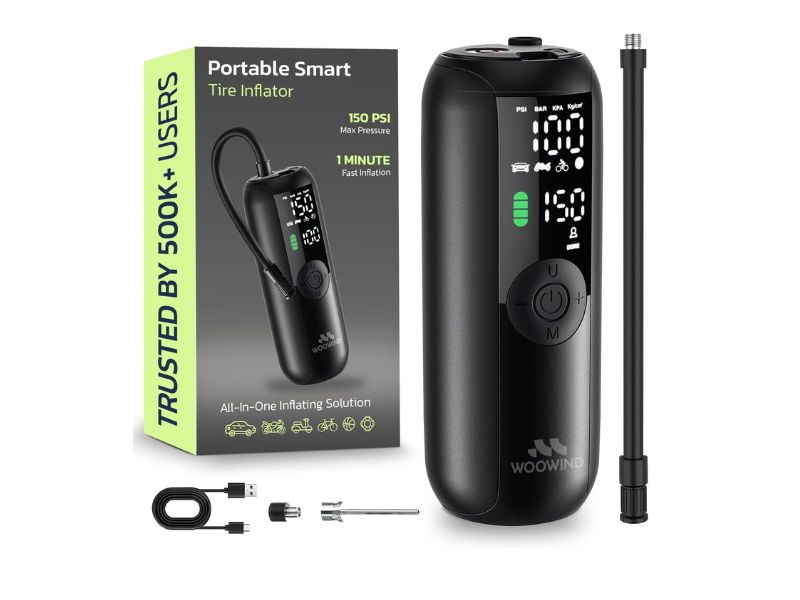
4. Woowind LP1 Cordless Tire Inflator – Best for Bikes and Motorcycles
Key Features
- Battery-powered cordless operation
- Up to 150 PSI
- Compact rectangular body
- Digital pressure display
- Automatic shutoff
- USB-C charging
- Schrader compatibility
- Presta adapter
- Dunlop valve adapter
- Ball needle
- Flexible inflation hose
- Carrying pouch
- Approximately one-pound class weight
Detailed Review
The Woowind LP1 is another model that feels naturally suited to two-wheel use.
Its compact vertical body takes up relatively little luggage space, and the included adapter package supports Schrader, Presta, and Dunlop valves.
Standard motorcycles overwhelmingly use Schrader-type tire valves, so you can use the primary hose connection directly in most situations.
The extra adapters become useful if you also maintain bicycles or other equipment.
The LP1 produces up to 150 PSI, which provides ample pressure range for motorcycle tires.
As always, riders should remember that maximum compressor pressure and correct tire pressure are completely different things.
Your motorcycle may call for something around 30–40 PSI depending on the model, tires, load, and manufacturer specification.
Never inflate a tire to 150 PSI simply because the compressor can generate that amount.
The LP1 includes a digital gauge and automatic stopping function.
Those features are especially convenient on motorcycles because reaching the valve stem can sometimes be awkward.
With the desired pressure programmed, you do not have to remain crouched next to the wheel constantly monitoring a tiny analog dial.
The rechargeable design also eliminates the need for a 12V power lead.
That can make setup much faster during a roadside stop.
Instead of removing a seat or accessing a motorcycle power socket, you simply retrieve the inflator, connect the hose, and begin.
USB-C charging further improves travel convenience.
A rider can potentially use the same general charging ecosystem for the inflator, smartphone, Bluetooth communicator, power bank, and other accessories.
The flexible hose helps with access around brake rotors and wheel spokes, though valve position will still determine how comfortable the connection is.
Before relying on any portable pump during a long trip, I recommend practicing with it at home.
Make sure you can connect the fitting easily to both wheels and confirm its built-in gauge against a quality standalone tire-pressure gauge.
What I Like
The LP1 is very motorcycle-friendly because it remains compact while still providing useful pressure capability.
USB-C charging is also a major convenience.
I appreciate the included valve adapters because the inflator can serve motorcycles and bicycles without requiring a separate pump.
What I Do Not Like
It does not offer the airflow or battery capacity of larger 20V compressors.
The small body also means heat management becomes more important during extended operation.
Verdict
The Woowind LP1 is a strong choice for riders who divide their time between motorcycles and bicycles or simply want a compact 150-PSI rechargeable pump.
It is especially appealing when minimizing packing space is more important than maximizing inflation speed.
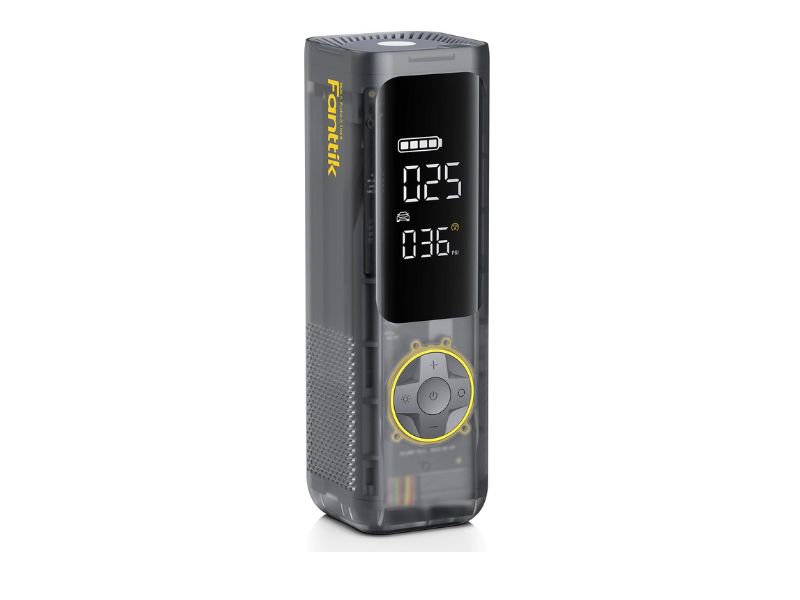
5. Fanttik X8 APEX Tire Inflator Portable Air Compressor – Best Premium Performance Pick
Key Features
- Battery-powered cordless design
- Up to 150 PSI
- Digital dual-screen interface
- Motorcycle inflation preset
- Automatic shutoff
- Long flexible hose
- Built-in LED lighting
- Multiple pressure units
- Presta valve adapter
- Ball needle
- USB charging
- Approximately 1.7-pound weight
- Compact upright design
Detailed Review
The Fanttik X8 APEX is the premium option in this lineup.
Its design emphasizes inflation performance, clear digital controls, and stronger sustained use while still remaining compact enough for motorcycle luggage.
The X8 APEX supports up to 150 PSI, which makes it versatile enough for motorcycles, cars, bicycles, and other high-pressure applications.
For motorcycle owners, one of the most useful features is the dedicated motorcycle preset.
Presets are not a replacement for checking your owner’s manual or tire-pressure placard, but they simplify navigation through the interface.
You can select the appropriate operating mode, then adjust the target pressure if your motorcycle requires a different specification.
The dual-screen display is another nice feature.
Being able to distinguish measured pressure from the preset target at a glance makes the inflation process easier to understand.
The compressor automatically stops once the selected target is reached.
Fanttik also gives the X8 APEX a relatively long flexible hose.
This can matter more on motorcycles than buyers initially expect.
Depending on wheel design, brake rotor size, valve-stem angle, and whether the valve happens to stop near the ground, an extremely short hose can make the connection awkward.
A longer hose gives you more flexibility in positioning the pump while keeping it away from hot or moving components.
At roughly 1.7 pounds, the X8 APEX is heavier than some mini inflators but still relatively easy to pack.
It makes the most sense for riders who have a top box, pannier, or reasonably sized tail bag rather than someone attempting to build the smallest possible emergency kit.
The additional bulk pays off in a more substantial-feeling pump.
This can be valuable for long-distance touring, where a tire inflator may need to handle more than occasional garage pressure adjustments.
What I Like
The combination of the long hose, clear display, motorcycle preset, and 150-PSI capability makes the X8 APEX exceptionally user-friendly.
Its design also feels more performance-oriented than the smallest pocket compressors.
Automatic shutoff and multiple pressure units add to its versatility.
What I Do Not Like
It is heavier and more expensive than basic mini inflators.
If your only goal is to add one or two PSI to motorcycle tires occasionally, a smaller model may provide better value.
Verdict
The Fanttik X8 APEX is a great choice for riders willing to trade a little extra size for stronger performance, a refined interface, and excellent hose flexibility.
It is particularly attractive for sport-touring, adventure, and long-distance riders.
Best Cordless Motorcycle Tire Inflator Comparison
| Product | Max Pressure | Power Setup | Approx. Airflow | Auto Shutoff | USB Charging | Digital Gauge | Motorcycle Friendly | Best For |
| Airmoto Tire Inflator | 120 PSI | Internal rechargeable battery | 20 L/min | Yes | USB-C | Yes | Excellent | Overall motorcycle use |
| AVID POWER Cordless Inflator | 100 PSI class | 20V battery + 12V backup | 30 L/min | Yes | Battery charger | Yes | Very Good | Faster inflation and versatility |
| AstroAI L7 | 150 PSI | 4,000mAh rechargeable battery | 17 L/min | Yes | Yes | Yes | Excellent | Lightweight value |
| Woowind LP1 | 150 PSI | Internal rechargeable battery | Compact-pump class | Yes | USB-C | Yes | Excellent | Motorcycles and bicycles |
| Fanttik X8 APEX | 150 PSI | Rechargeable battery | Performance-focused | Yes | Yes | Dual screen | Excellent | Premium touring setup |
Comparison Summary
The Airmoto Tire Inflator remains my top recommendation for most motorcycle riders because portability is especially important on two wheels. It provides enough pressure and airflow for motorcycle tire maintenance without occupying excessive luggage space.
The AVID POWER is the better choice when output and power flexibility matter more than compact dimensions.
The AstroAI L7 strikes an excellent middle ground with a larger internal battery, 150-PSI capability, and compact construction.
The Woowind LP1 is particularly attractive to riders who also own bicycles, while the Fanttik X8 APEX provides the most premium, performance-oriented experience.
How to Choose the Best Cordless Motorcycle Tire Inflator
Motorcycle tire inflators are relatively simple tools, but buying based only on maximum PSI can result in the wrong choice.
Here are the factors that actually matter.
Choose Portability Before Extreme Power
Size deserves more attention for motorcycles than cars.
A car has a trunk. A motorcycle may have nothing more than a small under-seat compartment or tail bag.
An inflator that performs brilliantly but is too large to carry regularly has limited roadside value.
For commuters, sport-bike riders, and lightweight ADV riders, a compact internal-battery design usually makes the most sense.
Touring riders with panniers can afford to prioritize a larger battery and stronger airflow.
120 PSI Is Already Plenty for Most Motorcycles
Maximum PSI is frequently used as a marketing headline.
For motorcycles, it is rarely the most important specification.
Typical street motorcycle tires operate far below 120 or 150 PSI.
A pump capable of 120 PSI therefore provides ample pressure headroom for ordinary motorcycle use.
Higher pressure capability becomes more meaningful if you also plan to inflate high-pressure bicycle tires.
Airflow Determines Inflation Speed
Pressure capability tells you whether a pump can achieve a target pressure.
Airflow tells you how quickly it can move air.
A model delivering 30 L/min will generally have more inflation potential than one delivering 15–20 L/min, assuming other factors are similar.
Fortunately, motorcycle tires contain less air than automobile tires.
This means compact pumps that feel slow when filling a large SUV tire can still be perfectly practical for motorcycles.
Look for Automatic Shutoff
Automatic shutoff is one of the most valuable features in a modern tire inflator.
You enter your desired PSI, start the compressor, and it stops automatically at the target.
This makes routine tire-pressure maintenance much easier.
It also reduces the likelihood of accidentally continuing inflation while distracted.
Still, periodically verify the compressor’s reading with a separate quality tire gauge.
Pay Attention to Battery Capacity
A cordless inflator is only useful when it has charge remaining.
Large batteries provide more operating time but increase size and weight.
For motorcycle riders, the best balance depends on the intended use.
A small battery is fine for occasional pressure adjustments.
A larger battery is preferable for extended trips, repeated use, or households with multiple vehicles.
USB-C Charging Is Excellent for Touring
USB-C is particularly useful on motorcycles because riders often already have USB charging equipment.
Many modern bikes have USB ports, accessory chargers, or aftermarket power systems.
A power bank can also recharge compatible inflators.
This reduces the number of different charging cables you need to pack.
Check the Valve Connection
Most motorcycle tires use a Schrader valve, so almost every automotive inflator can connect to them.
However, wheel design can make access difficult.
Large brake rotors, narrow spokes, angled valve stems, and crowded rear wheels may limit the space available around the valve.
A flexible hose is usually easier to position than a pump that attaches directly to the valve.
Angled valve stems can also make routine pressure checks much easier on motorcycles with difficult wheel access.
Digital Gauge Accuracy Matters
Motorcycle tire pressure affects handling more noticeably than many riders realize.
A pump with a readable digital gauge is therefore preferable to a vague analog scale.
However, no built-in gauge should automatically be treated as laboratory equipment.
Periodically compare its readings with a separate quality pressure gauge.
If the two differ consistently, you can account for that difference when setting the inflator.
Consider Heat Management
Tiny compressors work hard.
The motor and cylinder generate heat during operation, and compact housings have limited surface area for cooling.
For routine motorcycle top-ups, this generally is not an issue.
But if you run the compressor continuously for an extended period, pay attention to its recommended duty cycle.
Allow the unit to cool when necessary.
An LED Light Is More Useful Than It Sounds
A built-in LED seems like a minor accessory until you need to find the valve stem beside a road at night.
Motorcycle wheels can be difficult to work around in darkness.
A small integrated light can illuminate the valve, hose connection, and pressure controls without requiring you to hold a separate flashlight.
I would not select a compressor based solely on an LED, but it is a useful feature.
What PSI Should Motorcycle Tires Be?
There is no universal motorcycle tire pressure.
The correct pressure depends on your motorcycle model, tire specification, passenger or cargo load, riding conditions, and manufacturer recommendations.
Some street bikes may use pressures around the low-to-upper 30-PSI range, while other motorcycles can require different front and rear values.
Do not assume the maximum PSI printed on the tire sidewall is the correct operating pressure.
For normal road use, begin with the motorcycle manufacturer’s recommended cold tire pressure.
You can usually find that information in the owner’s manual, on a swingarm label, frame label, or another vehicle information sticker.
Why Check Motorcycle Tire Pressure When Cold?
Tire pressure rises as the tire heats up.
Riding flexes the tire carcass and creates heat. Ambient temperature and road-surface temperature also influence pressure.
For consistent measurements, check your tires before riding or after the motorcycle has been parked long enough for the tires to return near ambient temperature.
That gives you a reliable baseline against the manufacturer’s cold-pressure recommendation.
If you measure immediately after a long ride, the pressure will often be higher.
Do not automatically release air from a hot tire simply to return it to the cold specification.
Can a Cordless Inflator Fill a Completely Flat Motorcycle Tire?
Often, yes, provided the tire is still correctly seated on the wheel and does not have major structural damage.
Motorcycle tires have less internal volume than car tires, so many compact cordless pumps are capable of inflating them from very low pressure.
However, the reason the tire went flat is critical.
If it has a puncture, damaged valve stem, torn sidewall, bent wheel, or bead problem, adding air does not repair the underlying issue.
A tire that loses pressure rapidly should be inspected before continued riding.
A portable inflator is most useful when paired with an appropriate tubeless tire repair kit on motorcycles that use repairable tubeless tires.
Can You Use a Car Tire Inflator on a Motorcycle?
Yes.
A portable car inflator can usually inflate motorcycle tires because both generally use Schrader valves.
The main question is whether the compressor is convenient for motorcycle use.
Large compressors may be unnecessarily bulky, while 12V-only models may require access to a motorcycle-compatible outlet or direct battery connection.
A cordless rechargeable inflator removes that complication.
Is 150 PSI Necessary for Motorcycle Tires?
No.
A 150-PSI rating is not necessary for ordinary motorcycle tire inflation.
Most motorcycle tires operate at a much lower pressure.
A 150-PSI compressor simply offers additional pressure range.
That may be useful if you also inflate bicycle tires or other high-pressure equipment.
When comparing two inflators, do not automatically choose the one with the highest PSI rating.
Battery capacity, airflow, gauge accuracy, hose design, and portability are often more important.
Cordless vs. 12V Motorcycle Tire Inflator
Both have advantages.
A cordless inflator is usually more convenient.
There is no need to wire a plug to the bike, install an accessory socket, expose the battery terminals, or manage a cable around the motorcycle.
You simply connect the hose and inflate.
The disadvantage is battery maintenance.
You must remember to keep the inflator charged.
A 12V motorcycle compressor can theoretically provide power as long as the motorcycle battery can support it, but electrical compatibility matters. Some motorcycle accessory sockets have current limits that may be too low for certain compressors.
Cordless models avoid that problem entirely.
For most riders who value convenience and compact storage, I prefer cordless.
Should You Carry a Tire Inflator on Every Motorcycle Trip?
For local riding close to home, it is optional.
For touring, commuting over long distances, ADV riding, or travel through areas with limited services, a compact inflator becomes much more valuable.
Many modern motorcycles do not have spare wheels.
A minor tubeless puncture can therefore leave you stranded even if the tire itself is repairable.
A plug kit without an inflator only solves half the problem.
After repairing the puncture, you still need a way to restore pressure.
A small rechargeable pump can turn an otherwise complicated roadside problem into a manageable temporary repair.
Best Way to Store a Cordless Motorcycle Inflator
Store it somewhere dry and protected from direct impact.
A padded tail bag, pannier pocket, top-case compartment, or small tool pouch works well.
Avoid placing the inflator where heavy tools can repeatedly strike the display or controls.
Keep the charging cable and required valve adapters with the compressor.
It is frustrating to carry a perfectly functional pump only to discover that the adapter you need is sitting in a garage drawer.
Recharge the battery periodically, especially before long trips.
Frequently Asked Questions
What is the best cordless motorcycle tire inflator?
The Airmoto Tire Inflator is my top choice for most motorcycle riders.
Its compact dimensions, rechargeable battery, automatic shutoff, digital gauge, USB-C charging, and 120-PSI capability provide an excellent combination for motorcycle tire maintenance without taking up excessive storage space.
Can I carry a cordless tire inflator on a motorcycle?
Yes, compact rechargeable inflators are ideal for motorcycle luggage.
Small models can fit into panniers, tail bags, top boxes, backpacks, and sometimes under-seat storage. Always secure the unit so it cannot move around and become damaged while riding.
How powerful should a motorcycle tire inflator be?
A quality compact pump capable of at least around 100 PSI is more than sufficient for most motorcycles.
Actual convenience depends more on airflow, battery capacity, inflation time, and pressure accuracy than an extremely high maximum-PSI figure.
Is Airmoto good for motorcycle tires?
Yes, the Airmoto is particularly well suited to motorcycle tire top-ups and emergency inflation.
Its small size is its greatest advantage for riders, while preset pressure control, automatic shutoff, USB-C charging, and a digital gauge simplify roadside operation.
Can a cordless inflator damage a motorcycle tire?
Not when used correctly and set to the proper pressure.
The main danger is overinflation or inflating a tire that has structural damage. Always follow the motorcycle manufacturer’s recommended cold-tire pressure and inspect damaged tires before riding.
Do motorcycles use Schrader valves?
Most street motorcycles use standard Schrader-type tire valves.
That means most automotive tire inflators can connect directly. Bicycles may use Schrader, Presta, or Dunlop valves, which is why several inflators include additional adapters.
Do I need an external pressure gauge?
A separate quality tire-pressure gauge is still worth carrying.
Digital inflator gauges are convenient, but periodically comparing their readings with a known gauge gives you greater confidence in pressure accuracy.
How often should motorcycle tire pressure be checked?
Check pressure regularly and before long rides.
Tires naturally lose small amounts of air over time, and ambient temperature changes can alter pressure. Frequent checks also make it easier to detect a slow leak before it becomes a roadside problem.
Why does motorcycle tire pressure drop in cold weather?
Air contracts as temperature falls, reducing measured tire pressure.
This is why pressure often appears lower during colder mornings or seasonal temperature changes. Adjust pressure according to the manufacturer’s cold-tire specification.
Can a small cordless pump inflate adventure motorcycle tires?
Usually yes, although larger ADV tires may take longer.
Compact inflators are well suited to pressure corrections. Riders who frequently air large tires down substantially for off-road riding may prefer a faster compressor with stronger airflow and a larger battery.
Is an inflator enough for a motorcycle puncture?
No, an inflator restores pressure but does not repair the puncture.
For repairable tubeless tires, riders often carry both an inflator and a suitable plug kit. Sidewall damage, major cuts, damaged wheels, and some punctures require professional repair or replacement rather than a roadside plug.
Final Verdict
The Airmoto Tire Inflator Portable Air Compressor is my first recommendation for riders searching for the best cordless motorcycle tire inflator. Its greatest strength is not extreme compressor output—it is the balance of small size, sufficient motorcycle-tire performance, USB-C charging, digital pressure monitoring, and automatic shutoff.
The AVID POWER Cordless Tire Inflator is better if you want stronger airflow, a removable 20V battery, and the security of 12V backup power.
The AstroAI L7 is an excellent lightweight alternative with a larger internal battery and 150-PSI capability.
The Woowind LP1 is particularly practical for riders who also own bicycles, thanks to its compact construction and multiple valve adapters.
The Fanttik X8 APEX is the premium choice for riders who prioritize a refined digital interface, flexible hose, strong inflation capability, and touring-friendly performance.
For most motorcycles, you do not need the biggest or highest-PSI compressor. A compact, accurate inflator that you will actually carry and keep charged is far more valuable on the road.