A DC tire inflator is one of the simplest pieces of roadside equipment to keep in a vehicle because it can draw power directly from the car rather than relying on a rechargeable battery. That makes a good 12V inflator especially useful for unexpected low tire pressure, seasonal pressure changes, commuting, road trips, and routine maintenance.
My first choice is the AstroAI AIRUN H Tire Inflator Portable Air Compressor. I like its combination of compact size, digital pressure control, automatic shutoff, LED lighting, and straightforward 12V operation. For most passenger cars and crossovers, it offers the right balance of portability and convenience.
The EPAuto 12V DC Portable Air Compressor Pump is another strong option if you want a proven plug-in design with a digital display and automatic pressure control. It is particularly suitable for drivers who want an inflator they can leave in the trunk and use without maintaining a separate battery.
For larger tires or drivers who place more value on airflow than compact size, I would also consider the GSPSCN Heavy Duty Double Cylinder Tire Inflator. Its dual-cylinder design and substantially higher airflow make it better suited to SUVs, pickups, and more demanding inflation jobs than many small dashboard-powered pumps.
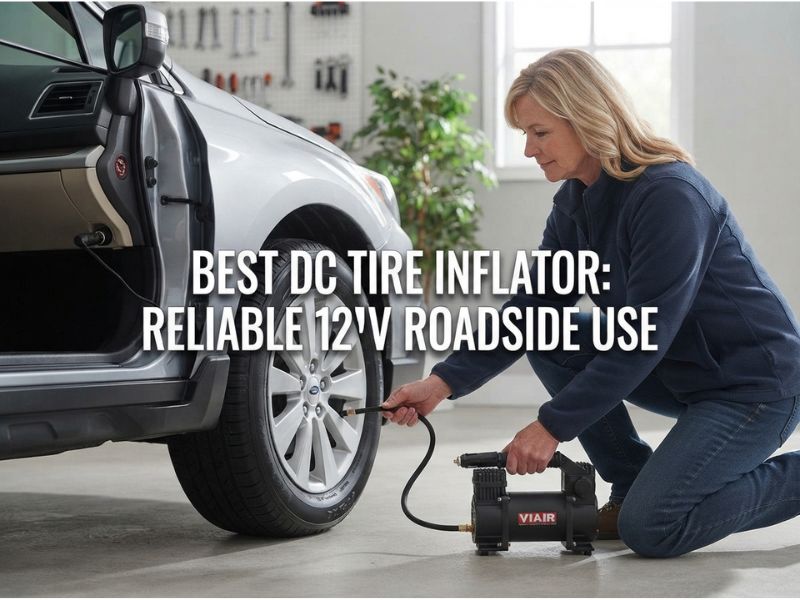
Best DC Tire Inflators
| Image | Product Name | Check Price |
|---|---|---|
Best Choice | AstroAI AIRUN H Tire Inflator Portable Air Compressor | Check Price |
Second Best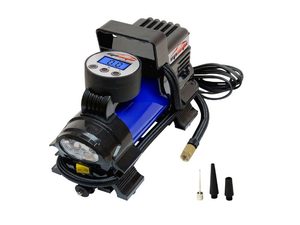 | EPAuto 12V DC Portable Air Compressor Pump | Check Price |
Third Choice | TEROMAS Tire Inflator Portable Air Compressor DC/AC | Check Price |
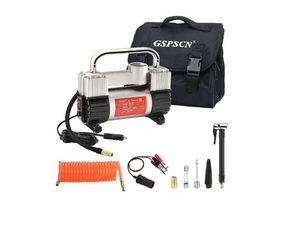 | GSPSCN Heavy Duty Double Cylinder Tire Inflator | Check Price |
The term DC tire inflator usually refers to an electric air compressor powered by a vehicle’s 12V direct-current system.
Some plug directly into a cigarette-lighter or accessory socket. More powerful compressors may connect straight to the vehicle battery using clamps because they require more current than a typical accessory circuit can safely provide.
For this guide, I considered inflation performance, automatic shutoff, pressure range, airflow, power requirements, cord and hose reach, portability, tire compatibility, storage, and ease of operation.
1. AstroAI AIRUN H Tire Inflator Portable Air Compressor – Best Overall DC Tire Inflator

Key Features
- 12V DC corded operation
- Up to 100 PSI maximum pressure
- Approximately 35 L/min airflow
- Digital pressure display
- Automatic shutoff
- Preset pressure function
- Built-in LED light
- Multiple inflation adapters
- Compact portable design
- Suitable for common passenger-vehicle tires
The AstroAI AIRUN H is my top recommendation for the average driver because it focuses on the features that make a portable inflator genuinely useful rather than simply advertising an extreme maximum pressure.
It runs directly from a 12V vehicle outlet, eliminating the concern that often comes with battery-powered emergency equipment: whether the battery will still be charged six months after you put it in the trunk.
That is a significant advantage for roadside equipment.
A cordless inflator can be more convenient around the vehicle, but a 12V DC model receives its power from the car whenever you need it. For an emergency tool that may sit unused for long periods, that simplicity is valuable.
The AstroAI also uses a digital pressure display and allows the desired pressure to be preset.
Instead of repeatedly switching the compressor off and checking the tire manually, you can enter the desired pressure and allow the automatic shutoff function to stop inflation once the setting is reached.
That makes the inflator particularly useful for routine top-offs.
For example, if cold weather causes all four tires to drop a few PSI, you can move around the vehicle and bring each one back to its recommended pressure without constantly watching an analog gauge.
The stated airflow is around 35 liters per minute, which is respectable for a compact 12V compressor.
That does not make it a heavy-duty truck compressor, but it is adequate for the type of work most passenger-car owners actually perform: adding several PSI to a car or crossover tire.
The 100 PSI maximum pressure is also more than enough for typical passenger-vehicle tires.
Many cars and SUVs use recommended cold pressures somewhere in the 30–40 PSI range, although you should always follow the pressure listed on your specific vehicle’s tire information placard.
Another useful feature is the built-in LED light.
A tire inflator is exactly the kind of tool that may be needed at night, during bad weather, or in a dark parking area. Integrated lighting makes it easier to locate the valve stem and handle the compressor without needing to hold a separate flashlight.
The compact body is also easy to store.
That matters because an inflator you leave in your garage provides no help when a tire loses pressure thirty miles from home.
What I Like
The automatic shutoff is the feature I appreciate most. It makes the pump far easier for occasional users and helps prevent accidentally inflating well beyond the intended pressure.
The digital interface is simple, and the small size makes permanent vehicle storage practical.
I also like that there is no internal battery to maintain.
What I Do Not Like
The compact compressor is designed mainly for passenger cars and similarly sized tires.
If you frequently inflate large pickup, commercial, or oversized off-road tires, a higher-airflow compressor will be considerably more appropriate.
Like most small tire inflators, it can also become warm during longer operation and should be allowed to cool according to the operating instructions.
Verdict
For most drivers who want a compact, automatic, dependable 12V DC tire inflator, the AstroAI AIRUN H is the strongest all-around choice.
It is easy to store, simple to operate, and particularly well suited to routine tire maintenance and emergency top-offs.
2. EPAuto 12V DC Portable Air Compressor Pump – Best Simple Digital DC Inflator
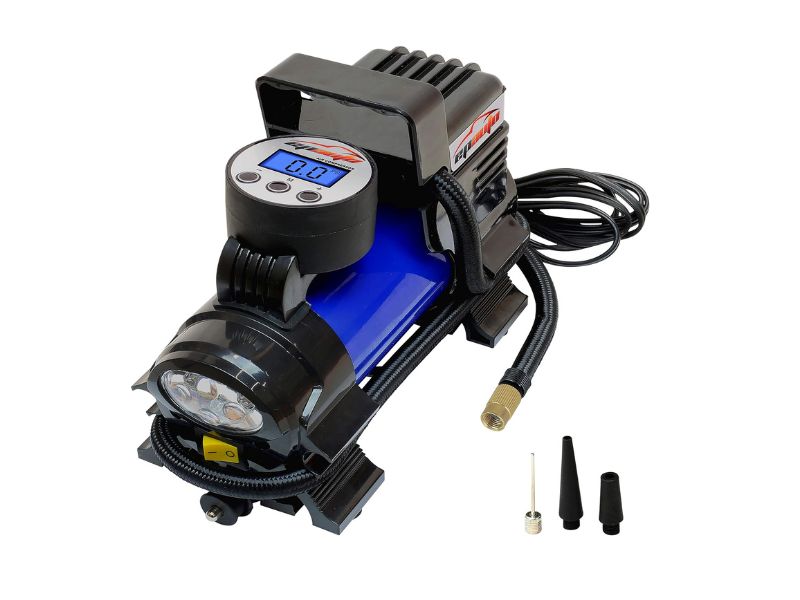
Key Features
- 12V vehicle power
- Digital pressure gauge
- Automatic shutoff
- Up to approximately 100 PSI capability
- Around 1.06 CFM airflow
- Multiple pressure units
- LED flashlight
- Compact carrying design
- Additional inflation adapters
The EPAuto 12V DC Portable Air Compressor Pump is another excellent choice for drivers who want a straightforward inflator rather than a complicated multi-purpose compressor.
Its basic operating method is simple.
Connect it to a vehicle’s 12V outlet, attach the hose to the tire valve, enter the desired pressure, and start the compressor.
Once the selected pressure is reached, the unit automatically stops.
That automatic function is especially useful for people who only check tire pressure occasionally.
Traditional portable compressors with analog gauges require more attention because you normally need to watch the gauge and manually switch the motor off.
The EPAuto makes the process more approachable.
Its airflow is suitable for normal passenger-car tire maintenance, and the inflator is easy to keep in a trunk or cargo compartment.
This is exactly where a DC model has an advantage over a garage compressor.
A shop compressor may fill tires faster, but it cannot help during a commute or road trip.
A small 12V compressor can remain in the vehicle year-round.
The EPAuto is particularly useful when dealing with gradual pressure loss rather than a completely flat tire.
Tire pressure changes naturally as ambient temperature changes, and a tire-pressure monitoring system may illuminate during colder weather when pressure falls below the system threshold.
Having an inflator available lets you correct the pressure rather than repeatedly searching for a service-station air pump.
The digital display can show different pressure units, making it useful for people accustomed to PSI, BAR, KPA, or other measurements.
For US drivers, PSI will generally be the most familiar setting.
The built-in flashlight is another worthwhile feature.
It is not a replacement for a dedicated emergency flashlight, but it makes nighttime inflation considerably easier.
What I Like
I like the simplicity of the EPAuto.
There is very little learning curve, which is exactly what I want from equipment that may be used during a stressful roadside situation.
The automatic shutoff, digital display, and compact format also make it convenient for routine monthly tire checks.
What I Do Not Like
This is not a high-volume compressor.
Large truck tires and oversized off-road tires can require substantially more air than ordinary passenger tires, and a compact compressor will take longer under those conditions.
It also depends completely on the vehicle’s 12V outlet, so you cannot use it independently of a compatible DC power source.
Verdict
The EPAuto is a strong choice for drivers who value simple operation, automatic shutoff, and easy trunk storage.
It is best suited to normal passenger cars, crossovers, motorcycles, bicycles with compatible valves, and other moderate-pressure inflation tasks.
3. VacLife 12V DC Tire Inflator Portable Air Compressor – Best Compact DC Inflator
Key Features
- 12V DC power
- Digital pressure display
- Automatic shutoff
- Built-in LED lighting
- Preset pressure control
- Compact body
- Multiple inflation nozzles
- Long vehicle power cord
- Suitable for cars and smaller SUVs
The VacLife 12V DC Tire Inflator is another highly practical compact model for drivers who want to keep emergency inflation capability in their vehicle without sacrificing much cargo space.
VacLife’s 12V models are designed to operate from a vehicle DC outlet.
That makes them particularly useful as permanent vehicle accessories because they do not rely on an internal battery that slowly discharges while sitting unused.
Like the AstroAI and EPAuto, this model emphasizes preset digital inflation.
The process is straightforward: connect the inflator, choose the target pressure, and start the pump.
Automatic shutoff stops operation once the desired value is reached.
This is especially convenient when adjusting multiple tires.
Imagine checking tire pressure on a cold morning and finding that all four tires are three PSI below the door-jamb specification.
With an automatic inflator, you do not have to carefully watch the display every second.
Set the target pressure and work your way around the car.
Another advantage is cable reach.
A DC tire inflator must be able to reach every tire from the location of the vehicle’s accessory outlet.
That becomes increasingly important as vehicle wheelbase grows.
A small sedan is easy.
A three-row crossover or midsize SUV places the rear wheels significantly farther from the dashboard outlet.
The VacLife’s longer power-cord format helps address that problem.
The built-in LED lighting is also useful for low-light roadside work.
The light can help you locate a valve stem, inspect the tire area, and make the vehicle slightly easier to notice at night.
As with any compact compressor, this is best treated as a maintenance and emergency inflator rather than a heavy-duty continuous-duty air compressor.
It is ideal for adding a few PSI to normal tires.
Drivers routinely inflating large truck or off-road tires should prioritize airflow and duty cycle instead.
What I Like
The VacLife offers the core features most drivers actually need: 12V operation, automatic shutoff, digital pressure control, lighting, and easy storage.
I also like the relatively simple control layout.
An emergency inflator should not require reading a complicated manual while kneeling beside a low tire.
What I Do Not Like
It is intended primarily for passenger vehicles and moderate-size SUV tires.
The small compressor will not match a dual-cylinder model when large air volume is required.
As with any outlet-powered unit, the user should also verify that the vehicle’s 12V circuit is suitable for the inflator.
Verdict
The VacLife is an appealing choice if compact storage and automatic operation matter more than maximum inflation speed.
It works particularly well as a glove-box or trunk companion for everyday passenger vehicles.
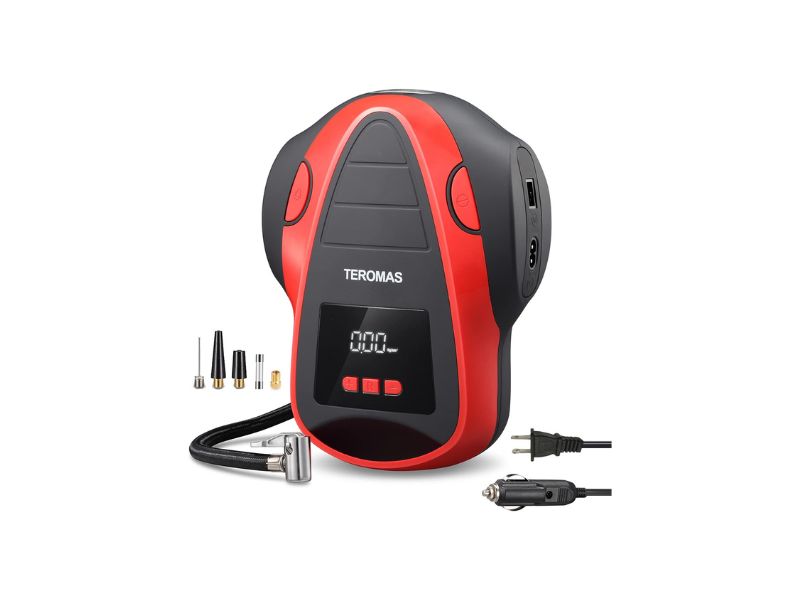
4. TEROMAS Tire Inflator Portable Air Compressor DC/AC – Best Dual-Power DC Inflator
Key Features
- 12V DC vehicle operation
- 110/120V AC household operation
- Up to 150 PSI maximum pressure
- Digital pressure gauge
- Preset inflation
- Automatic shutoff
- Approximately 120W power
- Multiple adapters
- Compact carrying design
- Suitable for passenger-vehicle tires and inflatables
The TEROMAS Tire Inflator is different from the first three models because it gives you two power options.
You can operate it from a 12V DC vehicle outlet when traveling or from a standard household AC outlet when working at home.
That versatility is useful for drivers who want one compressor to cover both garage and roadside use.
A dedicated 12V compressor is excellent to keep in a car, but using it at home usually means bringing the vehicle close enough to provide power.
The TEROMAS removes that limitation.
At home, plug it into a wall outlet.
On the road, use the 12V connector.
For households with multiple vehicles, bicycles, balls, and other inflatables, the additional AC capability increases its usefulness.
The inflator uses a digital programmable pressure system with automatic shutoff.
Set the target pressure and the compressor stops when that pressure is reached.
That makes it more convenient than a basic compressor requiring constant manual monitoring.
The maximum pressure rating is around 150 PSI, although that figure should not be confused with inflation speed.
Maximum PSI simply indicates the upper pressure the compressor can theoretically produce.
For normal vehicle tires, airflow is generally much more important.
A passenger vehicle may only need 35 PSI, but the amount of air required to reach that pressure depends heavily on tire size.
The TEROMAS is best suited to passenger cars, compact and midsize crossovers, motorcycles, bicycles, and general inflatables.
It should not be treated as a substitute for a high-output compressor intended for commercial truck or large off-road tires.
The compact body also makes storage easy.
You can keep it in a garage, closet, trunk, or RV storage compartment without giving up much space.
What I Like
The biggest advantage is the DC/AC dual-power design.
You get the convenience of household operation without giving up roadside 12V functionality.
Automatic shutoff and digital controls also make it approachable for inexperienced users.
What I Do Not Like
The additional AC hardware makes it slightly less minimalist than a dedicated 12V-only inflator.
More importantly, it is still a compact compressor.
A high 150 PSI rating should not be interpreted as evidence that it will inflate large truck tires quickly.
Verdict
Choose the TEROMAS if you want one portable inflator that works both from your vehicle and a household outlet.
It provides more power-source flexibility than a typical DC-only model while retaining automatic pressure control.
5. GSPSCN Heavy Duty Double Cylinder Tire Inflator – Best Heavy-Duty DC Tire Inflator

Key Features
- 12V DC operation
- Direct battery-clamp capability
- Dual-cylinder compressor
- Up to 150 PSI
- Approximately 70 L/min airflow
- Around 2.1 CFM rated capacity
- Approximately 11-foot extension air hose
- Metal and ABS construction
- Carrying bag
- Multiple inflation adapters
- Designed for cars, SUVs, vans, and pickups
The GSPSCN Heavy Duty Double Cylinder Tire Inflator is the model I would choose when airflow matters more than having automatic digital controls.
Its major advantage is the dual-cylinder compressor design.
Two cylinders work together to move considerably more air than most miniature emergency inflators.
The manufacturer rates the unit around 70 liters per minute, or slightly above 2 CFM.
That changes what the compressor is suited for.
Compact DC inflators are excellent for adding three or four PSI to a sedan tire.
The GSPSCN is a better match for larger tires, deeper pressure drops, SUVs, vans, pickups, and drivers who do not want to wait as long for inflation.
Power is another important difference.
High-output compressors draw more current.
Instead of relying solely on a standard low-amperage accessory outlet, this type of compressor can use battery clamps for a more direct electrical connection.
That is common with higher-output automotive compressors.
The included extension hose also helps around larger vehicles.
Reach is often ignored when choosing an inflator.
A compressor can have excellent performance but still be frustrating if the hose cannot reach the rear passenger-side tire from the battery area.
With SUVs and pickups, a longer hose quickly becomes valuable.
The GSPSCN’s metal-oriented construction gives it a more substantial feel than compact plastic pumps, although that also increases weight.
This is not the inflator I would choose if my only priority were fitting something into a tiny storage compartment.
It makes more sense for someone who wants stronger performance and is willing to allocate additional cargo space.
It also lacks some of the automation found in the first four products.
That means pressure needs to be monitored more actively.
For experienced users, that is usually not a significant disadvantage.
A separate quality tire-pressure gauge is worthwhile with any compressor anyway.
What I Like
Airflow is easily the biggest advantage.
Around 70 L/min is substantially more appropriate for large tires than the output of many compact emergency pumps.
I also like the long hose, battery clamps, metal construction, and carrying bag.
These features make the unit particularly practical for an SUV or pickup emergency kit.
What I Do Not Like
It is heavier and bulkier than the compact digital models.
You also give up the simple preset-and-forget operation of an automatic inflator.
High-output compressors can become hot during extended use, so cooling and safe handling are important.
Verdict
The GSPSCN is the strongest choice in this list if you need a higher-airflow 12V DC compressor for SUVs, pickups, or larger tires.
For ordinary compact-car top-offs, the AstroAI is easier to live with. For higher-volume inflation, the GSPSCN makes more sense.
DC Tire Inflator Comparison
| Product | Power Source | Max Pressure | Airflow | Auto Shutoff | Display | Vehicle Focus | Portability | Best For |
| AstroAI AIRUN H | 12V DC outlet | 100 PSI | Approx. 35 L/min | Yes | Digital | Cars and crossovers | Excellent | Best overall everyday use |
| EPAuto 12V DC | 12V DC outlet | Approx. 100 PSI | Approx. 1.06 CFM | Yes | Digital | Passenger cars and crossovers | Excellent | Simple automatic inflation |
| VacLife 12V DC | 12V DC outlet | Model-dependent | Compact-class airflow | Yes | Digital | Cars and midsize SUVs | Excellent | Compact emergency storage |
| TEROMAS DC/AC | 12V DC / 110–120V AC | 150 PSI | Compact-class airflow | Yes | Digital | Cars and crossovers | Very Good | Home and roadside use |
| GSPSCN Double Cylinder | 12V battery connection | 150 PSI | Approx. 70 L/min | No | Analog-style monitoring | Cars, SUVs, vans, pickups | Good | Higher-volume tire inflation |
For most everyday drivers, the AstroAI AIRUN H offers the strongest overall combination of automatic operation, compact storage, and practical performance.
The EPAuto and VacLife serve a similar purpose and make excellent trunk inflators for passenger vehicles.
The TEROMAS stands out if you want AC household power in addition to 12V DC operation.
The GSPSCN is the clear choice when you need more airflow for larger tires and are willing to trade some automatic convenience for stronger compressor performance.
How to Choose the Best DC Tire Inflator
Make Sure It Matches Your Vehicle’s Voltage
Most passenger vehicles use a 12V DC electrical system.
That is why the majority of portable tire inflators are designed around 12V operation.
Do not assume a 12V inflator is suitable for every electrical system.
Some commercial vehicles use 24V systems, and connecting a 12V compressor directly to an incompatible supply can damage the unit.
Always confirm the inflator’s input specification.
Understand Accessory-Socket Power
Small DC tire inflators typically plug into a vehicle’s cigarette-lighter-style accessory socket.
This is convenient because no battery access is required.
However, every accessory outlet has a current limit determined by the circuit wiring and fuse.
A typical compact inflator might draw around 10–15 amps.
Before connecting an unfamiliar compressor, check both the inflator requirements and your vehicle’s outlet capacity.
Never replace an outlet fuse with a larger fuse simply because the compressor keeps blowing it.
The fuse protects the wiring.
Direct Battery Power Is Better for Larger Compressors
Higher-output compressors often connect directly to the vehicle battery.
This allows them to draw significantly more current than a typical interior accessory socket can support.
The GSPSCN is a good example.
Its larger motor and dual-cylinder mechanism require more electrical power because they move more air.
Direct battery clamps are slightly less convenient than an accessory plug, but they are appropriate for higher-output equipment.
Look at Airflow, Not Just PSI
This is one of the most important buying considerations.
Manufacturers often highlight maximum pressure because numbers such as 100 PSI or 150 PSI sound impressive.
But maximum pressure does not tell you how fast a tire will inflate.
A small pump capable of 150 PSI may still take longer to inflate a large SUV tire than a stronger compressor rated for a lower maximum pressure.
For vehicle tires, CFM or L/min airflow is often much more meaningful.
CFM means cubic feet per minute.
L/min means liters per minute.
Higher airflow generally means faster tire inflation.
Match Airflow to Tire Size
Small sedan tires contain less air than SUV or pickup tires.
A compact inflator producing around 30–35 L/min can be perfectly adequate for routine passenger-car top-offs.
Larger SUV or truck tires benefit from significantly more airflow.
A unit producing around 70 L/min can reduce inflation time considerably when tire volume increases.
This is why the best inflator for a compact sedan may not be the best inflator for a full-size SUV.
Consider How Much Pressure You Usually Need to Add
Someone who checks tire pressure every month may rarely need more than two or three PSI.
That is easy work for nearly any quality inflator.
Someone dealing with a nearly flat tire has a very different workload.
Taking a large tire from 10 PSI to 35 PSI requires much more operating time and generates substantially more compressor heat.
If larger pressure increases are common, prioritize airflow and duty cycle.
Automatic Shutoff Is Worth Having
For routine tire maintenance, I strongly prefer automatic shutoff.
The inflator lets you enter the required pressure and stops automatically when that value is reached.
This makes the process easier and reduces the chance of accidentally overinflating the tire.
Automatic shutoff is particularly useful for drivers who rarely use an air compressor.
Heavy-duty compressors do not always include it.
Experienced users often prefer a stronger motor and separate pressure gauge instead.
Check the Pressure Display
Digital displays are easier to read than small analog gauges, particularly at night.
Many digital inflators can switch between:
- PSI
- BAR
- KPA
- KG/CM²
US vehicle specifications are most commonly given in PSI.
The important point is to use the pressure recommended by the vehicle manufacturer rather than simply inflating to the tire’s maximum sidewall number.
Look at Power-Cord Length
A 12V outlet may be located in the dashboard or center console.
The inflator needs enough cable to reach every wheel.
This can become surprisingly important with:
- Three-row SUVs
- Minivans
- Pickup trucks
- Long-wheelbase sedans
- Vehicles with only a front accessory socket
Before buying, think about the distance from your outlet to the rear tire on the opposite side of the vehicle.
Hose Length Matters Too
Power-cord length and hose length work together.
A short power cord can be compensated for by a long air hose, and vice versa.
On direct-battery compressors, a longer air hose is particularly useful because the compressor usually stays near the battery while you move around the vehicle with the hose.
Consider the Tire Chuck
The chuck is the fitting that connects the compressor hose to the tire’s Schrader valve.
Common designs include threaded and lever-lock chucks.
Threaded chucks provide a secure connection.
Lever chucks are faster to attach and remove.
Either style can work well as long as it seals properly.
Do Not Ignore Duty Cycle
Portable compressors generate heat.
A duty cycle describes how long a compressor can safely run before it should cool.
Cheap compact inflators may be suitable for several minutes of operation but not prolonged continuous use.
This usually does not matter when adding two PSI to one tire.
It matters much more when filling four large tires.
Always follow the manufacturer’s operating and cooling recommendations.
Think About Emergency Storage
The most powerful tire inflator in the world is useless if it stays in your garage while you are stranded on the road.
A good emergency inflator should fit easily into your normal vehicle-storage routine.
Compact models can usually live under a cargo floor or alongside other emergency equipment.
A useful roadside kit might also include:
- Tire-pressure gauge
- Tire plug kit
- Reflective warning equipment
- Work gloves
- Flashlight
- Portable jump starter
- Basic tools
- First-aid kit
DC vs. Cordless Tire Inflators
A DC inflator draws power directly from the vehicle.
A cordless inflator operates from a rechargeable battery.
Both have important advantages.
Advantages of DC Inflators
A DC model is always ready as long as the vehicle can provide power.
There is no dedicated battery to recharge.
That makes DC inflators excellent emergency tools.
They are also often less expensive than cordless models using large lithium-ion battery packs.
Advantages of Cordless Inflators
Cordless pumps are easier to move between tires.
You do not need to route a cable through a door or around the vehicle.
They can also be used away from a car.
The disadvantage is battery maintenance.
A cordless inflator left untouched in the trunk for a year may not have enough charge remaining when you finally need it.
Which Is Better?
For permanent emergency storage, I generally prefer 12V DC.
For frequent home use, cordless operation is extremely convenient.
A dual-power model can provide the best of both approaches.
DC vs. AC Tire Inflators
An AC tire inflator uses household power.
This works well in a garage but is less useful when traveling.
DC models are specifically designed for vehicle power, making them better suited to emergency storage.
Products such as the TEROMAS combine both systems.
That can be ideal if you want one compressor for the garage and the road.
What PSI Do Car Tires Need?
There is no universal correct PSI.
Your vehicle manufacturer determines the recommended cold tire pressure for the original tire and load configuration.
Look for a tire information placard on:
- Driver’s door jamb
- Driver’s door frame
- Fuel door on some vehicles
- Owner’s manual
Many passenger vehicles use pressures somewhere around the low-to-upper 30 PSI range, but there are numerous exceptions.
Front and rear pressures may also be different.
Never assume the correct operating pressure is the maximum number printed on the tire sidewall.
Why Tire Pressure Changes With Temperature
Air pressure changes as temperature changes.
When outside temperature drops, tire pressure usually falls.
This is why tire-pressure monitoring warnings often appear during the first major cold spell of the season.
As a rough general rule, passenger tire pressure can change about 1 PSI for approximately every 10°F change in temperature, although actual results vary.
Checking tire pressure during seasonal temperature changes is therefore worthwhile.
A portable DC inflator makes those adjustments easy at home.
How Often Should You Check Tire Pressure?
Checking approximately once a month is a reasonable routine for many drivers.
You should also check before:
- Long road trips
- Heavy towing
- Carrying unusually heavy loads
- Major temperature changes
- Driving after a TPMS warning
- Using a vehicle that has been parked for an extended period
Always check pressure when tires are cold whenever possible.
Driving generates heat, which temporarily raises tire pressure.
Can a DC Tire Inflator Fill a Completely Flat Tire?
Yes, in many cases—but there are limitations.
A completely deflated tire requires significantly more air than a routine top-off.
Compact pumps may need substantial operating time.
More importantly, you need to determine why the tire became flat.
If there is a puncture, damaged sidewall, broken valve stem, damaged wheel, or bead separation, simply adding air may not solve the problem.
A tire that has been driven while severely underinflated can also suffer internal structural damage that is not immediately visible.
Can a DC Inflator Be Used With an SUV?
Yes.
Many 12V inflators work well with compact and midsize SUV tires.
However, SUVs generally use larger tires than sedans, so inflation may take longer.
If you own a full-size SUV or use oversized all-terrain tires, consider a higher-flow compressor.
The GSPSCN-style dual-cylinder design is more suitable for those applications than a miniature emergency pump.
Can I Use a DC Tire Inflator on a Pickup Truck?
It depends on tire size.
A compact 12V pump may work perfectly well for normal light-duty pickup tires when you are only adding a few PSI.
Larger LT tires can require far more air.
For frequent pickup use, I prefer a higher-output compressor with:
- Strong airflow
- Direct battery connection
- Long hose
- Better heat management
- Adequate duty cycle
Is 100 PSI Enough?
For most passenger cars, crossovers, and many SUVs, 100 PSI is more than enough.
Normal vehicle tire pressures are far below that figure.
The more important question is whether the compressor can move enough air efficiently at ordinary tire pressures.
Do not choose a tire inflator solely because one model advertises 150 PSI and another advertises 100 PSI.
Is 150 PSI Better Than 100 PSI?
Not necessarily.
A 150 PSI compressor is only better if you actually require higher pressure or if it also has other performance advantages.
For typical vehicle tires, inflation speed depends more heavily on airflow.
A high-flow 100 PSI compressor can easily be more useful for a large vehicle tire than a low-flow 150 PSI pump.
How Fast Should a DC Tire Inflator Be?
There is no single acceptable inflation time.
It depends on:
- Tire size
- Starting pressure
- Target pressure
- Compressor airflow
- Battery voltage
- Ambient temperature
- Hose restriction
- Compressor temperature
Adding five PSI to a compact-car tire should not take nearly as long as filling a large SUV tire from almost flat.
Compare inflators based on the type of tire you actually own.
Why Does a Tire Inflator Get Hot?
Compressing air creates heat.
The motor, piston, cylinder, and fittings can all become hot during extended operation.
This is normal within limits.
However, excessive heat can shorten compressor life.
Always respect the recommended maximum continuous operating time and cooling interval.
Avoid touching exposed metal compressor components immediately after long inflation sessions.
Should the Engine Be Running While Inflating?
Follow the instructions for the specific inflator and vehicle.
Running a compressor draws current from the battery.
Operating the vehicle may help maintain system voltage during longer inflation sessions, but you should only do so in a safe, well-ventilated location.
Never run an engine inside a closed garage.
Carbon monoxide is extremely dangerous.
Common Mistakes When Buying a DC Tire Inflator
Buying Based Only on Maximum PSI
Maximum pressure does not equal inflation speed.
Airflow matters more for most car and SUV tires.
Ignoring the Vehicle Outlet Rating
A compressor drawing more current than the outlet circuit supports may blow a fuse or damage the circuit.
Match the compressor to the electrical supply.
Buying Too Small for Large Tires
A compact pump that works beautifully on a sedan may feel extremely slow on a large pickup tire.
Choose according to tire volume.
Forgetting Cord Reach
Make sure the cable and hose can reach all four wheels.
Ignoring Cooling Requirements
Portable compressors are not all designed for continuous operation.
Follow duty-cycle and cooling instructions.
Assuming the Inflator Repairs a Puncture
A compressor adds air.
It does not seal a nail hole, repair a damaged sidewall, or restore structural integrity to a damaged tire.
Using the Tire Sidewall Maximum as the Target Pressure
Use the vehicle manufacturer’s recommended pressure, usually found on the driver’s door-jamb placard.
Frequently Asked Questions
What is the best DC tire inflator?
The AstroAI AIRUN H is the best overall DC inflator for most passenger vehicles.
Its combination of 12V power, compact size, digital pressure control, automatic shutoff, LED lighting, and useful airflow makes it particularly convenient for routine maintenance and roadside emergencies.
What is a DC tire inflator?
A DC tire inflator is an electric air compressor powered by a direct-current source such as a vehicle’s 12V system.
Compact models normally plug into an accessory socket, while higher-output compressors may connect directly to the battery using clamps.
Is a 12V tire inflator powerful enough for a car?
Yes, a quality 12V inflator is more than adequate for normal passenger-car tire maintenance.
Adding several PSI requires relatively little compressor capacity. Larger tires or completely flat tires may require more time and airflow.
Can I leave a DC inflator in my car?
Yes, permanent vehicle storage is one of the biggest advantages of a DC inflator.
Store the compressor securely and protect the power cable and air hose from sharp objects, moisture, and unnecessary heat exposure.
Does a 12V tire inflator drain the car battery?
A tire inflator consumes battery power whenever it operates.
Short top-offs generally use relatively little energy, but longer inflation sessions draw more. Follow the manufacturer’s recommendations regarding engine operation and electrical requirements.
Can a DC tire inflator run from a portable power station?
Yes, if the power station provides a compatible 12V DC output with sufficient current capacity.
Check both voltage and maximum amperage before connecting the compressor.
Can I plug a 12V inflator into a wall outlet?
Not directly unless the inflator includes AC capability or you use a properly rated converter.
A household outlet supplies AC power at a much higher voltage. Models such as the TEROMAS include both AC and DC power options.
What size fuse does a 12V tire inflator need?
The correct fuse depends on the inflator’s electrical requirements and the vehicle circuit.
Never guess or replace a fuse with a higher-amperage unit just to keep it from blowing. Follow the compressor and vehicle manufacturer’s specifications.
Why does my tire inflator keep blowing the cigarette-lighter fuse?
The compressor may be drawing more current than the accessory circuit is designed to provide.
There could also be a damaged plug, wiring fault, or compressor problem. Do not bypass the circuit protection with a larger fuse.
Is automatic shutoff accurate?
Automatic shutoff is very convenient, but final pressure can still be checked with a separate quality gauge.
Small differences can occur because pressure fluctuates while air is flowing through the hose.
Can a DC tire inflator overinflate a tire?
Yes, especially a manual compressor without automatic shutoff.
Monitor pressure carefully and follow the vehicle manufacturer’s recommended cold inflation pressure.
What is better for large tires: 35 L/min or 70 L/min?
A 70 L/min compressor will generally be more suitable for large-volume tires if the ratings are measured comparably.
Greater airflow can significantly reduce inflation time on SUVs and pickups.
Final Verdict
For most drivers looking for the best DC tire inflator, the AstroAI AIRUN H Tire Inflator Portable Air Compressor is my first recommendation.
It provides the features that matter most for everyday tire maintenance: dependable 12V power, compact storage, a digital display, automatic shutoff, practical airflow, and built-in lighting.
The EPAuto 12V DC Portable Air Compressor Pump is an equally straightforward choice for drivers who want uncomplicated preset inflation and easy trunk storage.
The VacLife 12V DC Tire Inflator is another good compact alternative, especially if portability and simple digital operation are priorities.
The TEROMAS Tire Inflator Portable Air Compressor DC/AC is the most flexible option when you want to use the same inflator from both a vehicle outlet and a household electrical outlet.
For bigger vehicles, the GSPSCN Heavy Duty Double Cylinder Tire Inflator offers the strongest airflow of these five and makes more sense for SUVs, pickups, and larger-volume tires.
For most passenger vehicles, though, raw compressor size is unnecessary. A compact automatic 12V inflator is easier to store, easier to operate, and more likely to stay in the vehicle where it can actually help when tire pressure unexpectedly drops.