The phrase best car jump starter charger can describe two different tools. A portable jump pack stores energy internally and can start a vehicle without an electrical outlet. A battery charger with an engine-start function connects to household power, replenishes the vehicle battery, and provides temporary starting assistance.
My primary recommendation is the NOCO Boost X GBX45 1250A Jump Starter for drivers wanting a compact lithium booster that also serves as a high-output USB-C charger. I would choose the Schumacher SC1281 Battery Charger and Engine Starter for a home garage where properly charging, maintaining, testing, and starting 6- or 12-volt batteries matters more than cordless portability. The STANLEY J5C09 1000A Jump Starter with Compressor is more suitable for buyers who want a traditional self-contained booster, 120-PSI tire inflator, work light, and portable accessory power in one unit.
The correct choice depends on where the problem is likely to occur. A plug-in engine starter is useful at home but cannot provide roadside assistance without AC power. A lithium booster can start a vehicle almost anywhere but does not properly recharge a depleted car battery. The STANLEY combines several emergency functions, although its sealed lead-acid battery makes it heavier and more maintenance-sensitive than the NOCO.

Best Car Jump Starter Charger Reviews
| Image | Product Name | Check Price |
|---|---|---|
Best Choice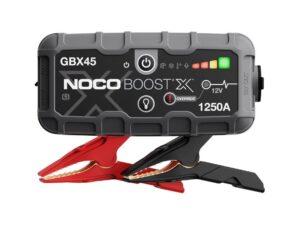 | NOCO Boost X GBX45 1250A Jump Starter | Check Price |
Second Best | Schumacher SC1281 Battery Charger and Engine Starter | Check Price |
Third Choice | STANLEY J5C09 1000A Jump Starter with Compressor | Check Price |
1. NOCO Boost X GBX45 1250A Jump Starter
Key Features
- 1,250-amp peak output
- Designed for 12-volt lead-acid vehicle batteries
- Compatible with gasoline engines up to 6.5 liters
- Compatible with diesel engines up to 4.0 liters
- 31-watt-hour lithium-ion internal battery
- USB-C Power Delivery input and output
- Up to 60-watt USB-C power
- Five-minute charge-to-boost capability with suitable equipment
- Reverse-polarity protection
- Spark-resistant connection design
- 60-second starting timeout
- 100-lumen multifunction flashlight
- Approximately 1.3-pound unit weight
- IP65-rated housing with ports closed
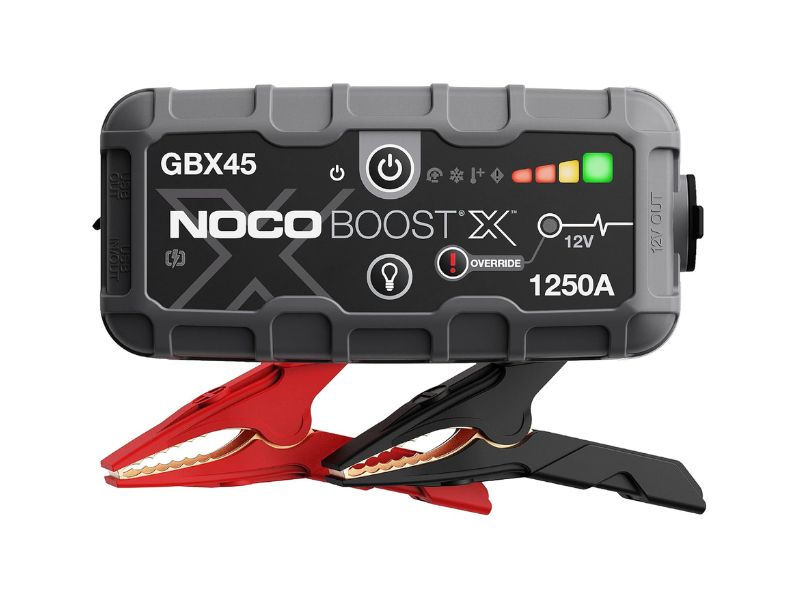
The NOCO Boost X GBX45 is my primary recommendation because it works well as both a portable vehicle booster and a modern USB-C power source. It is small enough to remain in a car while covering a broader range of engines than many entry-level lithium packs.
Its 1,250-amp peak rating supports gasoline engines up to 6.5 liters and diesel engines up to 4.0 liters. That range includes most passenger cars, crossovers, minivans, gasoline pickups, and smaller diesel vehicles. Owners of large diesel pickups, heavy commercial equipment, or 24-volt vehicles should select a product designed specifically for those applications.
The GBX45 works with compatible 12-volt lead-acid batteries, including common wet-cell, AGM, gel, maintenance-free, enhanced flooded, and similar types. It is not a universal solution for every lithium starting battery or 24-volt electrical system.
Its most distinctive charging feature is bidirectional USB-C Power Delivery. With a compatible high-output charger and cable, the USB-C port can replenish the internal battery substantially faster than a basic low-power USB connection. It can also provide up to 60 watts to compatible phones, tablets, and certain laptops.
Fast charging is important for an emergency tool because a partially depleted booster can be returned to useful condition without waiting all day. NOCO states that an empty unit can gain enough energy for a jump-start attempt after approximately five minutes of suitable charging. That is an emergency capability, not a substitute for fully charging the pack before storage.
The connection system includes reverse-polarity and spark-resistant protection. When the clamps are connected incorrectly during normal operation, the unit should identify the error rather than energizing the circuit.
These protections reduce the chance of an ordinary connection mistake, but they cannot inspect the vehicle battery for physical damage. A swollen, leaking, frozen, cracked, or internally shorted battery should not be boosted.
A manual-override function is available when the vehicle battery is too deeply discharged for automatic detection. Manual override can bypass normal safety logic, making correct polarity critical. I would use it only after confirming the system voltage, battery condition, positive terminal, and approved ground location.
The GBX45 uses a 60-second timeout. Once activated, the driver has a limited period to attempt a start before the unit exits the boosting state. This conserves internal energy and discourages leaving the clamps energized unnecessarily.
Its 100-lumen flashlight includes multiple modes for inspection and emergency signaling. The light is useful for identifying underhood jump points, but the booster should be kept away from drive belts, cooling fans, exhaust parts, and other hazards.
At approximately 1.3 pounds, the GBX45 is far easier to carry than a conventional sealed-battery booster. Its compact size also makes it more likely to remain in the vehicle, where it can be useful during an actual breakdown.
The primary limitation is that the GBX45 does not charge the vehicle battery like a dedicated battery charger. It supplies a short burst of current to crank the engine. Afterward, the battery and charging system still need proper testing. A deeply discharged battery should be recharged with a suitable charger rather than depending entirely on the alternator.
This is the strongest option for most drivers who interpret “jump starter charger” as a portable booster that also charges electronic devices. I would choose the Schumacher instead when restoring and maintaining the car battery is the main objective.
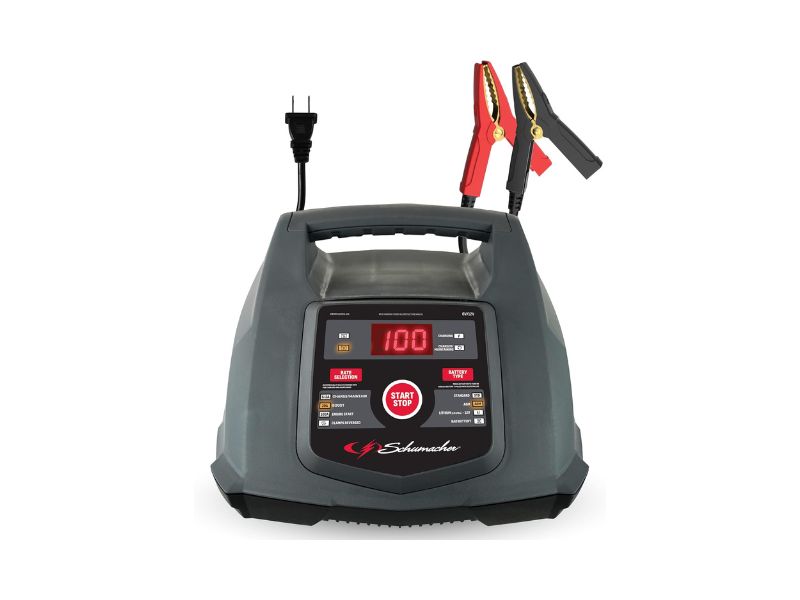
2. Schumacher SC1281 Battery Charger and Engine Starter
Key Features
- 6- and 12-volt battery compatibility
- 100-amp engine-start setting
- 30-amp boost function
- Automatic multi-stage charging
- Continuous 2-, 6-, and 12-amp charging outputs
- Compatible with standard flooded, AGM, gel, and deep-cycle batteries
- Automatic voltage and battery-type detection
- Battery testing function
- Alternator testing function
- Reverse-connection protection
- Digital display and push-button controls
- Intended for large automotive and marine batteries
- 120-volt AC input
- Approximately 12.65-pound weight
The Schumacher SC1281 serves a completely different purpose from the NOCO. It does not contain a portable battery and cannot jump-start a vehicle by itself at the roadside. Instead, it connects to a 120-volt electrical outlet, charges the vehicle battery, and provides a 100-amp engine-start mode.
This makes it a better choice for a garage, workshop, farm building, or home driveway where AC power is available. It can address the depleted battery rather than providing only enough temporary current to start the engine.
The charger supports both 6- and 12-volt batteries. Its compatible battery types include conventional flooded lead-acid, AGM, gel, and deep-cycle designs. Battery type and voltage must still be verified because an incorrect charging mode can damage the battery.
Automatic microprocessor control adjusts the charging process through multiple stages. Multi-stage charging can supply substantial current when the battery is low, reduce the rate as charging progresses, and move toward maintenance behavior after the battery reaches an appropriate state.
The available continuous outputs include 2-, 6-, and 12-amp rates, while the 30-amp boost and 100-amp engine-start outputs operate intermittently. The high-current settings are not intended for continuous use.
The 100-amp engine-start function assists the vehicle battery during cranking. It should not be confused with the peak-amp figures advertised for self-contained lithium boosters. The Schumacher draws energy from the electrical outlet and operates according to a defined duty cycle.
If the battery is deeply discharged, allowing it to charge before using engine-start mode is generally more effective than immediately trying to crank the engine. A battery with some recovered surface charge can work together with the charger rather than placing the entire demand on the engine-start circuit.
A 30-amp boost mode can bring a substantially discharged battery toward a usable state more quickly than the lower charging rates. Monitor the process through the controls and follow the manual’s duty-cycle requirements.
The SC1281 also includes battery and alternator testing. The battery function provides information about charge status, while the alternator test can help indicate whether the vehicle’s charging system is operating. These functions are useful for initial diagnosis but do not replace a full conductance test, load test, parasitic-draw test, or professional charging-system evaluation.
Reverse-hookup protection prevents normal charging output when the clamps are connected backward. Correct connection remains important: attach the positive clamp to the approved positive terminal and the negative clamp according to the battery or vehicle procedure.
At approximately 12.65 pounds, the SC1281 is portable around a garage but not convenient for everyday vehicle storage. It also requires adequate ventilation and protection from rain. Extension-cord selection matters because an undersized or damaged cord can overheat or cause voltage drop.
The charger is rated for batteries up to approximately 1,000 cold-cranking amps, making it suitable for many cars, SUVs, trucks, boats, and larger batteries. Its suitability still depends on chemistry, voltage, capacity, temperature, and condition.
A battery with an internal short, cracked case, active leakage, or freezing must not be charged. A battery that remains at an abnormally low voltage after a complete charging attempt may require replacement.
The Schumacher SC1281 is the best of these three choices for preventative battery care and home-garage recovery. I prefer it when a vehicle sits for long periods, the battery has been accidentally discharged, or the owner needs charging and diagnostic functions in addition to engine-start assistance.
3. STANLEY J5C09 1000A Jump Starter with Compressor
Key Features
- 1,000 peak amps
- 500 instantaneous amps
- 300 amps for five seconds
- Self-contained 12-volt sealed lead-acid battery
- Built-in 120-PSI air compressor
- USB charging port
- 12-volt DC accessory outlet
- Integrated emergency area light
- Reverse-polarity warning
- Cordless roadside operation
- Suitable for compatible 12-volt vehicle systems
- Rechargeable through the specified AC charging arrangement
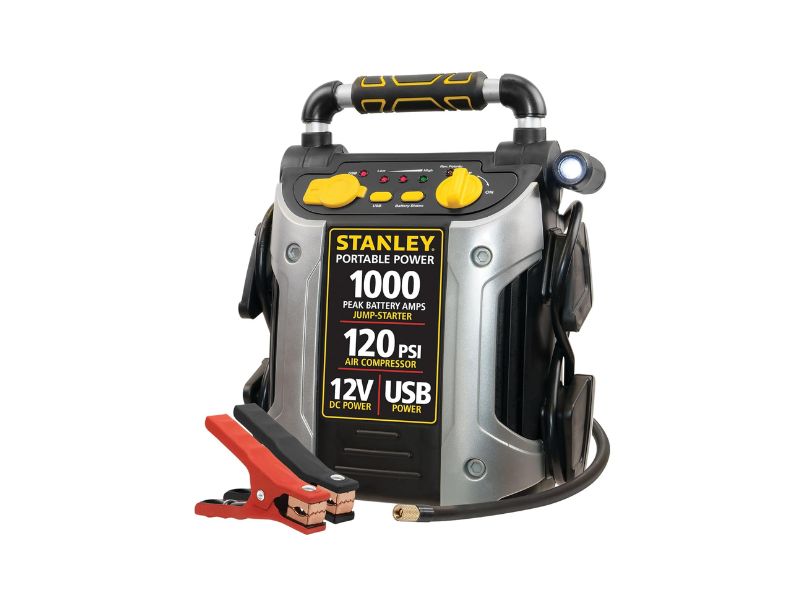
The STANLEY J5C09 is designed as a combined roadside power station rather than a compact lithium pack or a dedicated battery charger. It contains a sealed lead-acid battery that can provide jump-starting current without another vehicle or electrical outlet.
Its starting specifications include 1,000 peak amps, 500 instantaneous amps, and 300 amps for five seconds. These figures provide more context than a peak rating alone, although engine compatibility still depends on displacement, fuel type, temperature, and the condition of both batteries.
The J5C09 is most compelling for drivers who want an integrated compressor. The built-in inflator is rated up to 120 PSI and can inflate ordinary vehicle tires and certain other items using the appropriate fittings.
A 120-PSI maximum is not the same as rapid airflow. Compact compressors usually take time to inflate a low tire and require cooling pauses. They are appropriate for adjusting pressure or handling a moderate leak, not repeatedly filling large truck tires from empty.
The compressor should be monitored during use. Compare pressure with an accurate tire gauge, follow the inflator’s duty cycle, and do not leave it operating unattended. If a tire has sidewall damage, exposed cords, severe cracking, or bead separation, inflation may be unsafe.
The USB port can charge a phone or another compatible device, while the 12-volt accessory outlet can power suitable equipment within the outlet’s rating. As with any multipurpose booster, accessory use consumes energy that may otherwise be available for starting.
The area light can illuminate a tire valve, battery compartment, or immediate work area. Place the unit securely so that it cannot fall into the engine bay or contact moving components.
The internal sealed lead-acid battery makes the STANLEY heavier and bulkier than the NOCO. It also creates stricter charging-maintenance needs. Lead-acid booster batteries should be recharged after use and checked regularly during storage. Allowing the unit to remain discharged for an extended period can cause sulfation and permanent capacity loss.
Reverse-polarity indication warns when the clamps are connected incorrectly, but the system is more traditional than the NOCO’s mistake-resistant electronic interface. The clamps should be connected while the jump-starting switch is off, then output should be activated only after polarity has been confirmed.
The J5C09 does not function like the Schumacher SC1281. Although its internal battery can be recharged, it is not intended to apply a controlled multi-stage charging program to the vehicle battery. Its purpose is temporary starting power and portable accessory operation.
This model is appropriate for a driver who values a compressor and self-contained roadside power more than minimum size. It is less suitable for someone wanting a small booster for a glove compartment or a charger that maintains a stored vehicle battery.
Car Jump Starter Charger Comparison
| Product | Product Type | Starting Output | Vehicle-Battery Charging | Internal Battery | External Power Needed to Start | Device Charging | Additional Functions | Most Suitable Location |
| NOCO Boost X GBX45 | Portable lithium jump pack | 1,250A peak | No | 31Wh lithium-ion | No | USB-C PD and USB | Flashlight, manual override | Personal vehicle |
| Schumacher SC1281 | Plug-in charger and engine starter | 100A engine start | Yes, multi-stage | None | Yes, 120V AC | No | Battery and alternator testing | Home garage |
| STANLEY J5C09 | Portable sealed-battery power station | 1,000A peak | No controlled battery-charging program | Sealed lead-acid | No | USB and 12V outlet | 120-PSI compressor, area light | Vehicle cargo area or garage |
The NOCO is the most portable and provides the strongest modern device-charging system. The Schumacher is the only product here designed to recharge and maintain the vehicle battery through a controlled charging process. The STANLEY combines cordless starting power with tire inflation and accessory output.
Jump Starter, Battery Charger, and Maintainer Differences
These terms are often mixed together, but they describe different functions.
Jump Starter
A jump starter supplies a large amount of current for a short period so the starter motor can crank the engine. It does not necessarily restore meaningful charge to the vehicle battery.
Portable jump starters contain their own battery. Once the engine runs, disconnect the booster according to its instructions and diagnose why the vehicle battery became discharged.
Battery Charger
A battery charger converts household AC power into controlled DC current. It can gradually replenish the vehicle battery over several hours.
A charger is more appropriate when the battery has been drained by lights, long storage, or repeated short trips. Charging slowly is generally healthier and more complete than relying on the alternator to recover a severely discharged battery.
Battery Maintainer
A maintainer monitors a charged battery and supplies current only as needed. It is useful for seasonal cars, motorcycles, boats, and other vehicles stored for long periods.
A simple unregulated trickle charger is not necessarily a safe maintainer. Use a charger specifically designed for long-term automatic maintenance.
Engine Starter
A plug-in engine starter supplies substantial current from an AC outlet during cranking. It normally works with the vehicle battery rather than replacing it completely.
The output is governed by a duty cycle. Continuous cranking can overheat the charger, starter motor, wiring, and battery.
How to Choose the Best Car Jump Starter Charger
Decide Whether Roadside or Garage Use Matters More
This is the most important decision.
Choose a self-contained portable booster when:
- The main concern is being stranded away from home.
- The device must remain in the vehicle.
- No electrical outlet may be available.
- Compact storage matters.
- Phone charging or tire inflation is useful.
Choose a plug-in charger and engine starter when:
- The vehicle is usually parked near AC power.
- The battery needs to be fully recharged.
- Seasonal maintenance is required.
- Battery and alternator testing are useful.
- Cordless roadside operation is not necessary.
Many households benefit from having both types: a maintainer or charger in the garage and a compact jump starter in the vehicle.
Match Engine Coverage
Gasoline engines generally need less cranking power than similar-size diesel engines because diesel compression is higher.
The NOCO GBX45 is rated for gasoline engines up to 6.5 liters and diesel engines up to 4.0 liters. That specification is more useful than assuming 1,250 peak amps can start every vehicle.
The STANLEY does not use the same engine-displacement rating format. Consider its instantaneous and five-second output, ambient temperature, battery condition, and intended vehicle size.
A plug-in 100-amp engine starter works with the vehicle battery. It may not crank a large engine effectively if the battery is internally damaged or completely incapable of accepting charge.
Confirm Battery Voltage
The NOCO and STANLEY jump-starting functions are intended for compatible 12-volt systems. The Schumacher supports 6- and 12-volt batteries for charging, but the correct mode and application must be selected.
Do not assume that a vehicle with two batteries uses 24 volts. Some diesel vehicles connect two 12-volt batteries in parallel and maintain a 12-volt electrical system. Other equipment connects batteries in series for 24 volts.
Follow the vehicle manufacturer’s jump-starting diagram.
Match Battery Chemistry
Common vehicle battery types include:
- Flooded lead-acid
- AGM
- Gel
- Enhanced flooded battery
- Deep-cycle lead-acid
- Lithium starting battery
A jump starter’s compatibility describes the battery system it can assist. A charger’s chemistry setting controls how it applies voltage and current throughout the charging cycle.
AGM, gel, and lithium batteries should not be charged with an incompatible mode. Use the battery label and charger instructions rather than guessing from the vehicle model.
Understand Amp Ratings
The largest number on the package is not always the most useful.
Peak amps describe a brief maximum. Cranking amps represent a more sustained output under defined conditions. A charger’s engine-start amps describe intermittent output while connected to AC power.
Charging amps refer to gradual energy transfer into the battery. A 12-amp charger is not weak merely because a jump pack advertises 1,250 amps; the products perform different jobs over different time periods.
Consider Charging Speed
USB-C Power Delivery allows the NOCO to recharge faster when used with a sufficiently powerful adapter and cable. A low-output phone charger will take longer.
The Schumacher’s speed depends on battery capacity, depth of discharge, condition, temperature, and selected charging stage. A large, depleted battery may require hours even with an automatic charger.
The STANLEY’s internal sealed battery should be recharged promptly after use. Its charging system prioritizes safe replenishment rather than the fastest possible turnaround.
Evaluate Cold-Weather Needs
Cold weather affects both the vehicle and the jump starter. Engine oil thickens, battery output falls, and the starter requires more current.
Lithium jump packs can lose substantial performance when cold. A fully charged pack with output margin is more dependable than a minimally rated unit.
A sealed lead-acid booster is also affected by low temperature but can provide useful sustained current when maintained properly. A plug-in charger can warm through normal operation and build charge before a starting attempt, provided the battery is not frozen.
Never attempt to jump or charge a frozen battery.
Check Cable Reach and Clamp Access
A booster is useful only if its clamps reach the approved jump points. Some vehicles place the battery in the trunk, under a seat, or beneath covers and provide remote underhood terminals.
Compact lithium packs often use short cables to reduce resistance and storage bulk. Larger power stations and plug-in chargers may offer more placement flexibility.
Locate the vehicle’s jump terminals before an emergency.
Consider Compressor Requirements
An integrated compressor can be valuable if tire pressure loss is a common concern. Check:
- Maximum pressure
- Duty cycle
- Hose length
- Gauge visibility
- Inflation speed
- Adapter storage
- Ability to reach every tire valve
Maximum PSI does not describe airflow. A compact 120-PSI inflator may reach high pressure slowly.
Look for Diagnostic Functions
A voltage reading can reveal whether a battery is deeply discharged, but voltage alone does not measure starting capacity.
A charger with battery and alternator testing offers more useful information than a basic jump pack. However, it still cannot perform every diagnostic procedure.
A battery may show acceptable open-circuit voltage yet collapse under load. Professional testing may be necessary when starting problems continue.
Safe Jump-Starting Procedure
Always use the vehicle and product instructions. A general sequence for compatible systems is:
- Move the vehicle to a ventilated, safe location if possible.
- Shift into Park or Neutral and apply the parking brake.
- Turn off lights, climate control, audio, and accessories.
- Inspect the battery for swelling, leakage, cracks, and freezing.
- Confirm the electrical-system voltage.
- Locate the designated positive and negative jump points.
- Ensure the booster output is off.
- Attach the positive clamp to the approved positive point.
- Attach the negative clamp to the specified ground point.
- Confirm correct polarity.
- Activate the jump starter.
- Attempt to start the engine for the allowed duration.
- Pause between attempts.
- After the engine starts, turn off the booster if instructed.
- Remove the negative clamp.
- Remove the positive clamp.
- Keep cables away from fans, belts, pulleys, and hot surfaces.
- Recharge the jump starter promptly.
Do not lean over the battery. Wear eye protection and keep cigarettes, flames, and sparks away from the area.
Using a Plug-In Charger and Engine Starter
A charger requires a different process from a portable booster.
- Confirm the battery type and voltage.
- Place the charger on a dry, stable surface.
- Keep it away from battery gases and moving engine components.
- Connect the clamps according to the charger and vehicle instructions.
- Connect the charger to a suitable AC outlet.
- Select or confirm the correct battery mode.
- Allow the charger to analyze and charge the battery.
- Use engine-start mode only when necessary.
- Observe the specified cranking and cooling duty cycle.
- Disconnect AC power before removing clamps if directed.
Use an extension cord only when necessary. It must be properly grounded where required, undamaged, and sized for the charger’s input current and length.
When Not to Charge or Jump a Battery
Do not proceed when:
- The battery is frozen.
- The case is swollen or cracked.
- Electrolyte is leaking.
- Battery terminals are broken or loose.
- The voltage is incompatible.
- The charger does not support the battery chemistry.
- The jump starter or charger is wet or damaged.
- Cables have exposed conductors.
- The battery is unusually hot.
- Flammable fumes are present.
- The vehicle has flood or collision damage affecting its electrical system.
- The owner’s manual prohibits the proposed procedure.
Replace or professionally evaluate a physically damaged battery.
Common Reasons a Battery Keeps Dying
Aging Battery
Lead-acid batteries lose capacity with age and cycling. A battery can accept surface charge yet fail under starter load.
Alternator Problem
A weak alternator, failed regulator, slipping belt, poor wiring, or bad connection can prevent proper charging while the engine runs.
Parasitic Draw
Modules, lights, aftermarket accessories, or wiring faults can continue consuming power after the vehicle is shut down.
Short Trips
Repeated short drives may not restore the energy used during starting, especially in cold weather.
Corroded Connections
Resistance at the terminals, grounds, or starter cable can mimic a weak battery.
Vehicle Left in Storage
Normal electronic loads can discharge a battery over several weeks or months. A suitable maintainer can help during long-term storage.
A jump starter addresses the immediate no-start event, but repeated discharge requires diagnosis.
Maintenance and Storage
Recharge After Every Use
Jump-starting and device charging both remove energy from the internal battery. Recharge before returning the unit to storage.
Check the Charge Regularly
Inspect portable boosters every one to three months or according to the manufacturer’s schedule. Temperature and battery age influence self-discharge.
Protect Against Extreme Heat
Vehicle interiors can become very hot. Prolonged heat accelerates lithium and lead-acid battery deterioration.
Store the Clamps Safely
Prevent the clamps from touching each other or loose metal objects. Use the supplied holders, cable channels, or storage bag.
Inspect the Compressor
For combination units, check the hose, chuck, adapters, and gauge. A cracked hose may fail when pressurized.
Examine AC Cords
A plug-in charger should not be used with a damaged cord, loose plug, or cracked housing.
Watch for Battery Swelling
A swollen jump pack or power station should be removed from service. Do not puncture, compress, charge, or continue using it.
Common Buying Mistakes
Assuming Every Jump Starter Charges the Car Battery
Most portable packs provide temporary cranking power rather than a controlled battery-charging cycle.
Buying a Plug-In Starter for Roadside Use
Without AC power, a charger such as the Schumacher cannot operate.
Choosing by Peak Amps Alone
Engine coverage, cable quality, battery type, and temperature performance are also important.
Ignoring Battery Chemistry
An incorrect charging profile can damage AGM, gel, or lithium batteries.
Forgetting the Charger at Home
A portable booster must remain securely stored in the vehicle to help during travel.
Leaving a Sealed-Battery Booster Discharged
Extended low-charge storage can permanently reduce lead-acid battery capacity.
Using Device-Charging Features Without Recharging
Phone or laptop charging consumes the reserve needed to start the vehicle.
Expecting a Compressor to Repair Tire Damage
An inflator adds air but cannot repair sidewall damage, a failed bead, or a large puncture.
Using Engine-Start Mode Continuously
High-current starting modes require cooling periods. Ignoring the duty cycle can cause overheating.
Charging a Frozen Battery
A frozen battery can be severely damaged and may rupture. Allow professional inspection before charging.
Frequently Asked Questions
What is the best car jump starter charger for most drivers?
The NOCO Boost X GBX45 is the most practical portable option for most drivers. It provides cordless jump-starting, broad passenger-vehicle compatibility, fast USB-C charging, and useful connection protection.
Can a jump starter charge a dead car battery?
Most portable jump starters do not fully charge the vehicle battery. They provide brief current for cranking. Use a compatible battery charger to restore a deeply discharged battery properly.
What is the difference between a charger and a jump starter?
A charger replenishes stored energy slowly, while a jump starter supplies brief cranking current. Some plug-in products combine charging with engine-start assistance, but they still require household power.
Can the Schumacher SC1281 work without an outlet?
No, the Schumacher requires a suitable 120-volt AC power source. It contains no internal jump-starting battery, making it appropriate for garages rather than cordless roadside use.
Can the NOCO GBX45 charge a phone?
Yes, its USB-C Power Delivery output supports compatible phones and other devices. Accessory charging reduces the energy available for jump-starting, so recharge the unit afterward.
How powerful should a jump starter be?
Select a model rated for the vehicle’s engine size and fuel type. Diesel engines and cold-weather starting require more current than small gasoline engines. Leave additional capacity for severe conditions.
Can I use a jump starter on an AGM battery?
Yes, when the product supports 12-volt AGM vehicle batteries. Charging an AGM battery also requires an appropriate AGM-compatible charging program.
Can I charge a lithium car battery with these products?
Only use a charger specifically approved for that lithium battery and management system. The reviewed jump-starting compatibility does not automatically authorize charging every lithium chemistry.
Is a 100-amp engine starter enough?
It can assist many vehicles when the battery retains some usable capacity. A damaged or completely failed battery may not cooperate with the engine-start setting. Charging first often improves the result.
Can I leave a battery charger connected overnight?
Only when its instructions permit automatic unattended maintenance. Confirm correct battery type, ventilation, cable condition, and placement. Do not leave a damaged or abnormal battery charging.
Is a compressor-equipped jump starter worthwhile?
Yes, when tire-pressure emergencies are as important as battery failures. The tradeoffs are greater size, weight, charging maintenance, and slower inflation than a dedicated high-flow compressor.
Can a 120-PSI compressor inflate every vehicle tire?
It can reach typical passenger-tire pressures, but size and airflow affect inflation time. Large truck tires may take much longer, and the compressor’s duty cycle must be respected.
Can I leave a jump starter in a hot car?
Store it only within the manufacturer’s temperature limits and away from direct heat. Repeated extreme cabin temperatures can accelerate internal-battery aging and reduce service life.
Will a jump starter work in freezing weather?
It may work, but cold significantly reduces available battery output. Keep the unit fully charged, select sufficient capacity, and never charge a frozen lithium pack or jump a frozen vehicle battery.
What does reverse-polarity protection do?
It prevents normal output when the clamps are connected to the wrong terminals. Manual override may bypass protection, so users must still verify polarity before activation.
Why does the engine still not start with a booster?
The problem may involve the starter, cables, fuel, security system, or engine. Stop repeated attempts if the starter does not crank normally or the cables become hot.
Should I connect the black clamp to the battery?
Use the negative or chassis point specified in the vehicle owner’s manual. Many vehicles provide a designated ground away from the battery to reduce spark risk near battery gases.
How often should I recharge a portable jump starter?
Check it every one to three months and recharge after each use. Also recharge it after powering phones, laptops, lights, compressors, or other accessories.
Can I use engine-start mode to recharge the battery quickly?
No, engine-start mode supplies brief high current and is not a charging stage. Use the charger’s proper boost or charging program and follow its duty-cycle instructions.
Do I still need a new battery after jump-starting?
Not always, but repeated failures mean the battery and charging system need testing. Aging, parasitic drain, alternator faults, poor connections, and short-trip driving can all cause recurring discharge.
Conclusion
The best car jump starter charger depends on whether the buyer needs cordless roadside starting, controlled vehicle-battery charging, or a multipurpose emergency station.
The NOCO Boost X GBX45 remains my primary recommendation for most drivers. Its compact lithium battery can start compatible gasoline engines up to 6.5 liters and diesel engines up to 4.0 liters, while USB-C Power Delivery supports rapid internal recharging and portable-device power.
The Schumacher SC1281 is the better choice for a home garage. It can charge and maintain compatible 6- and 12-volt batteries, provide 30-amp boost and 100-amp engine-start assistance, and perform basic battery and alternator checks. Its dependence on AC power prevents it from replacing a roadside jump pack.
The STANLEY J5C09 suits buyers who want cordless starting, a 120-PSI compressor, a work light, USB charging, and 12-volt accessory power in one larger unit. Its sealed lead-acid battery requires regular charging and adds considerable weight.
For most motorists, I would keep the NOCO Boost X GBX45 securely stored in the vehicle and use a separate automatic maintainer at home when long-term battery care is necessary. Whichever option you select, verify voltage and battery chemistry, inspect the battery for physical damage, and recharge the equipment after every use.