Cold weather weakens both a vehicle battery and the portable booster intended to rescue it. The best car jump starter for cold weather therefore needs more than an impressive peak-amp number. Low-temperature operating limits, engine compatibility, internal battery capacity, cable quality, charge maintenance, and storage conditions all affect whether the device will work on a freezing morning.
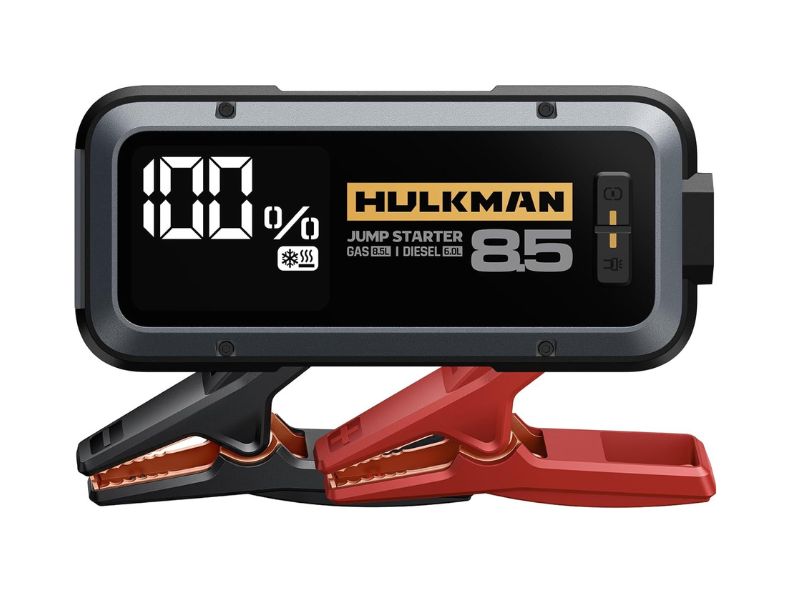
My primary recommendation is the HULKMAN Alpha 85S 2000A Jump Starter because its published operating range extends to -40°F, its 74-watt-hour battery provides useful capacity, and it supports gasoline engines up to 8.5 liters and diesel engines up to 6.0 liters.
I would choose the Jump-N-Carry JNC660 1700 Peak Amp Jump Starter for a garage, fleet, farm, or service vehicle where repeated starts, long heavy cables, and a published cranking-amp rating matter more than weight.
The NOCO Boost X GBX55 1750A Jump Starter is the more compact alternative for drivers who want broad engine compatibility, rapid USB-C recharging, and a straightforward protective interface.
No portable booster eliminates the effects of severe cold. A jump starter stored overnight at subzero temperatures may deliver less current than the same unit at room temperature. The vehicle’s oil viscosity, battery condition, engine size, and starter health also influence the result. Selecting extra output capacity and keeping the booster charged are essential winter practices.
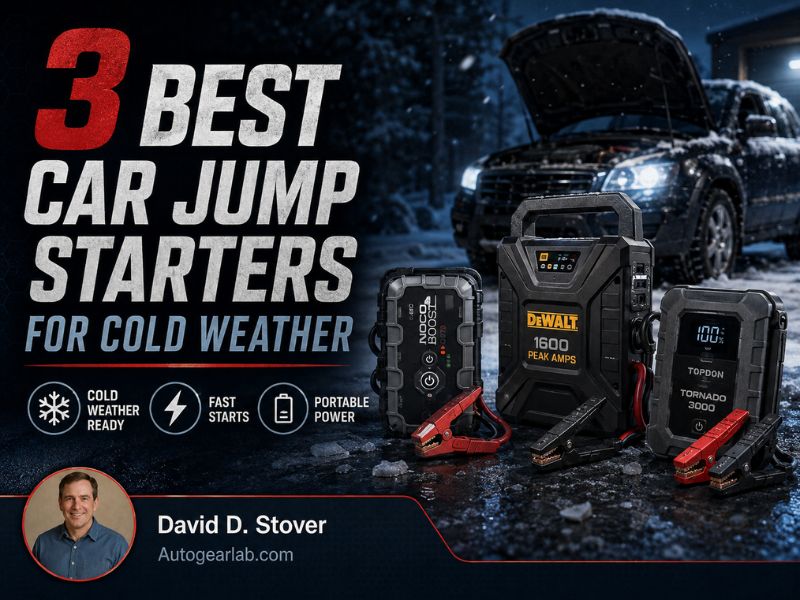
Best Cold-Weather Car Jump Starters Reviewed
| Image | Product Name | Check Price |
|---|---|---|
Best Choice | HULKMAN Alpha 85S 2000A Jump Starter | Check Price |
Second Best | Jump-N-Carry JNC660 1700 Peak Amp Jump Starter | Check Price |
Third Choice | NOCO Boost X GBX55 1750A Jump Starter | Check Price |
1. HULKMAN Alpha 85S 2000A Jump Starter
Key Features
- 2,000-amp advertised peak output
- Designed for compatible 12-volt vehicle systems
- Supports gasoline engines up to 8.5 liters
- Supports diesel engines up to 6.0 liters
- 74-watt-hour lithium-polymer battery
- Published working range from -40°F to 113°F
- Published storage range from -40°F to 131°F
- Cold-weather starting technology
- Large status display
- Automatic connection monitoring
- Manual forced-starting mode
- USB-C input and output
- Quick Charge USB output
- 15-volt accessory output up to 10 amps
- Approximately 2.57-pound unit weight
The HULKMAN Alpha 85S is my primary recommendation because it combines a broad published low-temperature range with enough internal capacity and engine coverage for most passenger vehicles. Its working-temperature specification extends to -40°F, giving it a clear cold-weather focus compared with conventional lithium boosters whose stated operating ranges commonly stop near -4°F.
Its 2,000-amp peak rating supports gasoline engines up to 8.5 liters and diesel engines up to 6.0 liters. This covers typical cars, crossovers, SUVs, gasoline pickups, and many diesel applications using compatible 12-volt systems.
Engine-size ratings are more informative than peak amperage alone, but they should still be treated as maximum compatibility claims rather than guaranteed performance in every condition. A large diesel at -25°F with thick oil and a severely degraded battery presents a harder starting task than a warm gasoline sedan with a battery that was drained by interior lights.
The Alpha 85S uses a 74-watt-hour lithium-polymer battery. Capacity matters in winter because low temperatures raise internal resistance and reduce immediately available energy. A larger reserve can provide useful margin for more than one carefully timed attempt.
The cold-starting system does not make lithium chemistry immune to freezing conditions. The pack may still perform better if its temperature is raised safely before use. If practical, carrying it in a warm cabin or insulated emergency bag can improve immediate output. Never place it on a heater, hot exhaust part, or open flame.
A large display communicates charge level and operating status more clearly than a row of small indicator lights. This is valuable in winter, when gloves, poor lighting, snow, and urgency can make small controls harder to interpret.
The clamp module evaluates connection conditions and reports common faults. Correct polarity remains essential, particularly when using the forced-start function for a battery whose voltage is too low to be detected automatically.
Forced-starting mode should be treated as an advanced emergency function. It may reduce or bypass ordinary protective logic. Before activating it, confirm that the system is 12 volts, the battery is not frozen or physically damaged, and the clamps are connected to the correct points.
USB-C and USB-A outputs allow the pack to power phones and other compatible devices. A 15-volt accessory output can operate certain automotive accessories through the appropriate adapter. These functions add useful winter-emergency flexibility but draw from the same battery reserve needed for starting.
At approximately 2.57 pounds, the HULKMAN remains portable enough for personal-vehicle storage. It is larger than a basic compact jump pack but much easier to carry than an 18-pound professional booster.
Its biggest limitation is the same one shared by every lithium jump starter: storage charge and temperature strongly influence performance. Leaving it uncharged for months in an extremely cold vehicle undermines its specifications. Check it frequently during winter and recharge it after every use.
The HULKMAN Alpha 85S offers the strongest overall balance for cold-climate motorists. I would choose it for a household with several 12-volt vehicles, a moderate-size diesel, or a driver who routinely experiences subzero temperatures but still needs a booster compact enough to remain in the car.
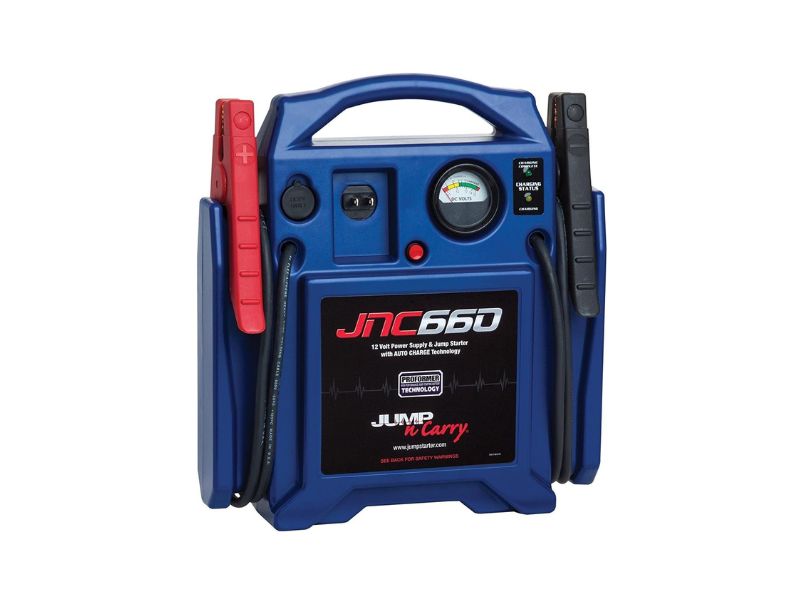
2. Jump-N-Carry JNC660 1700 Peak Amp Jump Starter
Key Features
- 1,700 peak amps
- 425 cranking amps
- 22-amp-hour Clore PROFORMER battery
- Designed for compatible 12-volt vehicles
- 46-inch booster cables
- Number 2 AWG cable conductors
- Industrial-grade clamps
- Built-in automatic charger
- Charge-status voltmeter
- 12-volt accessory outlet
- Suitable for multiple starts per charge
- Approximately 18-pound weight
- Designed for garages, fleets, and frequent use
The Jump-N-Carry JNC660 takes a traditional approach to cold-weather starting. Instead of relying on a compact lithium battery, it uses a substantial sealed lead-acid-style booster battery built specifically for delivering high starting current.
Its specifications include 1,700 peak amps and 425 cranking amps. The cranking rating is especially useful because it describes more sustained starting output than an instantaneous peak figure.
The JNC660 is designed for demanding environments such as garages, towing operations, dealerships, farms, fleets, and workshops. Those use cases align well with cold-weather requirements because the unit is intended to provide repeated starts rather than serve only as a rarely used emergency power bank.
The 22-amp-hour internal battery gives it considerably more stored capacity than a pocket-size lithium booster. This allows greater support during extended or repeated starting attempts, although the manufacturer’s cranking and rest limits must still be followed.
Its 46-inch number 2 AWG cables are a significant advantage. Long, heavy conductors improve access when a vehicle is parked beside a snowbank, close to a wall, or behind another disabled vehicle. The cable gauge limits voltage loss better than narrow accessory-grade leads.
Industrial clamps provide strong spring force and broad conductive contact. In winter, frost, corrosion, salt, and ice can prevent a clean connection. The clamps still need to reach bare, approved metal; high output cannot pass efficiently through corrosion or paint.
The built-in automatic charger allows the JNC660 to remain connected to suitable AC power according to its instructions. This makes it easy to maintain in an always-ready state inside a garage or service vehicle.
A front voltmeter indicates the approximate condition of the internal battery. Voltage does not provide a complete load test, but it helps prevent attempting a winter start with a depleted booster.
At approximately 18 pounds, this is not the most convenient unit to carry in a compact car. It takes meaningful cargo space and should be secured so it cannot move during sudden braking.
The internal lead-acid battery is also affected by cold. Its size and cranking-oriented design provide useful winter capability, but storing it outdoors in a deeply discharged condition will still reduce performance and accelerate deterioration.
Unlike modern lithium packs, the JNC660 does not emphasize spark-resistant connection electronics, USB-C charging, or detailed digital instructions. Its design assumes that the user understands battery polarity and professional jump-starting procedure.
The JNC660 is the most suitable choice here for repeated cold-weather starts, difficult battery access, and garage use. I prefer the HULKMAN for ordinary drivers because it is much easier to keep in a passenger vehicle. For a farm, workshop, roadside service vehicle, or household with multiple cars, the JNC660’s heavy cables and sustained output are compelling.
3. NOCO Boost X GBX55 1750A Jump Starter

Key Features
- 1,750-amp peak rating
- Compatible with 12-volt lead-acid vehicle batteries
- Supports gasoline engines up to 7.5 liters
- Supports diesel engines up to 5.0 liters
- Lithium-ion internal battery
- Published operation down to approximately -4°F
- USB-C Power Delivery charging
- Fast charge-to-boost capability
- Reverse-polarity protection
- Spark-resistant connection system
- Automatic 60-second starting timeout
- Manual override
- Multifunction LED flashlight
- Portable power-bank operation
- Compact vehicle-storage format
The NOCO Boost X GBX55 is the best choice of these three for drivers who need a compact winter jump starter but do not routinely experience temperatures below its published operating limit. Its engine coverage, protective interface, and rapid USB-C charging make it a practical emergency tool for most cars and light trucks.
The GBX55 supplies a 1,750-amp peak rating and supports gasoline engines up to 7.5 liters and diesel engines up to 5.0 liters. That gives it useful output margin for passenger vehicles that would technically fit within a smaller booster’s rating.
Its operating-temperature range reaches approximately -4°F. That is suitable for many winter climates, but it is not as broad as the HULKMAN’s published -40°F range. Drivers routinely facing temperatures below -4°F should not assume the NOCO will provide full rated output after being cold-soaked overnight.
The most practical strategy is to prevent extreme cold soaking when possible. During a winter trip, keeping the booster in the heated passenger compartment rather than an unheated external toolbox can help. At home, charge and inspect it indoors before returning it to secure vehicle storage.
The GBX55 supports USB-C Power Delivery for rapid recharging. With an appropriate charger and cable, it can recover usable starting energy much faster than a basic micro-USB booster.
Fast charging is especially helpful during winter, when the pack may need to be topped up before a storm or after one starting attempt. It does not eliminate the need for routine charge checks.
Reverse-polarity and spark-resistant protection help reduce normal connection errors. The interface also identifies high- and low-temperature conditions and can prevent activation when operation would be unsafe or ineffective.
A 60-second timeout limits how long the booster remains active during a starting sequence. If the engine does not start, switch off the unit, allow the required recovery period, and investigate rather than cranking continuously.
Manual override allows output when the vehicle battery is below the automatic detection threshold. This mode requires careful polarity verification because it can bypass parts of the normal protection system.
The built-in flashlight helps locate jump points during dark winter mornings. It can also provide emergency signaling if a vehicle is disabled near traffic. The unit should still be positioned away from belts, fans, pulleys, and hot components.
The GBX55 also functions as a USB power bank. A charged phone can be critical in winter, but using the booster for routine electronics charging reduces its emergency reserve.
I recommend the NOCO GBX55 for drivers seeking compact storage and broad vehicle compatibility in normal winter conditions. The HULKMAN is more appropriate when the published operating range must extend far below zero, while the JNC660 is better for repeated heavy use.
Cold-Weather Jump Starter Comparison
| Product | Internal Battery | Peak Output | Other Starting Rating | Gas Engine Coverage | Diesel Coverage | Published Low-Temperature Capability | Weight | Main Strength |
| HULKMAN Alpha 85S | 74Wh lithium polymer | 2,000A | Not separately stated | Up to 8.5L | Up to 6.0L | Working range to -40°F | Approx. 2.57 lb | Broad cold rating and portable capacity |
| Jump-N-Carry JNC660 | 22Ah PROFORMER booster battery | 1,700A | 425 cranking amps | Not stated by displacement | Not stated by displacement | Designed for demanding and cold conditions | Approx. 18 lb | Heavy cables and repeated starting |
| NOCO Boost X GBX55 | Lithium ion | 1,750A | Not separately stated | Up to 7.5L | Up to 5.0L | Operating range to about -4°F | Compact lithium format | Fast charging and protective interface |
The HULKMAN provides the broadest stated low-temperature working range. The Jump-N-Carry is the most substantial option for repeated use, with a large internal battery, long cables, and a published cranking rating. The NOCO is easier to store and recharge but has a less extreme published cold limit.
Why Cold Weather Makes Starting Difficult
A vehicle becomes harder to start in winter for several reasons occurring at the same time.
Battery Chemistry Slows Down
A lead-acid battery produces electricity through chemical reactions. Low temperature slows those reactions, reducing the current the battery can deliver.
A battery that starts the engine normally at 70°F may struggle below freezing, especially if it is several years old or only partially charged.
Engine Oil Thickens
Cold oil creates more resistance in bearings, cylinder walls, and other moving components. The starter motor must work harder to rotate the crankshaft.
Using an oil viscosity approved by the vehicle manufacturer for the expected temperature helps control this load.
Fuel Vaporization Changes
Gasoline vaporizes less readily in cold conditions. Modern fuel injection compensates through enrichment, but weak sensors, poor fuel pressure, or marginal ignition components can make starting more difficult.
Diesel fuel systems face additional cold-weather issues, including increased compression demands, glow-plug operation, and possible fuel gelling in severe conditions.
Electrical Resistance Becomes More Important
A small amount of corrosion at the battery terminals, engine ground, or starter cable can cause substantial voltage loss during high-current cranking. Winter exposes connections that seemed acceptable in warm weather.
The Jump Starter Also Gets Cold
The booster’s internal battery experiences the same temperature-related limitations. A unit rated for the engine at room temperature may provide less margin after hours in a freezing trunk.
This is why cold-weather selection should include extra capacity instead of matching the engine at the absolute limit.
Lithium Versus Lead-Acid Boosters in Winter
Lithium Jump Starters
Lithium packs offer:
- Compact size
- Low carrying weight
- High peak output
- USB charging
- Digital protection systems
- Easy storage in passenger vehicles
Their principal winter limitation is reduced output when cold. Battery-management electronics may also prevent operation below the allowed temperature.
A lithium pack with a broad working range, substantial capacity, and extra engine-size margin is preferable in cold climates.
Traditional Booster Batteries
Traditional units offer:
- Larger stored-energy capacity
- Sustained cranking performance
- Heavy cables
- Large clamps
- Multiple starts
- Workshop-oriented durability
Their disadvantages are weight, bulk, slower recharge, and ongoing charge-maintenance needs.
Neither chemistry should be left discharged in freezing conditions. A fully charged booster performs better and is less vulnerable to damage.
How to Choose a Cold-Weather Jump Starter
Start With the Lowest Expected Temperature
Consider actual overnight lows rather than typical daytime temperature.
A product rated to -4°F may be adequate in a climate where the coldest mornings stay above zero. It leaves insufficient specification margin for routine -20°F or -30°F exposure.
A broader published temperature range is useful, but storage practice remains important. Even an extreme-cold-rated pack should be charged and inspected regularly.
Match Gas or Diesel Engine Size
Diesel engines usually require more starting current because of their high compression. A jump starter rated for a 6.0-liter gasoline engine may support a much smaller diesel.
Select according to both displacement and fuel type. If the vehicle is near the stated maximum, choose a larger model for winter use.
Consider the Vehicle Battery’s CCA Rating
Cold-cranking amps, or CCA, indicate how much current a battery can provide at 0°F for a defined period while maintaining a specified voltage.
The booster does not need to duplicate the battery’s CCA rating exactly, but vehicles with large high-CCA batteries generally have substantial starting demands. A professional booster with published cranking amps can make comparison easier than a peak-only rating.
Look Beyond Peak Amps
Peak amperage is a brief maximum under manufacturer-defined conditions. It does not describe sustained current, cold-soaked performance, cable loss, or stored energy.
Compare:
- Engine-size rating
- Internal capacity
- Cranking amps when available
- Cable gauge
- Cable length
- Clamp construction
- Working-temperature range
- Battery chemistry
- Recharge method
A balanced unit is more useful than one with only a large marketing number.
Evaluate Internal Capacity
Battery capacity influences how many attempts the unit can support and how much energy remains available in cold conditions.
Lithium products may state watt-hours or milliamp-hours. Watt-hours provide a more useful comparison when voltage differs.
Traditional boosters often state amp-hours. These numbers cannot be compared directly with peak amps.
Inspect Cable and Clamp Design
Winter conditions make connections more difficult. Gloves reduce dexterity, terminals may be corroded, and battery locations may be obstructed by covers or snow.
Strong clamps with broad conductive surfaces improve contact. Flexible cables remain easier to position in low temperatures. Long cables help with remote or difficult battery locations, but sufficient conductor gauge is necessary to control voltage drop.
Prioritize Clear Controls
Large displays or obvious status lights help when visibility is poor. Useful indications include:
- Internal charge
- Correct connection
- Reverse polarity
- Boost readiness
- High or low temperature
- Fault conditions
- Manual-override status
A complicated interface becomes more difficult when the driver is cold, wearing gloves, or standing near traffic.
Consider Recharge Speed
A high-output USB-C system can prepare a lithium booster quickly before a storm. A traditional unit with a built-in automatic charger can remain maintained in a garage.
The ideal method depends on where the booster is stored. A garage-based product can remain near AC power, while a travel pack benefits from USB-C compatibility.
Winter Storage Strategy
A cold-weather jump starter should remain close enough to the vehicle to be useful but protected enough to retain performance.
Store It Securely
Use a fixed compartment, storage bag, or tied-down emergency box. A loose booster can become a projectile in a collision.
Avoid Direct Contact With Snow or Water
Moisture can enter open ports or clamp connectors. An enclosure protection rating may apply only when covers are closed.
Check Charge More Frequently
Inspect the charge approximately monthly during winter rather than assuming a long standby claim guarantees readiness.
Recharge After Any Accessory Use
Charging a phone, flashlight, or other device reduces the energy available for starting.
Do Not Charge a Frozen Lithium Pack
Move it to an approved charging environment and allow it to reach a safe temperature naturally. Follow the manufacturer’s charging-temperature limits.
Watch for Swelling or Damage
A swollen, cracked, leaking, or unusually hot jump starter should be removed from service. Do not puncture or continue charging it.
How to Warm a Cold Jump Starter Safely
If the pack is too cold to operate effectively:
- Move it into a heated passenger compartment or building.
- Allow it to warm gradually.
- Keep it dry.
- Check the temperature indicator if provided.
- Verify charge before reconnecting.
- Do not place it on a radiator, engine block, stove, or open flame.
- Do not use a heat gun or direct high-temperature air.
- Do not charge it until it is within the approved charging range.
A coat or insulated bag can slow further cooling, but wrapping a unit while it is actively operating or charging may trap heat. Follow the product instructions.
Safe Winter Jump-Starting Procedure
- Move away from traffic when possible.
- Engage the parking brake and shift into Park or Neutral.
- Turn off lights, fans, heated seats, defrosters, and accessories.
- Clear snow from the hood and battery area.
- Inspect the battery for freezing, swelling, cracks, or leakage.
- Confirm that the electrical system is 12 volts.
- Locate the designated positive and ground jump points.
- Switch off the booster before making connections.
- Attach the red clamp to the approved positive point.
- Attach the black clamp to the approved ground point.
- Confirm correct polarity and stable clamp contact.
- Activate the booster.
- Attempt to start the engine within the specified time.
- Limit each cranking attempt to the recommended duration.
- Allow the booster and starter to rest between attempts.
- After the engine starts, switch off the booster if directed.
- Remove the negative clamp first.
- Remove the positive clamp second.
- Keep cables away from fans, belts, and hot parts.
- Recharge the booster after use.
Wear eye protection and do not lean over the battery. Battery gases can ignite, even in winter.
When You Should Not Attempt a Jump Start
Do not boost the vehicle when:
- The battery is frozen.
- The case is swollen or split.
- Electrolyte is leaking.
- Terminals are broken.
- The electrical-system voltage is unknown.
- The booster is outside its permitted operating range.
- The jump starter is swollen, wet, cracked, or damaged.
- Cable insulation is cut.
- The clamps are burned or loose.
- The vehicle has flood damage.
- Flammable vapors or spilled fuel are present.
- The owner’s manual prohibits the planned connection.
A frozen battery may resemble a normally discharged battery. If the vehicle has been exposed to deep cold and the battery case looks distorted, have it inspected before applying power.
What to Do When the Engine Still Will Not Start
Listen to the Starter
A rapid clicking sound often indicates insufficient voltage or poor connections. One solid click can point toward the starter solenoid or motor. Normal cranking without ignition suggests a fuel, spark, compression, or security-system problem.
Check Clamp Contact
Remove corrosion, snow, and ice from approved connection points. Do not attach clamps to painted brackets.
Verify Booster Charge and Temperature
A cold or partially charged pack may not provide enough output. Warm and recharge it safely before another attempt.
Allow Recovery Time
Repeated cranking overheats the starter and booster. Follow the duty cycle.
Check the Vehicle Battery
An internally shorted battery can absorb booster current and prevent starting. Stop if the battery becomes hot, vents, or produces an unusual odor.
Consider Oil Viscosity
Oil that is too thick for the temperature increases cranking resistance. Follow the vehicle manufacturer’s winter viscosity recommendation.
Diagnose the Starting System
A failed starter, corroded ground strap, damaged cable, or locked engine cannot be corrected by a larger jump starter.
Cold-Weather Maintenance
Test the Vehicle Battery Before Winter
A battery near the end of its service life may start normally in autumn and fail after the first serious freeze. A proper conductance or load test can identify reduced capacity.
Clean Battery Connections
Disconnect and clean terminals using the vehicle manufacturer’s procedure. Ensure the engine-to-chassis ground is secure.
Check the Charging System
The alternator must restore energy after starting. Repeatedly needing a jump can indicate a charging fault or parasitic drain.
Use the Correct Engine Oil
Winter-approved viscosity reduces starter load. Do not select oil outside the manufacturer’s specifications merely to improve cranking.
Keep the Booster Charged
Set a monthly winter reminder to check it. A charge display is more useful than relying on memory.
Common Buying Mistakes
Buying at the Engine-Size Limit
A booster rated exactly for the engine may lack sufficient cold-weather margin.
Comparing Only Peak Amps
Peak output does not describe capacity, cranking duration, cables, or low-temperature performance.
Ignoring the Published Operating Range
Storage and working ranges are not interchangeable. A unit may survive storage at a temperature where it cannot safely operate or charge.
Leaving the Booster Nearly Empty
Cold reduces the performance of an already depleted internal battery.
Selecting a Large Professional Unit for a Small Car
An 18-pound booster may remain in the garage because it is inconvenient to carry.
Choosing a Tiny Lithium Pack for Repeated Fleet Use
Frequent heavy starting favors substantial cables, clamps, and stored capacity.
Charging a Frozen Pack
Charging outside the approved range can damage the internal battery and create a safety hazard.
Assuming a Jump Fixes the Vehicle Battery
The battery may still need controlled charging, testing, or replacement.
Ignoring Corroded Terminals
High-resistance connections waste booster output as heat.
Cranking Continuously
Long attempts can damage the starter and overheat the booster.
Frequently Asked Questions
What is the best car jump starter for cold weather?
The HULKMAN Alpha 85S offers the strongest balance for severe-cold personal-vehicle use. Its published working range reaches -40°F, and it supports gasoline engines up to 8.5 liters and diesels up to 6.0 liters.
Do lithium jump starters work below freezing?
Yes, but available output decreases as lithium cells become colder. Choose extra capacity, keep the pack fully charged, and observe its published operating-temperature limits.
What temperature is too cold for a jump starter?
The limit depends on the specific model’s published working range. The NOCO GBX55 is rated to approximately -4°F, while the HULKMAN Alpha 85S publishes a -40°F working limit.
Can I leave a jump starter in my car all winter?
Yes, if it is secured and stored within its approved temperature range. Check its charge frequently and protect it from moisture, loose metal objects, and collision movement.
Should I keep the booster inside my house?
Indoor storage improves temperature and charging conditions but removes roadside availability. A practical compromise is vehicle storage with regular indoor charging and inspection.
How many amps are needed for cold-weather starting?
Use the engine-size and fuel-type rating rather than peak amps alone. Select additional margin for diesel engines, large displacement, aging batteries, and subzero conditions.
Are diesel engines harder to jump-start in winter?
Yes, higher compression and cold-weather fuel-system demands increase starting requirements. Choose a booster explicitly rated for the diesel’s displacement with extra winter capacity.
Is lead acid better than lithium in cold weather?
Lead-acid boosters can provide sustained output, while lithium offers much better portability. Both lose performance in cold temperatures and must remain fully charged.
Why is the JNC660 so heavy?
Its 22-amp-hour booster battery, heavy cables, and industrial clamps add substantial weight. That construction favors repeated starting and garage use over compact travel storage.
Can I warm a frozen jump pack with a heater?
No, direct heat can damage the cells and create a fire risk. Warm the unit gradually in a dry, temperature-controlled space and follow its charging limits.
Can I charge a cold lithium jump starter?
Only charge it within the manufacturer’s approved charging-temperature range. Operation and charging often have different limits, so check the instructions before connecting power.
Will a jump starter work on a frozen car battery?
Do not jump-start a battery that is frozen or suspected of freezing. The case can rupture or the battery may explode when current is applied.
Does a higher peak-amp rating guarantee a better winter start?
No, peak output is only one part of cold-weather performance. Capacity, cell temperature, cables, clamps, engine rating, and charge level also matter.
Why does the booster show an error in the cold?
Its management system may detect low temperature, reversed clamps, or insufficient battery voltage. Read the error indication and correct the cause instead of repeatedly forcing operation.
What is manual override?
Manual override energizes the clamps when the vehicle battery is too depleted for detection. It can bypass protective logic and should be used only after carefully verifying polarity and battery condition.
How long should I crank the engine?
Follow the booster’s stated cranking duration and cooling interval. Short controlled attempts are safer than continuous cranking, which can overheat the starter, cables, and booster.
Why does the car click even with a jump starter connected?
The cause may be poor contact, insufficient output, a weak starter, or damaged cables. Check clean connections and booster charge before pursuing further diagnosis.
How often should I recharge a winter jump starter?
Check it approximately monthly during winter and recharge after every use. Also replenish it after charging phones, lights, or other accessories.
Should I replace my battery after one cold-weather failure?
One discharge does not always require replacement, but the battery should be tested. Age, low charge, alternator faults, parasitic draw, and loose terminals can all cause winter failure.
Can a jump starter damage my vehicle electronics?
Incorrect voltage, reversed polarity, or improper connection can cause damage. Use the designated jump points and follow both the vehicle and booster instructions.
Conclusion
The best car jump starter for cold weather needs adequate output, usable capacity, a suitable operating range, dependable clamps, and disciplined charge maintenance. No amp rating can compensate for a booster left nearly empty in a freezing vehicle.
The HULKMAN Alpha 85S remains my primary recommendation for most cold-climate drivers. Its published -40°F working range, 74-watt-hour lithium battery, 2,000-amp peak rating, and broad gas and diesel engine coverage provide the strongest overall winter balance.
The Jump-N-Carry JNC660 is the more appropriate alternative for garages, fleets, farms, and frequent starting. Its 425 cranking amps, 22-amp-hour internal battery, 46-inch heavy cables, and industrial clamps are valuable when portability is secondary.
The NOCO Boost X GBX55 is suitable for drivers who want a compact pack for ordinary winter conditions. Its engine coverage and rapid USB-C charging are useful, but its approximately -4°F operating limit makes it less appropriate for routine extreme-cold exposure.
Whichever model you choose, charge it before winter, check it monthly, and store it securely. Never attempt to boost a frozen, cracked, swollen, or leaking vehicle battery. For a portable unit that can remain in most passenger vehicles while offering meaningful subzero capability, I would choose the HULKMAN Alpha 85S.