A dependable emergency car battery jump starter provides a way to restart a vehicle without finding another driver or positioning jumper cables between two cars. It can be especially useful in an empty parking lot, during a late-night breakdown, or when a vehicle battery fails far from household power.
My primary recommendation is the Jump-N-Carry JNC325 2000A Lithium Jump Starter because it combines professional-style starting hardware, broad engine compatibility, useful protection systems, and a portable storage case. I would choose the DEWALT DXAEJ14 Digital Jump Starter with Compressor for drivers who want a traditional power station that can also inflate a tire and perform a basic alternator check. The TOPDON JS2000Pro 2000A Jump Starter is the more compact alternative for buyers who prioritize a straightforward lithium booster, bright emergency light, power-bank functionality, and broad gasoline or diesel engine coverage.
All three are designed for compatible 12-volt vehicle systems, but they serve different emergency plans. The Jump-N-Carry focuses on serious portable starting performance, the DEWALT combines several roadside tools in one heavier unit, and the TOPDON emphasizes compact storage and simple operation.
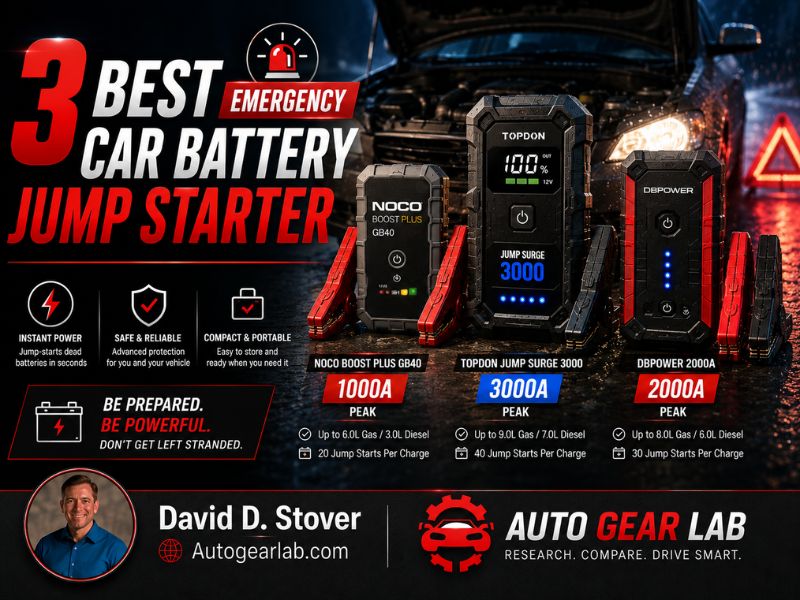
Best Emergency Car Battery Jump Starters Reviewed
| Image | Product Name | Check Price |
|---|---|---|
Best Choice | Jump-N-Carry JNC325 2000A Lithium Jump Starter | Check Price |
Second Best | DEWALT DXAEJ14 Digital Jump Starter with Compressor | Check Price |
Third Choice | TOPDON JS2000Pro 2000A Jump Starter | Check Price |
1. Jump-N-Carry JNC325 2000A Lithium Jump Starter

Key Features
- 2,000-amp peak rating
- 450 start-assist amps
- Compatible with 12-volt vehicle systems
- Supports gasoline engines up to 8.0 liters
- Supports diesel engines up to 6.0 liters
- Heavy-duty copper clamps
- 24-inch 6-AWG cable leads
- Reverse-polarity protection
- Backfeed protection
- Short-circuit protection
- Overvoltage and overtemperature protection
- Override mode for deeply discharged batteries
- USB device-charging outputs
- 12-volt accessory output
- Integrated LED work light
- Protective carrying case
The Jump-N-Carry JNC325 is my primary recommendation because it provides a strong balance between professional starting hardware and personal-vehicle portability. Unlike small emergency packs built around short, lightweight clamp assemblies, it uses substantial copper clamps and 24-inch 6-AWG leads.
The JNC325 carries a 2,000-amp peak rating and a more informative 450 start-assist amp specification. It supports gasoline engines up to 8.0 liters and diesel engines up to 6.0 liters, covering most passenger cars, SUVs, light trucks, and numerous diesel vehicles using 12-volt systems.
Engine compatibility is more useful than peak amperage alone. Peak current represents a brief maximum, whereas actual starting success also depends on the internal battery’s charge, cable resistance, clamp contact, engine temperature, oil viscosity, and condition of the vehicle battery.
The 24-inch cables provide more positioning freedom than many compact lithium packs. Extra reach can be valuable when a battery sits beneath a cover, behind an air-intake component, or close to the firewall. Vehicles with designated remote jump points should still be connected according to their owner’s manuals.
Cable gauge also matters. Thicker conductors reduce voltage loss while carrying high starting current. The JNC325’s 6-AWG leads and substantial clamps contribute to its ranking because emergency equipment needs to transfer stored energy effectively, not merely advertise a large number.
Its protection system monitors reverse polarity, short circuits, backfeed, overvoltage, overtemperature, and other abnormal conditions. Backfeed protection is particularly relevant after the engine starts because the vehicle’s alternator begins producing electrical power.
The standard operating mode requires the unit to detect a suitable battery connection. If the vehicle battery is so deeply discharged that detection fails, an override function can energize the output.
Override mode should be used cautiously. It may bypass important automatic safeguards, including ordinary polarity detection. Before activation, verify that the vehicle uses a 12-volt system, identify the positive terminal correctly, and inspect the battery for freezing or damage.
The USB outputs can recharge phones and other compatible devices during a breakdown. A 12-volt output can operate suitable accessories or support certain memory-saving applications through the proper adapter.
These secondary functions consume starting reserve. After using the JNC325 as a power bank or accessory source, recharge it before returning the unit to emergency storage.
The integrated LED work light helps locate battery terminals and connection points at night. The light is useful, but the unit must still be positioned where neither it nor its cables can contact cooling fans, belts, pulleys, or hot exhaust components.
A storage case keeps the clamps, charging equipment, and booster together. This is an important practical feature because a missing charging cable or unprotected clamp assembly can make an otherwise capable unit less reliable.
The JNC325 is the strongest option for buyers who want a portable emergency jump starter with serious clamps and broad engine coverage. I would select the DEWALT instead when tire inflation is equally important, or the TOPDON when a simpler compact pack is preferred.
2. DEWALT DXAEJ14 Digital Jump Starter with Compressor
Key Features
- Traditional self-contained power-station design
- Sealed lead-acid internal battery
- High-output jump-starting capability
- Compatible with appropriate 12-volt vehicle batteries
- Built-in 120-PSI digital air compressor
- Automatic pressure shutoff
- Reverse-polarity warning
- Alternator-check function
- Backlit digital display
- USB device-charging ports
- Integrated area light
- Onboard clamp storage
- Approximately 17-pound weight
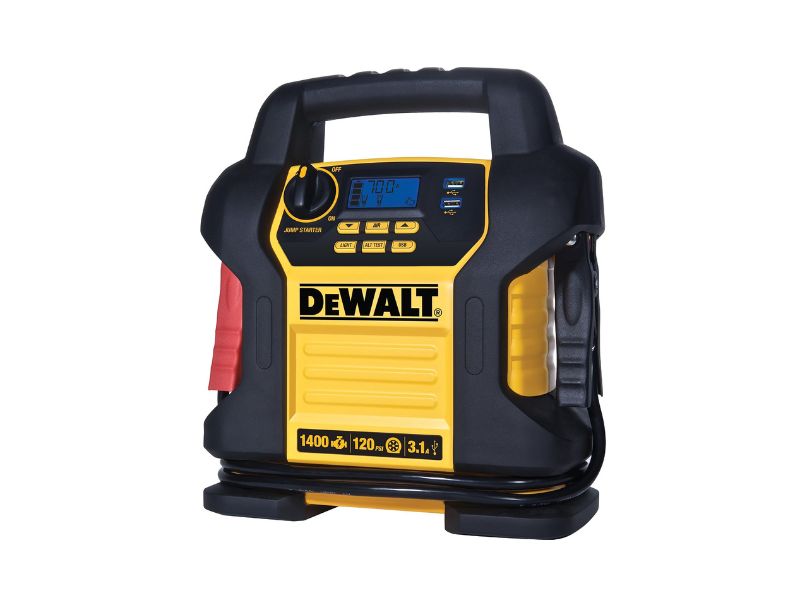
The DEWALT DXAEJ14 is more than a jump starter. It combines a sealed-battery booster, digital tire inflator, USB power source, work light, and basic alternator-check function in one substantial roadside unit.
Its built-in 120-PSI compressor is the principal reason to choose it over the lithium alternatives. A dead battery and a low tire are two of the most common roadside problems, and the DEWALT can address either without an additional power source.
The digital inflator allows the user to select a target pressure and uses an automatic shutoff function when that setting is reached. This reduces the need to repeatedly stop and check pressure during ordinary inflation.
Maximum pressure should not be confused with airflow. A compact integrated compressor may reach 120 PSI, but it will inflate a large tire more slowly than a high-output dedicated compressor. Follow its duty cycle and allow cooling periods to prevent overheating.
The jump starter uses a sealed lead-acid internal battery. This chemistry provides practical sustained output but makes the unit much larger and heavier than a lithium pack. At roughly 17 pounds, it is better suited to a trunk, cargo compartment, truck, or garage than a glove box.
Lead-acid booster batteries also demand regular maintenance charging. The unit should be charged before first use, after every jump or substantial compressor session, and at the interval specified in its instructions during storage.
Leaving a sealed lead-acid booster discharged for months encourages sulfation, permanently reducing capacity. This matters because an emergency power station is often purchased, stored, and forgotten until a breakdown occurs.
A reverse-polarity alarm helps identify an incorrect clamp connection. The output should remain off until the positive and negative connections have been verified.
The basic alternator check can help determine whether the charging system is producing an expected voltage after the engine starts. It is useful for initial screening but cannot replace a complete alternator load test, voltage-drop test, belt inspection, or parasitic-draw diagnosis.
USB outputs can charge a phone or another compatible electronic device. The emergency light illuminates the immediate work area, while the digital display communicates battery condition, compressor pressure, and operating information.
The larger enclosure provides onboard storage for the clamps and compressor hose. Securing these components reduces tangles and protects their connection points, although the entire unit must be restrained during vehicle travel.
The DEWALT is ideal for drivers who prefer one large emergency station instead of separate jump-starting and tire-inflation tools. Its disadvantages are weight, bulk, and the need for disciplined monthly charging. It is less convenient for small vehicles with limited storage.
3. TOPDON JS2000Pro 2000A Jump Starter

Key Features
- 2,000-amp peak output
- Designed for compatible 12-volt vehicle batteries
- Supports gasoline engines up to 8.0 liters
- Supports diesel engines up to 6.0 liters
- Lithium battery construction
- Boost mode for very low battery voltage
- Reverse-polarity protection
- Short-circuit and overcurrent protection
- Overtemperature protection
- Reverse-charge protection
- USB device-charging outputs
- 300-lumen LED flashlight
- Multiple emergency light modes
- Protective EVA carrying case
- Compact roadside storage format
The TOPDON JS2000Pro is a practical alternative for drivers who want broad engine coverage without the size and weight of a traditional power station. Its 2,000-amp peak rating supports gasoline engines up to 8.0 liters and diesel engines up to 6.0 liters.
The lithium battery and compact enclosure make it easier to store in a sedan, crossover, motorcycle luggage compartment, or small emergency kit. This portability improves the chance that the booster will be inside the vehicle when the battery fails.
Its smart-clamp module monitors common electrical problems such as reverse polarity, short circuits, overcurrent, excessive temperature, and reverse charging. These protective functions make ordinary connection more manageable for users without professional roadside experience.
When the vehicle battery falls below the automatic detection threshold, the JS2000Pro may require its boost mode. This forces output to the clamps and should be activated only after polarity and system voltage have been carefully confirmed.
A deeply discharged battery is not necessarily safe to boost. Physical swelling, cracks, leakage, excessive heat, freezing, or an unusual odor are reasons to stop rather than force output.
The bright 300-lumen flashlight distinguishes this model from many small jump packs. It can illuminate the engine bay and provide steady, strobe, or emergency signaling modes. The light should be aimed without placing the booster near moving or hot engine components.
USB outputs allow it to act as an emergency power bank. This function can keep a phone operational while waiting for help, but it reduces available starting energy. The unit should be recharged immediately afterward.
The carrying case helps protect the battery, clamp module, and charging cable. It also makes inspection easier because all parts remain organized in one place.
The JS2000Pro’s compact size comes with shorter cable reach than the Jump-N-Carry. Check the vehicle’s battery location and remote jump points before relying on it. A booster that cannot rest securely while both clamps reach their connection points can be awkward or unsafe to operate.
This model is best for an owner who wants a compact, capable emergency pack for typical personal use. The Jump-N-Carry remains my primary recommendation because its cable and clamp construction provides a stronger overall starting system, while the DEWALT is more versatile for combined battery and tire emergencies.
Emergency Jump Starter Comparison
| Product | Internal Battery | Peak Rating | Additional Starting Rating | Gas Engine Coverage | Diesel Coverage | Cable or Clamp Advantage | Main Extra Function | Approximate Portability |
| Jump-N-Carry JNC325 | Lithium | 2,000A | 450 start-assist amps | Up to 8.0L | Up to 6.0L | 24-in. 6-AWG leads and copper clamps | USB and 12V accessory power | Portable carrying case |
| DEWALT DXAEJ14 | Sealed lead acid | Varies by current production version | Traditional sustained booster output | Suitable for compatible passenger vehicles | Verify application | Integrated heavy clamps | 120-PSI compressor and alternator check | Heavy, about 17 lb |
| TOPDON JS2000Pro | Lithium | 2,000A | Not separately stated | Up to 8.0L | Up to 6.0L | Smart protective clamp module | 300-lumen light and USB power bank | Compact EVA case |
The Jump-N-Carry JNC325 offers the strongest overall combination of starting specifications and cable construction. The DEWALT is the most versatile emergency station but is substantially heavier. The TOPDON is the easiest compact alternative to organize and carry.
Why Every Vehicle Should Have an Emergency Jump Starter
A vehicle battery can fail without much warning. Low temperature, old age, short trips, lights left on, parasitic electrical draw, and charging-system problems can all leave the starter without enough current.
Traditional jumper cables require a second vehicle and enough space to position both vehicles safely. In a parking garage, narrow driveway, roadside shoulder, or isolated location, that arrangement may be impractical.
A self-contained booster offers several advantages:
- No donor vehicle is required.
- There is no risk to another vehicle’s electronics.
- The driver can perform the procedure without moving two cars.
- Smart clamp modules can identify common connection errors.
- USB power may keep a phone operational.
- A flashlight can improve nighttime visibility.
- Some models include a compressor or accessory outlet.
The booster does not eliminate the need to diagnose the original battery failure. It provides temporary starting assistance, not a permanent battery repair.
Portable Lithium Versus Sealed Lead-Acid Jump Starters
Lithium Jump Packs
Lithium jump starters store substantial power in a lightweight enclosure. Their main advantages include:
- Compact dimensions
- Low weight
- High peak output
- USB charging
- Long standby potential
- Electronic safety systems
- Easy personal-vehicle storage
Their limitations include short clamp leads, reduced output in severe cold, heat sensitivity, and eventual lithium-cell aging. They also depend on charge-management electronics that may refuse to operate when the vehicle battery voltage is extremely low.
A lithium pack is usually the most practical emergency choice for a commuter.
Sealed Lead-Acid Power Stations
Traditional power stations use a larger lead-acid battery. Their strengths include:
- More sustained cranking support
- Familiar booster-box operation
- Integrated accessory functions
- Potentially larger clamps
- Useful workshop capability
- Compressor integration on some models
The tradeoffs are weight, bulk, slower charging, and sulfation if stored discharged. A traditional unit demands more frequent charge maintenance.
How to Choose an Emergency Car Battery Jump Starter
Match the Engine Size and Fuel Type
Gasoline and diesel engines have different starting demands. Diesel engines use higher compression and generally require more current.
Choose a product whose published engine coverage meets or exceeds the vehicle’s displacement. For severe cold or an older large engine, select additional output margin instead of buying at the exact stated limit.
Confirm the Vehicle Voltage
The reviewed products are intended for compatible 12-volt systems. They should not be connected to unsupported 24-volt trucks or equipment.
Two batteries under the hood do not automatically indicate 24 volts. Diesel vehicles may connect two 12-volt batteries in parallel to retain a 12-volt system, while commercial vehicles may connect batteries in series.
Follow the vehicle’s jump-starting diagram.
Look Beyond Peak Amperage
Peak amperage describes a brief maximum and can be defined differently among manufacturers. It does not reveal cable resistance, energy capacity, cold-temperature behavior, or sustained cranking ability.
More useful factors include:
- Published engine coverage
- Start-assist or cranking amps
- Internal battery capacity
- Cable gauge
- Cable length
- Clamp construction
- Operating-temperature limits
- Protection systems
- Recharge time
- Storage convenience
Consider Cable Reach
Short cables reduce storage bulk but may be difficult to use on vehicles with hidden batteries or widely separated jump points.
Measure or visually inspect the vehicle’s connection locations before an emergency. The booster should rest securely while both clamps remain properly attached.
Do not suspend the jump starter by its cables.
Evaluate Clamp Quality
Strong spring tension and broad conductive surfaces help establish low-resistance contact. Clamps should open wide enough for the vehicle’s approved posts or terminals.
Protective insulation should cover surfaces the user may touch. Inspect the hinges, springs, cables, and connections regularly.
Prioritize Useful Protection
Helpful protective systems include:
- Reverse-polarity detection
- Short-circuit protection
- Overcurrent protection
- Overvoltage protection
- Overtemperature protection
- Low-temperature protection
- Reverse-charge or backfeed protection
- Automatic timeout
Protection reduces ordinary risk but does not make a damaged battery safe. Forced or manual modes can bypass important safeguards.
Decide Whether You Need a Compressor
A built-in inflator is valuable when the emergency kit must address both dead batteries and low tires.
Consider the compressor’s:
- Maximum pressure
- Airflow
- Duty cycle
- Hose reach
- Automatic shutoff
- Pressure display
- Nozzle storage
- Cooling requirement
A compressor cannot repair a puncture or damaged sidewall. It only adds air.
Assess Power-Bank Functions
Phone charging can be important during an emergency, particularly when roadside service must be contacted. Some jump starters also operate 12-volt accessories.
Using these outputs reduces the starting reserve. Recharge the unit after accessory use.
Choose a Manageable Size
A powerful booster that remains in the garage cannot help during a roadside failure. Select a unit that fits the vehicle and can be secured safely.
Compact lithium packs suit small cars and commuters. Larger power stations suit trucks, SUVs, RVs, and households that value multiple emergency functions.
How to Prepare a Jump Starter Before an Emergency
Charge It Fully
Charge the unit before initial use and follow its maintenance schedule. Do not assume it arrived ready to start a vehicle.
Read the Instructions
Learn how to activate normal and forced-start modes before a stressful situation. Keep the manual in the case or save an offline copy.
Locate the Vehicle Jump Points
Some vehicles have remote terminals because the battery is under a seat, in the trunk, or beneath a cover. Identify these points in daylight.
Inspect the Battery
Know the signs of swelling, leakage, broken posts, and corrosion. A visibly damaged battery should not be boosted.
Practice Clamp Placement
With the booster switched off, confirm that its cables can reach the designated points and that the unit has a safe resting position.
Build a Complete Emergency Kit
Useful companion items include:
- Reflective vest
- Warning triangle or flare alternative
- Safety glasses
- Work gloves
- Flashlight
- Tire-pressure gauge
- Basic first-aid kit
- Ice scraper
- Blanket
- Phone charging cable
- Vehicle owner’s manual
Safe Jump-Starting Procedure
Always follow the product and vehicle instructions. A general process for compatible 12-volt systems is:
- Park safely away from moving traffic when possible.
- Engage the parking brake.
- Shift into Park or Neutral.
- Turn off the ignition and all accessories.
- Inspect the battery for cracks, swelling, leakage, and freezing.
- Confirm that the booster is sufficiently charged.
- Identify the approved positive and ground points.
- Connect the red clamp to the positive point.
- Connect the black clamp to the specified ground point.
- Confirm that the smart-clamp indicator shows a correct connection.
- Activate the jump starter.
- Attempt to start the vehicle within the specified time.
- Limit cranking to the recommended duration.
- Wait between attempts.
- After the engine starts, deactivate the booster if required.
- Remove the black clamp first.
- Remove the red clamp second.
- Keep cables away from fans, belts, and hot surfaces.
- Recharge the jump starter promptly.
Wear eye protection and avoid leaning over the battery. Lead-acid batteries can release explosive gases.
Understanding Manual or Boost Mode
Automatic jump starters check for voltage and proper connection before energizing the clamps. A battery discharged below the detection threshold may appear absent to the booster.
Manual, forced, or boost mode overrides that limitation. Depending on the product, it may disable reverse-polarity or other normal protection.
Before using forced mode:
- Confirm the vehicle uses 12 volts.
- Identify positive and negative points.
- Verify that the clamps are not reversed.
- Inspect the battery for physical damage.
- Ensure the battery is not frozen.
- Keep people away from the battery.
- Follow the exact activation sequence.
- Stop if cables, clamps, or the battery become hot.
Manual mode should not be the default starting method.
When Not to Use a Jump Starter
Do not attempt a jump when:
- The battery is frozen.
- The case is cracked or swollen.
- Electrolyte is leaking.
- The battery is unusually hot.
- The terminals are loose or broken.
- The system voltage is unknown or incompatible.
- The booster has a swollen enclosure.
- Cable insulation is damaged.
- The clamps are burned or corroded.
- Flammable fuel or vapors are present.
- The vehicle has significant flood or collision damage.
- The manufacturer prohibits the proposed procedure.
If uncertain, request professional roadside assistance.
Why the Vehicle May Not Start
Poor Clamp Contact
Corrosion, dirt, paint, and weak clamp positioning restrict current flow. Reconnect to clean approved metal.
Failed Starter
A defective solenoid or starter motor may click without cranking. Additional booster power will not repair it.
Discharged Jump Starter
An emergency pack stored without maintenance may not contain enough energy. Check the charge indicator before connecting.
Damaged Vehicle Battery
An internal short can absorb booster output and create heat. Stop if the battery behaves abnormally.
Fuel or Ignition Failure
If the engine cranks at normal speed but does not start, the fault may involve fuel, spark, compression, sensors, or an immobilizer.
Mechanical Problem
A seized engine or accessory can prevent rotation. Repeated high-current attempts can damage the starter and cables.
Cold-Weather Load
Thick oil and reduced battery output increase the starting requirement. Use the manufacturer-approved winter oil viscosity and a sufficiently rated booster.
Maintenance and Storage
Recharge After Every Use
A single difficult start can remove substantial energy. Recharge the unit before returning it to the vehicle.
Check It Regularly
Inspect lithium packs every one to three months. Check sealed lead-acid boosters more frequently if their instructions require monthly charging.
Avoid Extreme Heat
A closed vehicle can reach damaging temperatures. Store the booster within its permitted range and away from direct sunlight.
Secure the Case
Place the unit where it cannot move during braking or a collision. Do not leave it loose on a seat or cargo floor.
Protect the Ports and Clamps
Keep charging ports covered and prevent clamps from contacting metal tools, coins, or each other.
Inspect for Damage
Remove a unit from service if it develops swelling, leakage, unusual heat, cracked casing, damaged cables, or unreliable charging behavior.
Common Buying Mistakes
Buying by Peak Amps Only
A high peak figure does not guarantee good clamps, cables, capacity, or cold-weather performance.
Ignoring Diesel Compatibility
Large diesel engines generally need substantially more starting current than gasoline engines.
Selecting the Wrong Voltage
A 12-volt booster is not intended for unsupported 24-volt equipment.
Buying a Unit Too Large to Carry
A heavy emergency station may be left at home because it is inconvenient.
Choosing a Tiny Pack With Inadequate Cable Reach
Confirm that the clamps can reach the vehicle’s approved jump points.
Forgetting Maintenance Charging
A neglected booster may be empty when the emergency occurs.
Using It as a Daily Phone Charger
Regular accessory use reduces starting reserve unless the pack is immediately recharged.
Assuming a Compressor Repairs Tires
An inflator cannot fix structural damage or a significant puncture.
Activating Boost Mode Without Checking Polarity
Forced output can bypass safety protection and cause severe damage.
Continuing to Crank Repeatedly
Long attempts can overheat the starter, cables, clamps, and booster.
Frequently Asked Questions
What is the best emergency car battery jump starter?
The Jump-N-Carry JNC325 offers the strongest overall balance for most drivers. Its broad engine coverage, heavy copper clamps, 6-AWG leads, protection systems, and carrying case make it well suited to roadside storage.
How many amps should an emergency jump starter have?
Choose by engine displacement and fuel type rather than peak amps alone. Cable quality, capacity, temperature, and battery condition also influence real starting performance.
Can a 2,000-amp jump starter start a V8?
Yes, when the product’s engine rating includes that V8’s displacement and fuel type. Both lithium options reviewed here support gasoline engines up to 8.0 liters.
Can a portable jump starter charge the car battery?
It normally provides brief cranking assistance rather than a complete battery charge. Use a compatible battery charger to restore a deeply discharged battery properly.
How long should I leave a jump starter connected?
Keep it connected only as long as the product instructions specify. Disconnect it in the correct sequence after the engine starts.
What does boost mode do?
Boost mode energizes the clamps when an extremely discharged battery cannot be detected. Because it may bypass protection, verify polarity and battery condition before activation.
Are lithium jump starters safe?
Yes, when an undamaged unit is used according to its instructions. Protective electronics help, but correct voltage, polarity, ventilation, and battery inspection remain essential.
Can I leave a lithium jump starter in the car?
Yes, if it is secured and stored within the specified temperature range. Check its charge regularly and protect it from moisture, crushing, and prolonged extreme heat.
How often should I recharge the jump starter?
Recharge after every use and check it every one to three months. Traditional sealed lead-acid power stations may require more frequent maintenance charging.
Can I jump-start a completely dead battery?
Possibly, but the booster may require manual or forced-start mode. Confirm that the battery is not frozen, damaged, or internally shorted before applying output.
Can I jump-start a frozen battery?
No, applying high current to a frozen battery can be dangerous. Have it warmed and inspected safely before charging or boosting.
Should the black clamp connect to the negative terminal?
Use the ground point specified in the vehicle owner’s manual. Many vehicles recommend connecting away from the battery to reduce spark risk near battery gases.
Are compressor jump starters worth buying?
Yes, when tire-pressure emergencies are also a priority. The tradeoffs are increased size, weight, slower recharge, and additional maintenance.
Is 120 PSI enough for car tires?
Yes, it exceeds normal passenger-tire pressure requirements. Inflation speed and duty cycle matter more than maximum pressure for ordinary roadside use.
Why does my booster show a polarity warning?
The clamps may be reversed or connected poorly. Switch off the booster, remove both clamps, identify the approved terminals, and reconnect correctly.
Why does the starter click but not turn?
Insufficient current, bad connections, or a failed starter may be responsible. Check the booster charge, clamps, vehicle cables, and starter circuit.
Will a jump starter damage vehicle electronics?
Incorrect voltage, reversed polarity, or improper connection can cause damage. Follow the vehicle’s designated jump-point procedure and avoid unsupported systems.
Do I need to replace the car battery after using a booster?
Not automatically, but the battery and charging system should be tested. Repeated discharge can indicate aging, alternator trouble, parasitic draw, or connection problems.
Can a jump starter power a phone?
Yes, many lithium boosters include USB outputs for emergency device charging. Recharge the pack afterward so it retains enough energy for starting.
What should stay with the jump starter in its case?
Keep the clamps, charging cable, instructions, and necessary adapters together. A phone cable, safety glasses, gloves, and reflective vest also strengthen the roadside kit.
Conclusion
The best emergency car battery jump starter should be powerful enough for the vehicle, easy to store, equipped with dependable clamps, and simple enough to operate during a stressful roadside situation.
The Jump-N-Carry JNC325 remains my primary recommendation for most drivers. Its 2,000-amp peak rating, 450 start-assist amps, 24-inch 6-AWG leads, substantial copper clamps, and support for gas engines up to 8.0 liters and diesels up to 6.0 liters provide a strong overall emergency package.
The DEWALT DXAEJ14 is the better alternative for drivers wanting one substantial power station for both battery and tire emergencies. Its built-in 120-PSI compressor, digital display, USB outputs, light, and alternator check increase versatility, although its weight and monthly charging requirements make it less portable.
The TOPDON JS2000Pro suits buyers who want a compact lithium pack with broad engine compatibility, a bright 300-lumen emergency light, protective clamps, and organized case storage.
Whichever model you select, charge it before placing it in the vehicle and check it regularly. Identify the vehicle’s approved jump points in advance, and never boost a frozen, swollen, cracked, or leaking battery. For the strongest combination of portability, cable quality, and starting capability, I would keep the Jump-N-Carry JNC325 in the vehicle’s emergency kit.