A good ignition coil tester can save a surprising amount of diagnostic time when an engine misfires, runs roughly, or cranks without starting. The challenge is that the term covers several different tools. Some testers detect whether a coil-on-plug unit is being energized, while others create a controlled spark gap so you can evaluate whether the ignition system is producing useful spark.
For most modern automotive troubleshooting, my primary recommendation is the Waekon 76500 Ignition Coil Tester. Its non-contact design is especially convenient when you want to compare coil activity across cylinders without repeatedly disconnecting individual coils.
I would consider the Lisle 20700 Coil-On-Plug Spark Tester when determining spark capability is more important than simply detecting coil activity. Its adjustable spark gap gives you another level of diagnostic information.
The Lisle 20580 In-Line Spark Tester with Coil-On-Plug Wire makes more sense for buyers who want a versatile visual tester that can work with both traditional ignition leads and many recessed coil-on-plug arrangements.
The best ignition coil tester for your situation ultimately depends on your ignition-system layout and what you are trying to prove. A non-contact detector is excellent for quickly identifying an inactive cylinder, while an adjustable spark tester is better when you need to know whether the ignition system can jump a meaningful air gap. Neither approach replaces complete diagnosis when wiring, spark plugs, engine control, fuel delivery, or mechanical problems may also be involved.
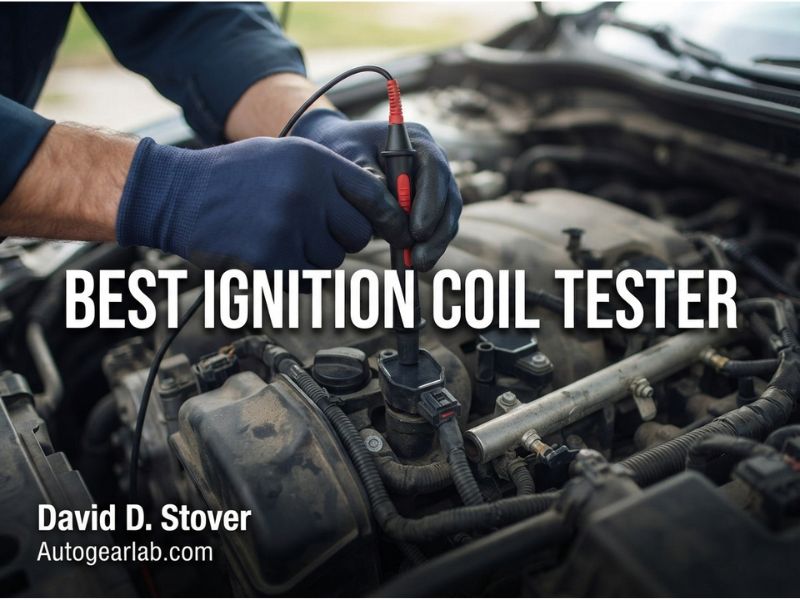
5 Best Ignition Coil Tester Options for Engine Diagnosis
| Image | Product Name | Check Price |
|---|---|---|
Best Choice | Waekon 76500 Ignition Coil Tester | Check Price |
Second Best | Lisle 20700 Coil-On-Plug Spark Tester | Check Price |
Third Choice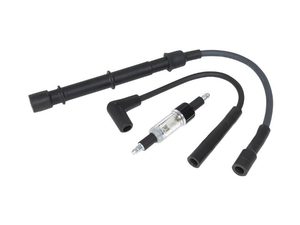 | Lisle 20580 In-Line Spark Tester with Coil-On-Plug Wire | Check Price |
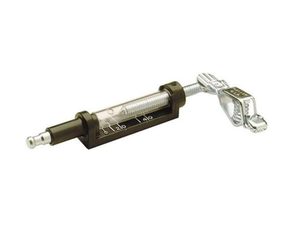 | Thexton THE404 Ignition Spark Tester | Check Price |
 | OTC 6589 Electronic Ignition Spark Tester | Check Price |
1. Waekon 76500 Ignition Coil Tester
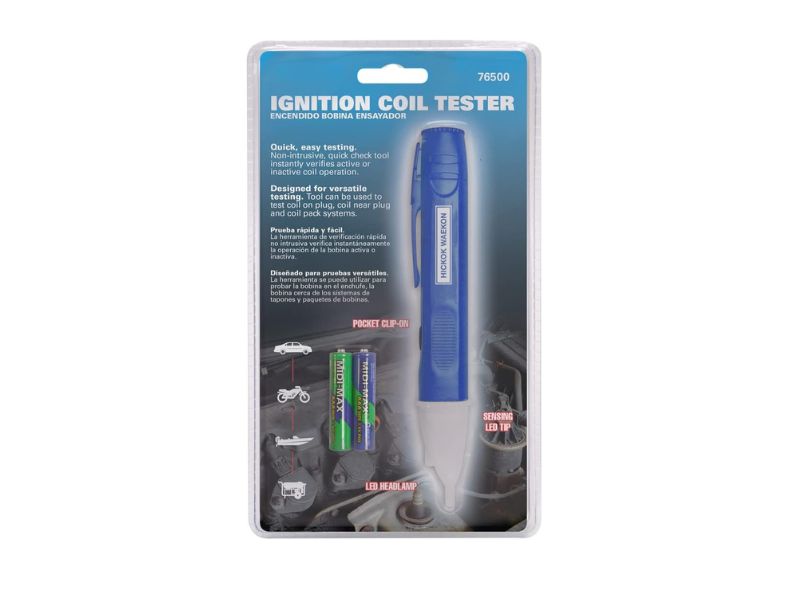
Key Features
- Non-contact magnetic-field detection
- Designed for coil-on-plug, coil-near-plug, and coil-pack systems
- Approximately 300 Gauss / 30 mT sensitivity
- Blue LED firing indication
- Powered by two AAA batteries
- Built-in self-check capability
- Compact handheld format
Detailed Review
The Waekon 76500 is the most directly relevant option here for buyers specifically searching for an ignition coil tester rather than a traditional spark-gap tool. Instead of inserting the tester into the secondary ignition circuit, you position its sensing end near the ignition coil. The tool detects the magnetic activity created as the coil operates.
That approach is particularly useful with coil-on-plug (COP) systems. Modern COP engines often place a separate ignition coil directly above each spark plug. When one cylinder begins misfiring, reaching every plug and installing an inline tester can take additional disassembly. A non-contact detector lets you move from coil to coil relatively quickly and observe whether each unit is producing a firing indication.
This is also useful for comparison testing. If seven coils consistently trigger the tester and one does not, you have found a cylinder that deserves closer inspection. The cause may be the coil itself, but it could also be a connector, wiring, control-circuit, power-supply, or engine-management problem. That distinction is important because the tester identifies ignition activity; it does not automatically identify the failed component.
The approximately 300 Gauss / 30 mT sensitivity helps the tester detect the electromagnetic activity surrounding the coil. A blue LED provides the visual indication, so there is no complicated numerical display to interpret.
Another practical benefit is that you do not have to expose a high-voltage spark gap simply to determine whether a coil is operating. For a quick initial check on a crowded engine bay, I prefer that simplicity.
The limitation is equally important. Detecting magnetic activity does not prove that the spark plug is receiving enough voltage to fire reliably under cylinder pressure. A coil can potentially produce an observable firing event yet still be involved in an intermittent or load-related misfire. If the Waekon indicates that a questionable coil is active, diagnosis may need to continue with a spark-gap tester, known-good coil substitution, scan-tool data, wiring checks, or waveform analysis.
For technicians and serious DIY users working mainly on late-model gasoline vehicles, however, the Waekon 76500 provides a fast and practical first step.
What I Like
- Non-contact design reduces unnecessary disassembly.
- Works naturally with many modern COP and CNP ignition layouts.
- Makes cylinder-to-cylinder comparison fast.
- Simple LED indication requires little interpretation.
What I Do Not Like
- It does not directly show actual spark at the plug.
- It cannot by itself prove that a coil is strong enough under engine load.
- Additional testing may still be required before condemning an ignition coil.
Verdict
The Waekon 76500 is my primary recommendation because it matches the ignition-coil diagnostic intent particularly well. I would choose it when the main goal is quickly identifying whether individual COP, CNP, or compatible coil-pack units are operating before moving into deeper diagnosis.
2. Lisle 20700 Coil-On-Plug Spark Tester
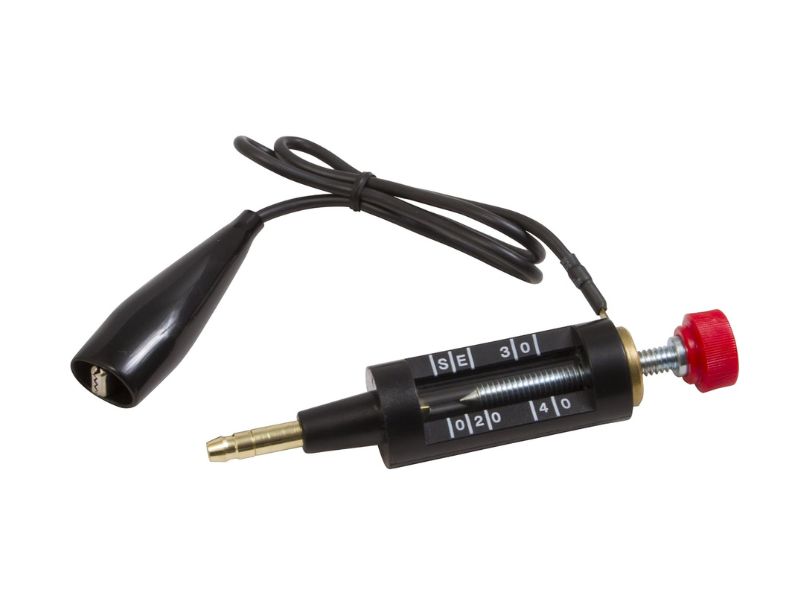
Key Features
- Designed around coil-on-plug ignition diagnosis
- Adjustable spark gap
- Marked 0–40k scale
- Approximately 12-inch ground lead
- Shielded grounding clip
- High-visibility gap area
- Suitable for comparative spark testing
Detailed Review
The Lisle 20700 approaches ignition diagnosis differently from the Waekon. Rather than detecting the coil’s magnetic field, it creates a physical air gap that the ignition system must jump.
That matters because producing a spark across a controlled gap requires the ignition system to develop sufficient voltage. Increasing the tester gap increases the electrical challenge, making an adjustable tester useful when you want more information than a simple yes-or-no firing indication.
The tool has markings extending from 0 to 40k. Those markings should be treated as a practical spark-gap reference rather than as a precision measurement of actual coil output voltage. This is an important distinction. An adjustable spark tester can help compare ignition performance, but it is not the same thing as connecting laboratory equipment and directly measuring the full secondary ignition waveform.
The Lisle 20700 is especially useful when dealing with a no-start condition. If an engine has appropriate fuel delivery and mechanical integrity but will not start, confirming spark is one of the basic diagnostic steps. A properly connected spark tester allows you to determine whether the ignition system can create a visible spark without using unsafe improvised methods.
The longer grounding lead also helps when the coil or plug well sits in a difficult location. You still need a clean and reliable engine ground, but you have more freedom to position the tester where the spark can be observed safely.
I also like the adjustable design for cylinder comparison. For example, if several known-good cylinders consistently jump a chosen gap and one suspect cylinder does not, that difference gives you useful information. It still does not prove that the coil itself is solely responsible, but it narrows the investigation.
There is more setup involved than with a non-contact detector. You are intentionally working with the secondary ignition output, so grounding and positioning matter. The tester and leads must also be kept away from belts, pulleys, cooling fans, hot exhaust components, and fuel vapor.
What I Like
- Adjustable gap gives more diagnostic information than a simple firing indicator.
- Purpose-built for many coil-on-plug systems.
- Ground lead improves positioning flexibility.
- Useful for both no-spark and comparative ignition checks.
What I Do Not Like
- Requires more setup than a non-contact tester.
- Marked gap scale should not be mistaken for laboratory-grade voltage measurement.
- Proper grounding and high-voltage safety are essential.
Verdict
I would choose the Lisle 20700 when spark capability matters more than rapid non-contact screening. It is especially useful for buyers who want to challenge a COP ignition system across an adjustable gap instead of simply confirming that a coil is being energized.
3. Lisle 20580 In-Line Spark Tester with Coil-On-Plug Wire
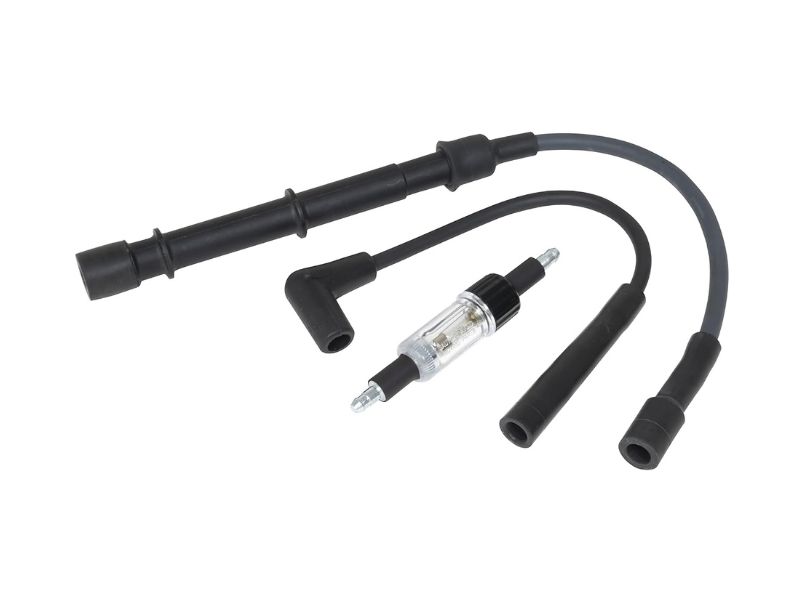
Key Features
- Inline spark-testing design
- Works with conventional ignition leads
- Includes coil-on-plug extension capability
- Approximately 7-inch COP extension lead
- Straight and 90-degree connection options
- Visual flashing indication
- No battery required
Detailed Review
The Lisle 20580 fills the gap between a traditional inline spark tester and a tool suitable for modern coil-on-plug layouts. That makes it a useful option for a garage that works on a mixture of older vehicles, newer cars, trucks, motorcycles, and other gasoline engines.
An inline tester is installed in the ignition path. During cranking or operation, the tester provides a visible indication each time the ignition event occurs. That can make an intermittent firing pattern easier to notice than when you are relying entirely on engine sound.
The included coil-on-plug extension wire is particularly useful because COP coils are frequently buried in deep spark-plug wells. A conventional inline tester designed only for exposed spark plug wires may be awkward or impossible to connect in those situations. The additional lead expands the range of applications without requiring a separate tester for every ignition layout.
Straight and 90-degree boot arrangements also help with packaging. Engine compartments differ considerably, and a connection that works easily on an exposed longitudinal engine may not work as well on a tightly packaged transverse engine.
Unlike an electronic detector, the Lisle 20580 does not require batteries. That is useful for a tool that may spend weeks or months in a toolbox between jobs.
Its main limitation is that the flashing indication is still fundamentally a visual representation of ignition activity. It does not provide a numerical secondary-voltage reading, and it does not create the same adjustable challenge as a dedicated variable-gap tester.
I would therefore view this as a flexible general-purpose ignition troubleshooting tool rather than the most specialized instrument for evaluating weak coil output.
For buyers who maintain several types of gasoline-powered equipment, however, that versatility is exactly what makes the 20580 attractive.
What I Like
- Useful with both traditional and many COP ignition arrangements.
- Extension wire helps with recessed spark-plug wells.
- No batteries are required.
- Straight and angled connection options improve versatility.
What I Do Not Like
- Visual activity does not necessarily prove strong spark under load.
- It lacks an adjustable spark gap.
- Some engine layouts may still require additional adapters or access work.
Verdict
The Lisle 20580 is a sensible choice when versatility matters more than specialized COP-only diagnosis. I prefer it for a mixed garage where one tester may need to handle both older spark-plug-wire systems and modern recessed coils.
4. Thexton THE404 Ignition Spark Tester
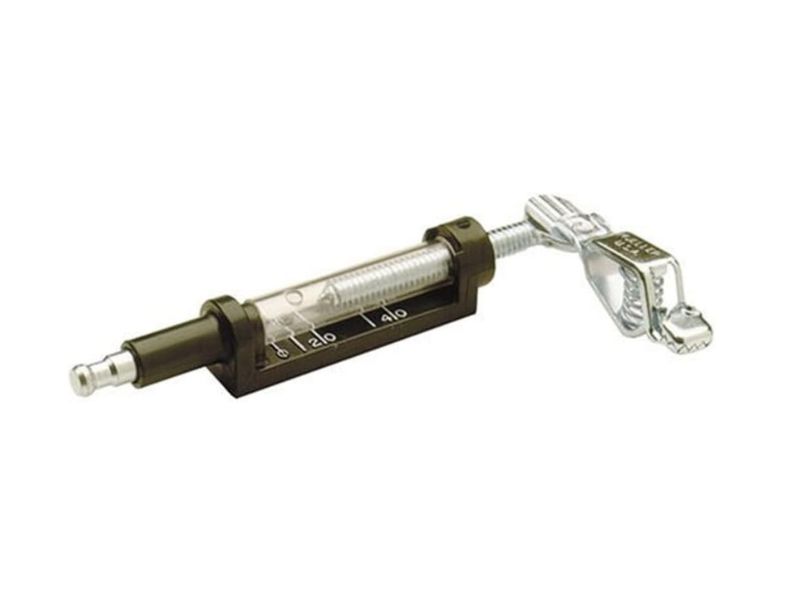
Key Features
- Adjustable spark-gap design
- Marked range up to approximately 40,000 volts
- Visible gap area
- Screw-style adjustment
- Grounding clip
- Protective shielding around spark area
- Useful for automotive and compatible small-engine applications
Detailed Review
The Thexton THE404 is a traditional adjustable spark tester built around one straightforward concept: force the ignition system to jump a defined air gap and observe the result.
This design has been useful for decades because it provides more information than simply holding a spark plug near ground. More importantly, a dedicated tester is a much more controlled diagnostic method than intentionally creating an open high-voltage arc with improvised tools.
The adjustable mechanism allows you to vary the air gap. A larger gap generally requires more voltage to bridge, so comparison testing can help expose an ignition system that produces a weak spark relative to known-good cylinders.
The marked scale extends toward 40,000 volts, but the same caution applies as with other adjustable spark testers: the marking is a practical reference related to gap size. It should not be interpreted as a precise measurement of the actual secondary voltage generated by the ignition coil under every operating condition.
The high-visibility gap area makes the spark easier to see, while the grounding clip allows the tester to be secured to an appropriate engine ground.
This model makes the most sense when you are comfortable making a physical ignition connection and want an inexpensive tool that can be used on different gasoline engines. It can also be useful around lawn equipment, motorcycles, and other engines when the ignition arrangement permits a safe connection.
Where it falls behind the first three products is convenience on modern COP systems. Deep plug wells, short coil boots, unusual coil assemblies, and crowded engine compartments can make a conventional adjustable tester less straightforward to connect.
That does not make the Thexton ineffective. It simply means that buyers working almost exclusively on modern coil-on-plug vehicles may appreciate a more specialized tool.
What I Like
- Adjustable gap allows comparative spark-strength testing.
- Simple design has few components to manage.
- Highly visible test area improves observation.
- Useful across several gasoline-engine applications.
What I Do Not Like
- Less convenient for some recessed COP systems.
- Requires a secure ground connection.
- Gap markings are not a substitute for detailed waveform analysis.
Verdict
The Thexton THE404 is a practical adjustable spark tester for buyers who value simplicity and broad gasoline-engine usefulness. I would consider it when direct spark-gap testing is the priority and specialized non-contact COP detection is unnecessary.
5. OTC 6589 Electronic Ignition Spark Tester
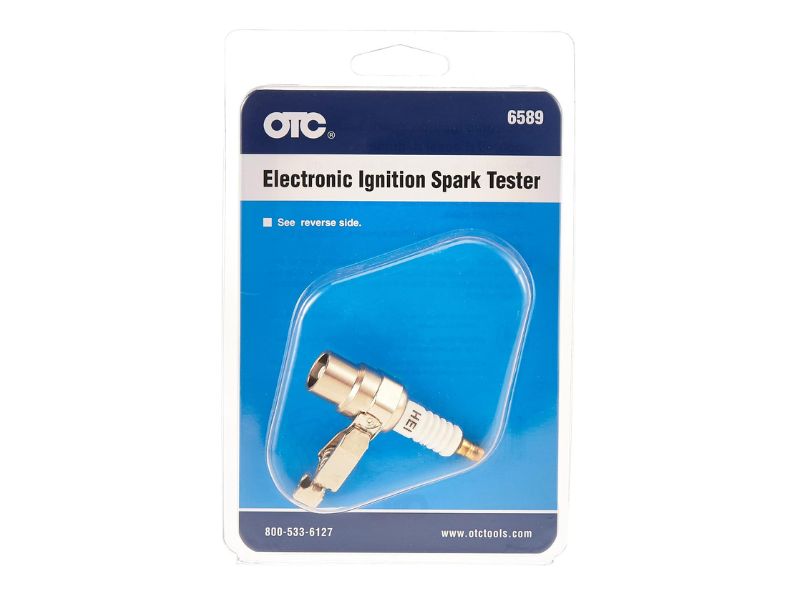
Key Features
- Fixed-gap ignition spark tester
- Approximately 0.250-inch preset gap
- Intended for gasoline ignition systems
- Grounding clamp
- Visible spark test
- No complex adjustments
- Suitable for straightforward no-spark checks
Detailed Review
The OTC 6589 is the simplest tool in this group. Instead of giving you an adjustable air gap or non-contact electronic sensing, it uses a fixed gap of approximately 0.250 inch.
That fixed design is useful when you primarily want a straightforward answer to a basic diagnostic question: is the ignition system producing a visible spark through a meaningful test gap?
Because there is no adjustment mechanism, setup is relatively simple. Connect the tester correctly, secure the grounding clamp to an appropriate engine ground, position the tool where it can be observed safely, and crank the engine according to the applicable service procedure.
This is particularly useful for a crank-no-start diagnosis. If there is no spark, you know the ignition system requires additional investigation. That investigation may involve the coil, coil power supply, ignition module, crankshaft-position signal, control wiring, engine computer command, or another part of the system.
The fixed gap also reduces interpretation. You are not trying to decide which air-gap setting to use or what a particular scale means.
The tradeoff is reduced flexibility. An adjustable tester allows you to progressively increase the challenge to the ignition system or compare performance at different gaps. The OTC 6589 cannot do that.
It is also less specialized for modern COP layouts. Depending on the engine, access and connection can be less convenient than with a COP-specific lead or non-contact detector.
For basic troubleshooting on compatible gasoline engines, however, a fixed-gap spark tester can still be a valuable toolbox item because it provides a controlled alternative to improvised spark-testing methods.
What I Like
- Very simple testing procedure.
- Fixed gap eliminates adjustment guesswork.
- Useful for basic crank-no-start troubleshooting.
- Few parts and no complicated interface.
What I Do Not Like
- Fixed gap provides less diagnostic flexibility.
- Not the most convenient tool for every COP engine.
- Does not provide detailed information about intermittent or load-related ignition faults.
Verdict
The OTC 6589 works best for buyers who want a straightforward physical spark check without adjustable settings. It ranks fifth because the other tools provide greater COP convenience or diagnostic flexibility, but its simplicity can still be useful for basic gasoline-engine troubleshooting.
Ignition Coil Tester Comparison
| Product | Tester Type | COP Support | Testing Method | Gap Type | Indicator | Power | Grounding | Main Strength | Main Limitation |
| Waekon 76500 Ignition Coil Tester | Non-contact detector | Strong | Magnetic-field sensing | Not applicable | LED | 2 AAA batteries | Not normally required for sensing | Fast coil-to-coil comparison | Does not directly prove spark strength |
| Lisle 20700 Coil-On-Plug Spark Tester | Adjustable spark tester | Strong | Physical spark-gap test | Adjustable | Visible spark | None | Required | Tests ability to jump a controlled gap | More setup required |
| Lisle 20580 In-Line Spark Tester with Coil-On-Plug Wire | Inline tester | Good | Inline ignition activity | Fixed internal visual test | Flashing/visible indication | None | Depends on setup | Versatility across ignition layouts | No adjustable gap |
| Thexton THE404 Ignition Spark Tester | Adjustable spark tester | Application-dependent | Physical spark-gap test | Adjustable | Visible spark | None | Required | Simple comparative spark testing | Less convenient in deep COP wells |
| OTC 6589 Electronic Ignition Spark Tester | Fixed-gap spark tester | Application-dependent | Physical spark-gap test | Fixed | Visible spark | None | Required | Straightforward no-spark testing | Limited diagnostic adjustment |
The most important difference is not brand or appearance; it is what the tool actually proves.
The Waekon is the easiest choice when your priority is determining whether individual coils are being activated. The Lisle 20700 and Thexton THE404 are more appropriate when you want the ignition system to jump a controlled external gap. The Lisle 20580 favors versatility, while the OTC 6589 favors simplicity.
How I Would Choose an Ignition Coil Tester
I would start with the vehicle’s ignition architecture.
For a modern engine with one coil mounted directly on each spark plug, I prefer a tool designed specifically around coil-on-plug diagnosis. That usually means either a non-contact detector or a COP-compatible spark tester.
For a no-start problem where I need to prove usable secondary ignition output, I prefer a physical spark tester.
For a mixed garage containing older vehicles, motorcycles, lawn equipment, and modern cars, versatility becomes more important.
I also consider what the tester cannot prove. A good diagnostic tool should narrow the problem efficiently, but no single inexpensive ignition tester can conclusively diagnose every weak-coil, wiring, spark-plug, control-module, or engine-management fault.
How to Choose the Right Ignition Coil Tester
Identify Your Ignition System First
Before buying a tester, identify how your engine generates and distributes spark.
Older vehicles may use a distributor and high-voltage spark-plug wires. Later systems often use a distributorless ignition system, with one coil serving two or more cylinders. Many modern engines use coil-on-plug, where each cylinder has its own coil mounted directly over the spark plug.
Some engines use coil-near-plug configurations, where an individual coil sits close to the plug but still uses a short high-voltage lead.
The physical layout matters because not every tester connects easily to every ignition design.
Non-Contact COP Tester vs Spark Tester
A non-contact tester detects electromagnetic activity around an energized ignition coil. It is fast and convenient because the tester may not need to be inserted into the ignition circuit.
This type is useful for identifying an inactive coil or comparing firing activity between cylinders.
A spark tester physically places a test gap or indicator in the secondary ignition path. It tells you more directly whether the ignition system is producing spark.
Neither method is universally superior. They answer slightly different questions.
Adjustable Gap vs Fixed Gap
An adjustable spark tester allows you to change the distance the spark must jump.
A wider gap generally requires more voltage, so the tool can help you compare ignition strength between cylinders or determine whether the system can overcome a more demanding test condition.
A fixed-gap tester is simpler. You connect it and observe whether spark crosses the preset gap.
For occasional troubleshooting, fixed-gap simplicity can be attractive. For deeper comparative diagnosis, I prefer adjustability.
Compatibility With Recessed Coil-On-Plug Systems
Modern cylinder heads frequently position the spark plug at the bottom of a narrow well.
The ignition coil may have a long rubber boot that extends deep into that well. A standard spark tester may not connect conveniently.
This is where tools with dedicated COP adapters, extension leads, or non-contact sensing become useful.
Before choosing a tester, look at the actual coil arrangement on the engines you expect to service.
Visual Indicators vs Electronic Detection
Most ignition testers communicate results using either a visible spark, a flashing light, or an electronic LED.
A bright electronic indicator is convenient in daylight and crowded engine compartments.
A visible spark gap gives more direct information about secondary ignition output, especially when the gap is adjustable.
The tradeoff is that spark-gap testing requires more careful grounding and positioning.
Consider the Fault You Are Diagnosing
Different symptoms call for different diagnostic approaches.
For a completely dead cylinder, a non-contact detector can quickly show whether the coil is receiving a firing event.
For a crank-no-start condition, a physical spark tester is often more informative because you need to know whether usable spark is present.
For a misfire that appears only during hard acceleration, towing, or high engine load, a basic spark tester may not reproduce the exact conditions under which the fault occurs. More advanced diagnosis may be needed.
Ease of Setup and Access
Simple tools are often used more consistently.
If installing the tester requires removing numerous engine components, you may prefer a non-contact detector for your first diagnostic pass.
If access is easy, an adjustable spark tester may provide more useful information without adding much work.
Also consider cable length, grounding-lead length, connector angle, and whether you can position the indicator where it remains visible during cranking.
Build Quality and Grounding Hardware
A spark tester is exposed to high secondary ignition voltage, engine heat, oil, dirt, and frequent handling.
Look for secure insulation, a firm adjustment mechanism where applicable, a reliable grounding clamp, and connectors that fit tightly.
A poor ground can create misleading results, so grounding hardware is more important than it may appear.
What an Ignition Coil Tester Can—and Cannot—Tell You
An ignition tester is most useful when you understand its limitations.
A non-contact coil tester can indicate that an ignition event is occurring. That is valuable information, but it does not automatically prove that the spark plug is firing correctly inside the cylinder.
A physical spark tester can prove that the ignition system is capable of jumping an external air gap. That is stronger evidence, but the environment outside the combustion chamber differs from the environment inside a running engine.
Cylinder pressure increases the voltage required to fire a spark plug. A coil may appear acceptable during a light external test yet fail during high-load operation.
Similarly, a tester showing no spark does not automatically mean the ignition coil itself has failed. The coil may be missing battery power, ground, or a control signal. The engine-control system may also be withholding ignition because a crankshaft or camshaft position signal is absent.
A complete diagnosis therefore considers:
- Coil activity
- Secondary spark
- Spark-plug condition
- Coil boot condition
- Electrical connectors
- Power and ground
- Control signals
- Scan-tool fault codes and data
- Cylinder compression
- Fuel delivery
Use an ignition coil tester to narrow the problem, not to replace diagnostic reasoning.
Ignition Coil Tester vs Multimeter
An ignition coil tester and a digital multimeter serve different purposes.
A multimeter can measure resistance, voltage, continuity, and other electrical values. On ignition systems where resistance specifications are provided, checking primary or secondary winding resistance may reveal an open circuit or an obvious internal fault.
However, a resistance reading is a static test.
An ignition coil operates under high voltage, temperature, vibration, and rapidly changing electrical conditions. A winding may measure within an expected resistance range and still fail intermittently during actual engine operation.
A spark tester evaluates the ignition system dynamically by requiring it to produce a spark.
A non-contact COP detector evaluates whether a firing event is occurring around the coil.
For that reason, I would not choose between a multimeter and an ignition tester as though one replaces the other. A more complete toolbox uses them for different diagnostic questions.
A multimeter is useful for checking power supply, ground integrity, continuity, and certain coil specifications. An ignition tester is better for confirming whether ignition activity or secondary spark is actually occurring.
Ignition Coil Tester vs Oscilloscope
An automotive oscilloscope provides much more detailed ignition information than a basic handheld tester.
With the proper probe and setup, a scope can display ignition waveforms that reveal charging time, firing voltage behavior, burn time, oscillations, and cylinder-to-cylinder differences.
That level of information can be extremely useful when diagnosing intermittent misfires, weak coils, control problems, or faults that only appear under particular operating conditions.
The drawback is complexity.
Oscilloscopes require more knowledge, more setup, and usually more expensive equipment. For many DIY repairs and routine no-spark checks, starting with a simple ignition tester is far more practical.
I see the tools as different diagnostic levels rather than competitors.
How to Test an Ignition Coil Safely
Ignition systems can generate tens of thousands of volts. The current available from the secondary system is limited, but contact can still cause painful shock and can create additional hazards around moving machinery or combustible vapor.
Start by reviewing the correct service procedure for the specific vehicle.
Turn the engine off before installing or repositioning a physical tester. Once the tool is connected, make sure it cannot fall into belts, pulleys, fans, or other moving components.
When a spark tester requires a ground, attach the clamp to a clean and suitable engine ground. Poor grounding can create weak or inconsistent spark and lead to an incorrect diagnosis.
Keep ignition-testing equipment away from:
- Fuel leaks
- Open fuel containers
- Fuel vapor
- Battery vent areas
- Extremely hot exhaust components
- Accessory belts
- Cooling fans
- Pulleys
Do not create an improvised test by holding a disconnected ignition lead in your hand while someone cranks the engine.
If you are using a non-contact detector, follow the recommended sensing position rather than pressing the tool randomly against electrical connectors or exposed conductors.
When comparing cylinders, use the same test method and similar conditions for each cylinder. Consistency makes the comparison more meaningful.
After testing, reinstall all coil connectors, boots, covers, and fasteners correctly before operating the vehicle normally.
Maintaining an Ignition Coil Tester
Ignition testers require relatively little maintenance, but a few habits help keep results consistent.
Wipe oil and dirt from insulated surfaces after use. Contamination can make a tool harder to inspect and, in severe cases, can contribute to unwanted electrical tracking.
Inspect test leads for:
- Cuts
- Cracks
- Hardened insulation
- Loose terminals
- Damaged boots
Check grounding clips for corrosion and weak spring tension.
For battery-powered electronic testers, remove old batteries if the tool will be stored for a long period. Battery leakage can damage a tool that would otherwise last for years.
Store adjustable spark testers with the adjustment mechanism clean and dry. Avoid forcing the screw or knob beyond its normal travel.
Most importantly, replace a tester if the insulation or housing is damaged. High-voltage diagnostic equipment is not a good place for temporary repairs involving damaged leads or cracked plastic.
Common Ignition-Coil Testing Mistakes
Assuming Any Visible Spark Means the Coil Is Healthy
A spark can be present while the coil still performs poorly under cylinder pressure or heavy engine load.
Treat a basic spark test as evidence, not absolute proof.
Replacing the Coil Before Checking the Circuit
If a coil does not fire, verify the relevant power supply, connector condition, wiring, ground, and control signal before automatically installing another coil.
Ignoring the Spark Plug
A worn, fouled, cracked, or incorrectly gapped spark plug can cause symptoms similar to a weak ignition coil.
Ignoring the Coil Boot
Carbon tracking, moisture, damaged insulation, or a deteriorated spring inside the boot can cause misfires even when the coil itself is functional.
Using the Wrong Tester for the Ignition Layout
A traditional tester can be inconvenient on a deeply recessed COP engine. A non-contact detector may be easier for initial diagnosis.
Confusing Tester Gap With Spark-Plug Gap
The gap on an adjustable ignition tester is a diagnostic air gap. It is not a replacement specification for the actual spark plug.
Testing With a Poor Ground
A weak or unstable ground can produce misleading results. Connect physical spark testers exactly as intended.
Creating an Open Spark Near Fuel Vapor
Spark testing must never be performed near leaking gasoline or concentrated fuel vapor.
Treating Every Misfire as an Ignition Problem
Fuel injectors, vacuum leaks, compression problems, valve issues, wiring faults, and engine-control problems can all produce misfire symptoms.
Relying on Resistance Testing Alone
A coil can pass a static resistance check and still fail under operating conditions. Use resistance results as one part of the diagnosis.
Frequently Asked Questions
What is the best ignition coil tester for coil-on-plug engines?
A non-contact COP detector is one of the fastest options for initial coil comparison.
For modern engines with individual coils mounted directly over the spark plugs, a tester such as the Waekon 76500 can quickly show whether each coil is producing detectable ignition activity. If you also need to assess the system’s ability to jump a controlled spark gap, an adjustable COP-compatible spark tester such as the Lisle 20700 provides additional diagnostic information.
Can an ignition coil tester tell me whether a coil is bad?
It can identify suspicious ignition behavior, but it may not conclusively prove the coil itself is faulty.
A missing firing indication or lack of spark can result from a failed coil, but it can also come from missing power, a wiring fault, connector damage, an absent trigger signal, or another control-system problem. The best diagnostic approach combines tester results with circuit checks and other evidence before replacing the coil.
How does a non-contact ignition coil tester work?
It senses the electromagnetic field created when an ignition coil is energized.
When current flows through the coil and the ignition event occurs, the changing magnetic field can be detected without placing the tool directly in the high-voltage secondary circuit. The tester then provides a visual indication, usually an LED. This makes non-contact testing especially convenient for comparing individual coil-on-plug units quickly.
What is the difference between a coil tester and a spark tester?
A coil detector senses ignition activity, while a spark tester verifies actual secondary spark.
The terminology is sometimes used interchangeably, which causes confusion. A non-contact coil tester may detect whether the coil is firing without exposing the spark. A physical spark tester installs into the ignition path and requires the system to create a spark across a gap or internal indicator. Each approach provides different diagnostic information.
Can I test an ignition coil without removing it?
Yes, many coil-on-plug systems can be checked without completely removing the ignition coil.
A non-contact tester may detect ignition activity while the coil remains installed. Depending on engine design, an inline or adjustable spark test may require disconnecting or partially removing the coil so the tester can be connected safely. Always use a procedure appropriate for the specific ignition system rather than forcing a connector or boot.
Can I use a spark tester on a coil-on-plug ignition system?
Yes, but the tester must connect correctly to the specific coil-on-plug arrangement.
COP systems often place the coil boot deep inside the cylinder head, so ordinary plug-wire testers may not fit conveniently. A COP-specific tester or an extension lead can make the connection much easier. Make sure the tool is properly grounded when required and keep all leads away from moving or hot engine components.
Is an adjustable spark tester better than an inline tester?
An adjustable tester provides more spark-strength information, while an inline tester is usually simpler.
By increasing the external gap, an adjustable tester can place a greater electrical demand on the ignition system and help compare cylinders. An inline tester is useful for quickly determining whether ignition events are occurring. Which is better depends on whether your priority is simple spark confirmation or a more demanding comparative test.
Can an ignition coil tester detect a weak coil?
Sometimes, but basic testers cannot identify every weak-coil condition.
An adjustable spark tester may expose a coil that cannot consistently jump the same gap as known-good cylinders. A non-contact detector may reveal missing or irregular firing activity. However, coils can fail only when hot or under high engine load. Those faults may require deeper diagnosis, including scan data, substitution testing, or waveform analysis.
Can I test an ignition coil with a multimeter instead?
A multimeter can test certain electrical characteristics, but it does not replace dynamic ignition testing.
Resistance measurements may reveal an open winding or an obviously abnormal coil where applicable. A multimeter is also useful for checking power supply, ground, and wiring. However, a coil may have acceptable static resistance and still fail while producing high-voltage spark. For that reason, a multimeter and ignition tester are complementary tools.
What does no spark on an ignition tester mean?
It means the tested ignition path is not producing the expected spark during that test.
The ignition coil may be defective, but do not assume it is the only possible cause. Check whether the coil has the correct power supply, ground where applicable, control signal, and secure electrical connections. Engine-position sensors and control-module decisions can also affect whether the coil is commanded to fire.
Does a visible spark always mean the ignition coil is good?
No, a coil can produce visible spark yet still misfire under real engine load.
Cylinder pressure makes the spark plug harder to fire than an open-air test gap under some conditions. Heat can also expose internal coil faults that are not obvious when the engine is cold. If a vehicle misfires only during acceleration or after warming up, further diagnosis may be needed even when a basic spark test looks normal.
Can a bad spark plug look like a failed ignition coil?
Yes, worn or damaged spark plugs can create symptoms that closely resemble coil failure.
A worn electrode increases the voltage required to fire the plug. Fouling, cracks, incorrect gap, or contamination can also cause misfires. Before replacing an ignition coil, inspect the spark plug and coil boot whenever access allows. On engines with identical coils, a controlled coil-swap test can also help determine whether the misfire follows the coil.
Is it safe to test an ignition coil while the engine is running?
Some tests are performed with the engine running, but high-voltage and moving-component precautions are essential.
Non-contact testers may be designed specifically for observation during engine operation. Physical spark testers may be used during cranking or running depending on the procedure. Never touch ignition components while they are energized, and keep tools, clothing, hands, and leads away from cooling fans, pulleys, belts, exhaust parts, and fuel vapor.
Can the same ignition tester be used on cars, motorcycles, and small engines?
Many spark testers can work across several gasoline engines when the ignition connection is compatible.
Traditional adjustable and fixed-gap testers are often useful for cars, motorcycles, lawn equipment, and other spark-ignition engines. Modern automotive COP systems may require dedicated adapters or a non-contact tester. Compatibility depends more on the ignition-system layout and connection method than simply on the type of vehicle.
Conclusion
Choosing the best ignition coil tester becomes easier once you decide what you actually need the tool to confirm.
My primary recommendation remains the Waekon 76500 Ignition Coil Tester for modern automotive troubleshooting because its non-contact design makes it particularly convenient for comparing coil-on-plug, coil-near-plug, and compatible coil-pack activity without unnecessary disassembly.
The Lisle 20700 Coil-On-Plug Spark Tester is the stronger alternative when you want an adjustable physical spark gap and more information about the ignition system’s ability to produce usable secondary output.
I would choose the Lisle 20580 In-Line Spark Tester with Coil-On-Plug Wire for a mixed garage where compatibility with both conventional ignition leads and recessed COP systems matters. The Thexton THE404 is a useful adjustable traditional spark tester, while the OTC 6589 suits straightforward fixed-gap spark checks.
Whichever tester you choose, remember that ignition diagnosis involves more than simply finding spark. Check plugs, boots, connectors, coil power, control signals, and mechanical condition before replacing expensive components.
For the broadest range of modern COP diagnostic work, I would start with the Waekon 76500 and add an adjustable spark tester when deeper secondary-ignition testing is required.