Finding the best oxygen sensor cleaner can be confusing because most products in this category are not sprays that you apply directly to the O2 sensor. They are fuel additives designed to travel through the fuel and combustion system, helping reduce carbon, soot, and oily deposits that may affect oxygen sensors, catalytic converters, fuel injectors, EGR valves, and other emissions-related components.
Choosing the wrong product or expecting too much from an additive can waste both time and money. A cleaner may help when light deposit buildup is affecting emissions performance, but it cannot repair a broken sensing element, failed heater circuit, damaged connector, exhaust leak, melted catalytic converter, or faulty wiring.
Keeping these limitations in mind, I selected five products available through Amazon US and compared their compatibility, bottle size, treatment coverage, application process, preventive-maintenance value, and overall usefulness. The products include formulas for gasoline, hybrid, diesel, and flex-fuel vehicles, so checking the label before use is essential.
If you do not have time to read every review, I recommend the Cataclean Fuel and Exhaust System Cleaner as my best overall option for compatible gasoline vehicles. Its formula is marketed to reduce carbon buildup across the fuel and exhaust systems, including the oxygen sensors and catalytic converter.
Below, I review five of the best O2 sensor cleaner products and explain which type of vehicle or maintenance situation each one suits best.
Read More : Best O2 Sensors for Fuel Economy and Performance
5 Best Oxygen (O2) Sensor Cleaner
| Image | Product Name | Check Price |
|---|---|---|
Best Choice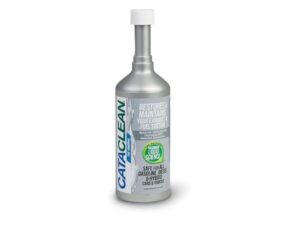 | Cataclean Fuel and Exhaust System Cleaner | Check Price |
Second Best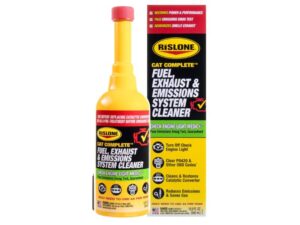 | Rislone Complete Fuel, Exhaust and Emissions System Cleaner | Check Price |
Third Choice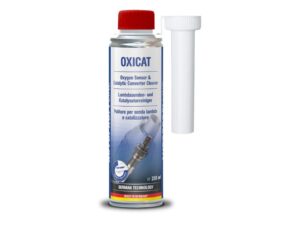 | AUTOPROFI OXICAT Oxygen Sensor and Catalytic Converter Cleaner | Check Price |
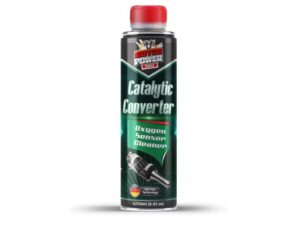 | MotorPower Care Catalytic Converter and Oxygen Sensor Cleaner | Check Price |
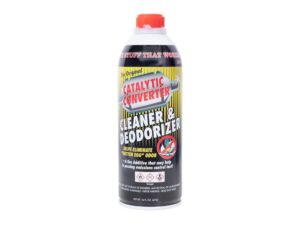 | Solder-It CAT-1 Catalytic Converter Cleaner and Deodorizer | Check Price |
1. Cataclean Fuel and Exhaust System Cleaner – Best Overall
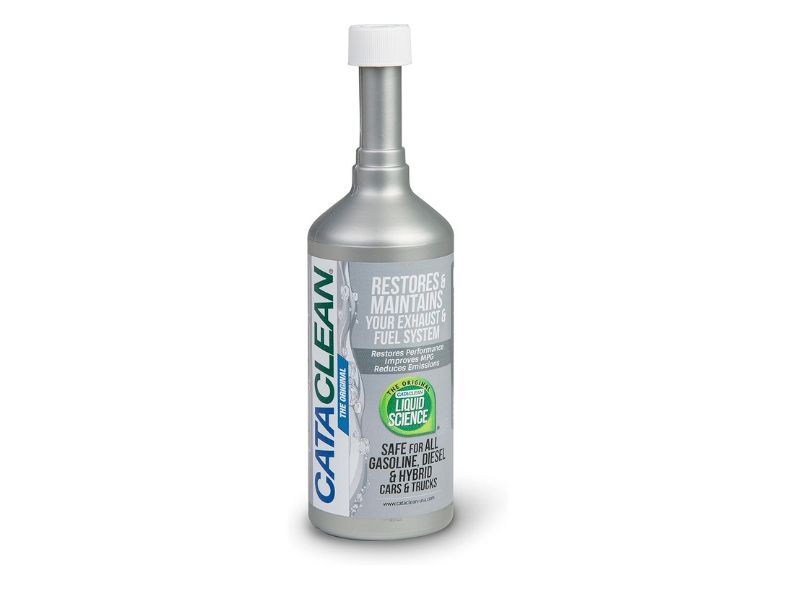
Cataclean is my best overall choice for gasoline-vehicle owners looking for an easy, fuel-tank-based treatment. Rather than cleaning only one component, its formula is marketed to reduce carbon buildup in oxygen sensors, catalytic converters, fuel injectors, and cylinder heads. This broader coverage makes it useful for drivers concerned about emissions-system deposits as well as general fuel-system cleanliness.
The product comes in a 16-ounce bottle and is intended for gasoline engines. Because it is poured into the fuel tank, there is no need to remove the oxygen sensor or work underneath the vehicle. This makes Cataclean more accessible for DIY users who do not have specialty tools or mechanical experience.
I particularly like that it targets both sides of the combustion process. Cleaning fuel injectors and combustion-related deposits may support more complete fuel burning, while reducing exhaust-side carbon may help a functional oxygen sensor and catalytic converter operate under cleaner conditions. However, any improvement depends on deposits being the actual problem.
Cataclean should not be treated as a guaranteed repair for a P0420 code, failed emissions test, or check engine light. Those issues can also result from a damaged converter, exhaust leak, misfire, wiring fault, or failed O2 sensor. I would scan the vehicle and check for mechanical problems before relying on an additive.
Pros
- Targets fuel and exhaust-system deposits
- Simple pour-in-tank application
- Comes in a full-size 16-ounce bottle
- No sensor removal required
- Established product with broad availability
Cons
- Intended primarily for gasoline vehicles
- Cannot repair damaged sensors or converters
- Results depend on carbon buildup being the cause
My Verdict
Cataclean provides the best balance of ease of use, system coverage, and brand recognition. I consider it the strongest starting point for compatible gasoline vehicles needing preventive maintenance or help with light carbon deposits.
2. Rislone Complete Fuel, Exhaust and Emissions System Cleaner – Best Complete System Cleaner
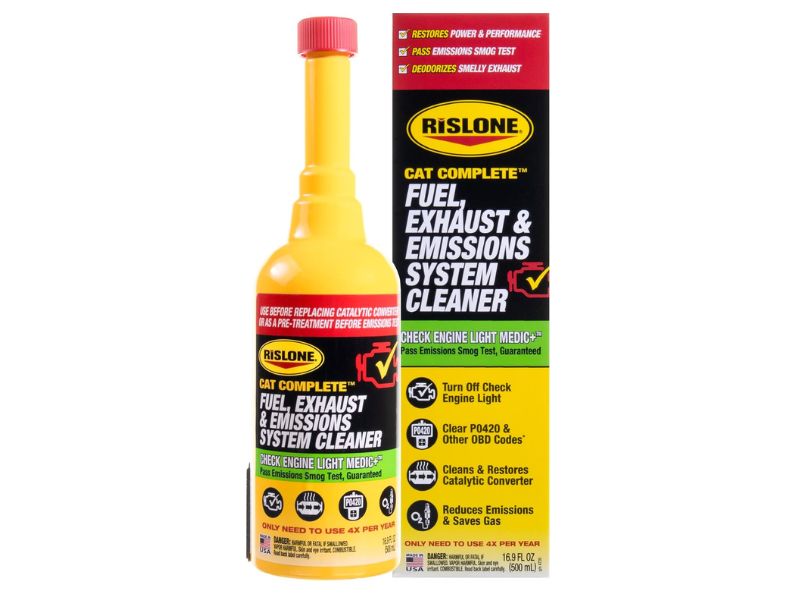
Rislone 4720 Cat Complete is my recommendation for drivers who want the broadest cleaning coverage from one bottle. Its formula is designed to target contaminants, soot, carbon buildup, and oily residue across fuel injectors, combustion chambers, turbochargers, EGR systems, catalytic converters, oxygen sensors, and exhaust components.
The 16.9-ounce bottle is intended as a complete treatment for a normal passenger car, SUV, or light truck. Rislone states that one full bottle is used per treatment and markets regular use at approximately 5,000-mile intervals. It is compatible with regular gasoline, premium gasoline, oxygenated fuel, and ethanol blends including E10, E15, and E85. The Amazon listing also identifies compatibility with gasoline, ethanol, and hybrid vehicles.
What separates this cleaner from a simpler O2-sensor additive is its whole-system approach. Deposits affecting oxygen-sensor readings may originate from poor combustion, dirty injectors, oil residue, or exhaust contamination. Treating several related areas may be more useful than focusing solely on the sensor.
However, the wide range of claimed applications does not mean it can correct every emissions fault. A cleaner will not repair a damaged turbocharger, failed EGR valve, broken oxygen sensor, or physically restricted catalytic converter.
Pros
- Cleans multiple fuel and emissions components
- Large 16.9-ounce treatment
- Supports gasoline, ethanol blends, and hybrids
- Suitable for cars, SUVs, and light trucks
- Straightforward fuel-tank application
Cons
- More extensive than some vehicles need
- Not a substitute for fault-code diagnosis
- Cannot restore physically damaged components
My Verdict
Rislone 4720 is my best complete-system option. I would choose it when I want one treatment aimed at the fuel system, combustion areas, oxygen sensors, catalytic converter, and exhaust system rather than a narrowly focused additive.
3. AUTOPROFI OXICAT Oxygen Sensor and Catalytic Converter Cleaner – Best Preventive Treatment
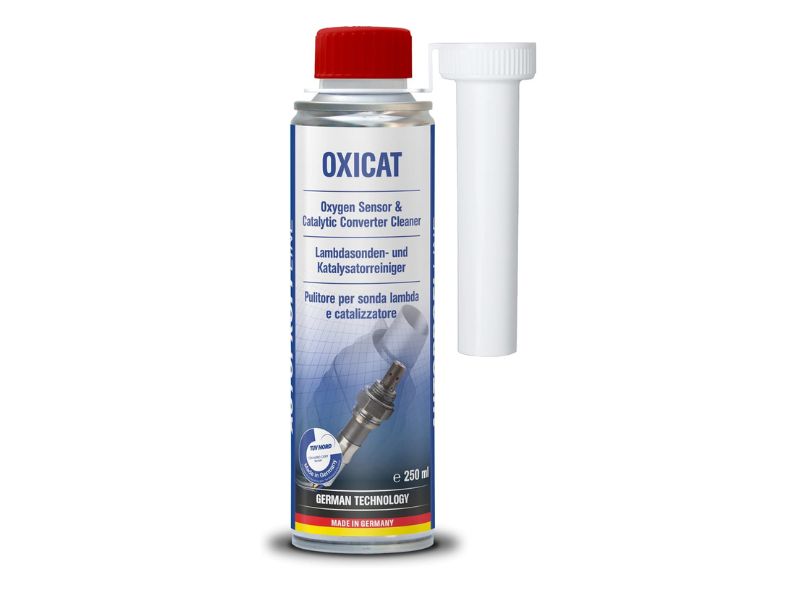
AUTOPROFI OXICAT is my preferred preventive-maintenance product because it is specifically positioned as an oxygen-sensor and catalytic-converter cleaner. It is formulated to reduce soot and carbon deposits throughout the exhaust system, including the lambda or oxygen sensor, catalytic converter, EGR valve, and turbocharger.
One of its strongest advantages is fuel compatibility. Official product information lists it for gasoline, diesel, and hybrid engines, making it more versatile than gasoline-only alternatives. The 250-milliliter bottle treats up to approximately 60 liters, or 16 gallons, of fuel at the stated 1:200 mixing ratio. The manufacturer recommends regular use every three to four months and warns users not to overdose the treatment.
OXICAT requires the catalytic converter to reach and sustain its normal working temperature. This means very short journeys may not provide the heat and operating time required for the treatment to work as intended. A longer drive after application may therefore be more suitable, provided the vehicle is safe to operate.
I see this as a maintenance product rather than an emergency repair. It may help reduce gradual deposit formation in an otherwise functional exhaust system, but it will not repair a cracked converter, failed heater circuit, or damaged sensor wiring.
Pros
- Designed specifically for O2 sensors and converters
- Compatible with gasoline, diesel, and hybrid engines
- Targets the EGR valve and turbocharger as well
- Clear preventive-maintenance positioning
- One bottle treats up to about 16 gallons
Cons
- Requires sustained operating temperature
- Dosage must be measured carefully
- Will not repair mechanical or electrical failures
My Verdict
OXICAT is my top preventive choice, especially for drivers who want one cleaner that supports gasoline, diesel, or hybrid vehicles. I recommend it most for regular exhaust-system maintenance rather than attempting to revive a severely damaged component.
4. MotorPower Care Catalytic Converter and Oxygen Sensor Cleaner – Best for Gasoline and Hybrid Vehicles
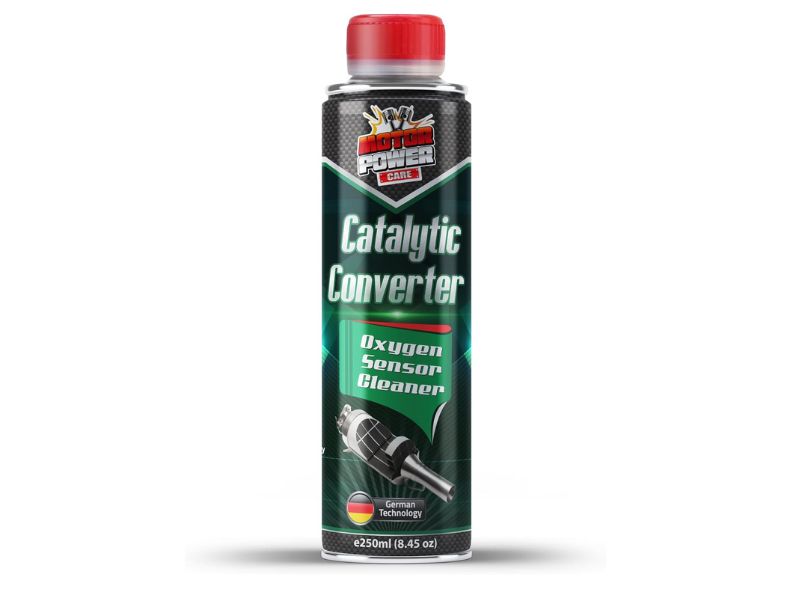
MotorPower Care is my recommended compact treatment for gasoline and hybrid vehicles. The 8.45-fluid-ounce bottle is marketed to clean carbon and other deposits from the catalytic converter, oxygen sensors, EGR valve, fuel injectors, combustion chamber, turbocharger, and exhaust system.
The application process is simple: the liquid is poured into the fuel tank and works while the vehicle is driven. The Amazon instructions recommend mixing the 250-milliliter bottle with a specified quantity of gasoline and driving for approximately 40 minutes after application. Users should follow the current bottle directions rather than estimating the treatment ratio.
I like this product for drivers who want a single-use treatment without buying a large bottle or multipack. Its gasoline and hybrid compatibility also makes it relevant for many modern passenger vehicles. The manufacturer presents regular use as preventive maintenance rather than requiring sensor or converter removal.
The listing makes strong claims about emissions codes and performance, but I would remain cautious. A P0420 or P0430 code does not always mean carbon buildup is the only problem. A cracked, melted, or broken converter cannot be repaired with a fuel additive, and the manufacturer itself advises checking for physical converter damage before treatment.
Pros
- Suitable for gasoline and hybrid vehicles
- Compact single-treatment bottle
- Targets several emissions-related components
- No sensor removal or tools required
- Works during normal driving
Cons
- Smaller bottle than several competitors
- Not intended for diesel vehicles
- Strong marketing claims require realistic expectations
My Verdict
MotorPower Care is a convenient option for gasoline and hybrid drivers seeking a compact preventive treatment. I would consider it for light deposit buildup, but not as a substitute for diagnosing persistent fault codes or physical converter damage.
5. Solder-It CAT-1 Catalytic Converter Cleaner and Deodorizer – Best for Exhaust Odor
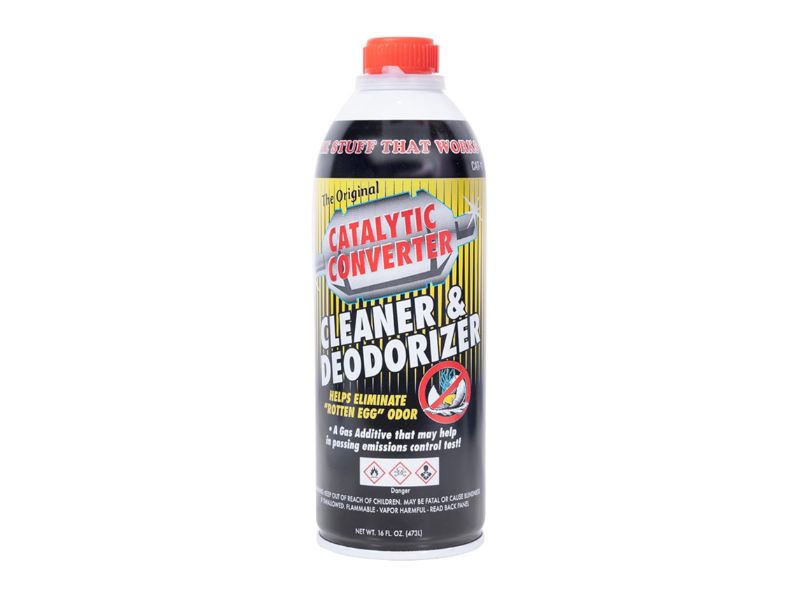
Solder-It CAT-1 is my preferred option for drivers concerned about both deposit buildup and unpleasant exhaust odor. It is a 16-ounce gasoline fuel additive formulated to clean and deodorize functional catalytic converters while also targeting oxygen sensors, EGR valves, and combustion chambers.
The product is marketed for both monolithic and pelletized catalytic converters. That makes it particularly relevant to owners of some older vehicles, although the converter must still be functional. The manufacturer also highlights its ability to address the rotten-egg smell sometimes associated with catalytic or fuel-system problems.
Application is straightforward: the manufacturer directs users to add the full 16-ounce bottle to a full tank of gasoline. I appreciate the simple dosage because it reduces uncertainty, but I would still check the current bottle label before use.
An important limitation is that exhaust odor can indicate more than ordinary carbon deposits. A sulfur smell may be related to an overly rich fuel mixture, failing converter, ignition problem, or contaminated fuel. Adding a cleaner without diagnosing the cause could temporarily mask a symptom while the underlying problem continues.
Pros
- Combines cleaning and deodorizing functions
- Full-size 16-ounce bottle
- Targets O2 sensors, EGR valves, and combustion chambers
- Works with monolithic and pelletized converters
- Simple full-tank application
Cons
- Designed for gasoline engines
- Odor may indicate a more serious fault
- Only suitable for functional catalytic converters
My Verdict
Solder-It CAT-1 is my best odor-focused choice. I would use it when a functional gasoline vehicle needs deposit maintenance and exhaust deodorizing, while still investigating persistent sulfur smells or emissions codes professionally.
How I Selected These Oxygen Sensor Cleaners
I selected these products by focusing on their intended use, fuel compatibility, treatment coverage, ease of application, and overall value. Since most products marketed as oxygen sensor cleaners are fuel additives, I gave priority to formulas that clearly mention oxygen sensors, catalytic converters, or complete emissions-system cleaning.
My main evaluation factors included:
- Oxygen-sensor and catalytic-converter cleaning claims
- Gasoline, diesel, ethanol, or hybrid compatibility
- Bottle size and treatment ratio
- Fuel-system and combustion-system coverage
- Ease of pour-in-tank application
- Preventive-maintenance suitability
- Brand reputation and product documentation
- Realistic limitations
I also considered whether each product served a different type of buyer. Cataclean offers a balanced option for gasoline vehicles, while Rislone targets a broader range of fuel and emissions components. OXICAT is more suitable for preventive maintenance across several engine types, and MotorPower Care offers a compact treatment for gasoline and hybrid vehicles. Solder-It CAT-1 stands out for drivers concerned about exhaust odor.
I did not treat these additives as guaranteed repairs. A cleaner may reduce light carbon or combustion deposits, but it cannot repair damaged electronics, broken wiring, exhaust leaks, or a physically failed catalytic converter.
Buying Guide: How to Choose the Best Oxygen Sensor Cleaner
Choosing the right oxygen sensor cleaner requires more than finding a product with “O2 sensor” written on the bottle. You need to confirm that the formula matches your vehicle, fuel type, and maintenance goal.
Confirm Your Vehicle’s Fuel Type
Always check whether the product supports your vehicle’s fuel system.
Common categories include:
- Gasoline
- Diesel
- Hybrid
- Ethanol blends
- Flex-fuel vehicles
Some formulas are designed only for gasoline engines, while others support gasoline, diesel, and hybrid applications.
Using an incompatible product may reduce effectiveness or create unnecessary risk. I recommend checking both the Amazon listing and the bottle label before pouring anything into the fuel tank.
Understand How the Cleaner Works
Most oxygen sensor cleaners are not applied directly to the sensor. They are fuel additives that pass through the following areas:
- Fuel injectors
- Combustion chambers
- Exhaust valves
- Oxygen sensors
- Catalytic converter
- Exhaust system
The formula is intended to reduce deposits as the engine burns the treated fuel.
This indirect cleaning method is safer than spraying harsh chemicals directly onto the delicate sensing element. However, it also means that results depend on the type and severity of the contamination.
Choose Between Preventive and Corrective Use
Some cleaners are positioned mainly for preventive maintenance. They are intended to reduce gradual deposit buildup before serious emissions problems develop.
Corrective products are marketed toward symptoms such as:
- Reduced emissions performance
- Light carbon buildup
- Poor fuel economy
- Exhaust odor
- Sluggish engine response
- Minor deposit-related trouble codes
Even corrective products have limitations. They cannot fix a physically damaged oxygen sensor or catalytic converter.
I prefer using these additives as preventive maintenance or an early response to light deposit buildup rather than waiting until the vehicle has a severe mechanical fault.
Check the Treatment Ratio
Each product has its own dosage instructions.
A bottle may be intended for:
- A nearly empty fuel tank
- A full fuel tank
- Up to 16 gallons
- A specific fuel-to-additive ratio
- One complete treatment
Adding too little may reduce effectiveness, while overdosing can create problems or waste product.
Never assume that all 8-, 16-, or 16.9-ounce bottles should be used in the same way. Follow the current label directions for the specific product.
Consider the Bottle Size
A larger bottle does not automatically provide better cleaning.
Smaller bottles may contain a more concentrated formula, while larger bottles may treat a full tank or provide broader system coverage.
Common sizes in this guide include:
- 8.45 ounces
- 16 ounces
- 16.9 ounces
- 250 milliliters
The best value depends on how much fuel the bottle treats and how often you plan to use it.
Look at the Full System Coverage
Some products focus mainly on oxygen sensors and catalytic converters. Others are marketed to clean additional components, such as:
- Fuel injectors
- EGR valves
- Turbochargers
- Combustion chambers
- Cylinder heads
- Exhaust passages
A complete-system cleaner may be useful when deposits affect several related areas. However, broader coverage does not always mean better results for a specific oxygen-sensor fault.
Avoid Unrealistic Product Claims
No fuel additive can repair:
- A broken sensing element
- A failed heater circuit
- Melted or corroded wiring
- A damaged electrical connector
- A cracked exhaust manifold
- A leaking exhaust pipe
- A melted catalytic converter
- A completely blocked converter
- Internal engine damage
I would be cautious of any product promising to permanently clear every check engine light or restore every failed emissions component.
How to Use an Oxygen Sensor Cleaner
The exact directions vary by product, but the general process is straightforward.
Step 1: Diagnose the Vehicle First
Read stored trouble codes with an OBD-II scanner before adding the cleaner.
Codes involving oxygen sensors or catalyst efficiency may be caused by:
- Carbon deposits
- Exhaust leaks
- Wiring problems
- Fuel-system faults
- Vacuum leaks
- Engine misfires
- Failed sensors
- Catalytic-converter damage
Knowing the code gives you a reference point for monitoring the result.
Step 2: Read the Product Label
Confirm:
- Vehicle compatibility
- Fuel type
- Recommended fuel level
- Treatment ratio
- Driving requirements
- Usage frequency
The bottle directions should take priority over general online advice.
Step 3: Add the Cleaner to the Fuel Tank
Pour the specified amount into the fuel tank.
Some products work best when added before refueling, allowing the fuel to help mix the additive. Others instruct users to add the product to an existing amount of gasoline.
Avoid spilling the liquid on painted surfaces.
Step 4: Add the Recommended Fuel Quantity
Fill the tank according to the product directions.
Do not automatically use a full tank if the cleaner is designed for a smaller quantity of fuel. Excessive dilution may reduce the intended concentration.
Step 5: Bring the Engine to Operating Temperature
Catalytic-converter and exhaust-system cleaners generally depend on heat to work.
A short idle period may not generate enough temperature. The vehicle may need to be driven until the engine and catalytic converter reach normal operating conditions.
Step 6: Drive the Vehicle
Follow the recommended driving time or distance.
A steady highway drive may allow the exhaust system to remain hotter than repeated short urban trips. However, only drive the vehicle if it is operating safely.
Do not continue driving if you notice:
- Severe misfires
- Flashing check engine light
- Overheating
- Major power loss
- Strong fuel leaks
- Abnormal exhaust heat
Step 7: Monitor the Results
After completing the treatment, observe:
- Check engine light
- Fuel economy
- Idle quality
- Acceleration
- Exhaust odor
- Returning trouble codes
A cleaner may require some driving before results become noticeable.
Step 8: Rescan the Vehicle
Use an OBD-II scanner to check whether the original codes return.
Do not repeatedly clear codes without diagnosing the cause. Clearing a warning light does not repair the underlying fault.
Can You Clean an Oxygen Sensor Directly?
I generally do not recommend removing an oxygen sensor and spraying it with brake cleaner, carburetor cleaner, contact cleaner, or another harsh solvent.
The sensing element is made from delicate ceramic materials and may contain protective coatings. Direct chemical cleaning can:
- Damage the ceramic element
- Contaminate the reference-air passages
- Affect sensor response
- Damage protective coatings
- Leave unwanted residue
- Create false readings
Unlike a MAF sensor, an oxygen sensor is not normally considered a routine spray-cleanable component.
Fuel additives work indirectly by reducing deposits through combustion and exhaust flow. This approach does not guarantee that every contaminated sensor will recover, but it avoids physically touching or soaking the sensing element.
If a sensor has failed electrically or become chemically poisoned by oil, coolant, silicone, or fuel additives, replacement is usually more reliable than direct cleaning.
When an Oxygen Sensor Cleaner May Help
A cleaner may be useful when the vehicle is mechanically healthy and the problem involves light deposit buildup.
Possible situations include:
- Preventive emissions-system maintenance
- Light carbon accumulation
- Short-trip driving
- Mild exhaust odor
- Gradual fuel-economy reduction
- Deposits from incomplete combustion
- Functional catalytic converter with surface contamination
- Oxygen sensor affected by light soot buildup
Vehicles driven mainly on short trips may not reach full exhaust operating temperature often enough to burn away deposits naturally.
A cleaner may also be useful before an emissions inspection, but it should not be viewed as a guaranteed way to pass the test.
When an Oxygen Sensor Cleaner Will Not Work
A cleaner is unlikely to help when the problem is mechanical, electrical, or severe.
Failed Heater Circuit
Modern oxygen sensors often contain an internal heater. If the heater circuit has failed, a fuel additive cannot repair it.
Damaged Wiring
Wires near the exhaust can melt, break, corrode, or rub against metal components. The wiring must be repaired or replaced.
Exhaust Leaks
A leak before the sensor can introduce outside air and create a false lean reading. Cleaner will not seal the leak.
Vacuum Leaks
Unmetered air entering the engine can cause lean fuel trims and oxygen-sensor codes. The intake leak must be repaired.
Oil or Coolant Contamination
Burning oil or coolant can chemically contaminate the sensor and catalytic converter. The engine problem must be corrected first.
Failed Catalytic Converter
A melted, cracked, severely restricted, or internally broken converter cannot be restored with an additive.
Broken Oxygen Sensor
A sensor with a damaged ceramic element, failed electronics, or worn-out internal components requires replacement.
Common Symptoms Mistaken for a Dirty Oxygen Sensor
Many engine and emissions problems share similar symptoms.
Check Engine Light
A check engine light may involve the sensor circuit, fuel mixture, catalytic converter, or another engine-management component.
Poor Fuel Economy
Reduced mileage may result from a slow oxygen sensor, but it can also come from:
- Low tire pressure
- Dirty air filter
- Faulty MAF sensor
- Worn spark plugs
- Leaking fuel injectors
- Driving habits
Rough Idle
A rough idle may be caused by vacuum leaks, ignition misfires, dirty injectors, throttle-body buildup, or low compression.
Engine Hesitation
Weak acceleration or hesitation can involve fuel pressure, ignition timing, airflow measurement, transmission behavior, or oxygen-sensor feedback.
Failed Emissions Test
An emissions failure may involve:
- Catalytic converter efficiency
- Fuel mixture
- Misfires
- Evaporative-emissions faults
- Oxygen-sensor response
- Incomplete readiness monitors
P0420 or P0430 Codes
These codes indicate that catalytic-converter efficiency is below the expected threshold.
A cleaner may help only when light deposits are reducing the efficiency of an otherwise functional converter. It will not restore a melted or worn-out converter.
Rotten-Egg Exhaust Smell
A sulfur smell may indicate:
- Rich fuel mixture
- Overloaded catalytic converter
- Poor-quality fuel
- Ignition problems
- Failing converter
An odor-focused cleaner may help with light deposits, but persistent odor requires diagnosis.
Frequently Asked Questions
What is the best oxygen sensor cleaner?
Cataclean is my best overall choice for compatible gasoline vehicles because it targets oxygen sensors, catalytic converters, fuel injectors, and combustion deposits through a simple fuel-tank treatment.
Does oxygen sensor cleaner really work?
It may help when light carbon, soot, or combustion deposits are affecting a functional oxygen sensor or exhaust system. It will not repair electrical, mechanical, or structural damage.
Can fuel additives clean an oxygen sensor?
Fuel additives may indirectly reduce deposits by passing through the combustion and exhaust systems. They do not physically wash the sensor in the way a spray cleaner works on a MAF sensor.
Can I spray cleaner directly on an O2 sensor?
I do not recommend spraying harsh chemicals directly onto the sensor. Brake cleaner, carburetor cleaner, and strong solvents may damage the ceramic sensing element or protective coatings.
Is Cataclean safe for oxygen sensors?
Cataclean is marketed for use in compatible gasoline fuel and exhaust systems, including oxygen sensors. Users should follow the bottle directions and confirm vehicle compatibility.
Can an oxygen sensor cleaner clear a P0420 code?
It may help if light deposit buildup is lowering converter efficiency. However, P0420 can also result from a failed catalytic converter, exhaust leak, engine misfire, fuel-mixture issue, or sensor fault.
Can a cleaner fix a failed oxygen sensor?
No. A cleaner cannot repair failed electronics, heater circuits, broken ceramic elements, damaged connectors, or melted wiring.
How often should I use an O2 sensor cleaner?
Follow the individual product instructions. Some formulas are intended for occasional corrective treatment, while others recommend preventive use every few thousand miles or every few months.
Are oxygen sensor cleaners safe for catalytic converters?
Products specifically formulated for catalytic converters and oxygen sensors should be safe when used as directed in compatible vehicles. Overdosing or using the wrong fuel-system product should be avoided.
Can I use an oxygen sensor cleaner in a diesel engine?
Only use a product that clearly states diesel compatibility. OXICAT is marketed for gasoline, diesel, and hybrid vehicles, while several other products in this guide are primarily intended for gasoline engines.
Can I use one in a hybrid vehicle?
Some formulas, including Rislone Cat Complete, OXICAT, and MotorPower Care, are marketed for compatible hybrid vehicles. Always check the current product label.
Will an oxygen sensor cleaner improve fuel economy?
It may restore some lost efficiency if deposits were affecting combustion, injectors, oxygen-sensor response, or exhaust flow. It will not improve fuel economy when another mechanical fault is responsible.
Can it help a vehicle pass an emissions test?
A cleaner may help reduce light deposit-related emissions, but it cannot guarantee a passing result. The vehicle must also have functional sensors, a working catalytic converter, no major leaks, and completed readiness monitors.
What causes oxygen-sensor contamination?
Common causes include:
- Oil burning
- Coolant leaks
- Rich fuel mixtures
- Carbon buildup
- Silicone sealants
- Fuel additives
- Short-trip driving
- Engine misfires
The underlying cause should be repaired to prevent repeated contamination.
Should I clean or replace my oxygen sensor?
Consider a cleaner when the sensor is functional and light deposits are suspected. Replace the sensor when testing confirms slow response, failed heater operation, damaged wiring, or internal failure.
Can a bad oxygen sensor damage the catalytic converter?
A faulty upstream sensor may contribute to incorrect fuel control. Prolonged rich operation can send excess fuel into the converter and increase its temperature.
Can a catalytic-converter cleaner damage an engine?
A compatible product used at the correct dosage should not damage a healthy engine. Problems may occur when the wrong product is used, the treatment is overdosed, or the vehicle already has a serious mechanical fault.
Should I clear the check engine light after using the cleaner?
You may clear the code with a scanner after recording it, but readiness monitors will reset. I prefer driving the vehicle and rescanning it to see whether the code returns.
Conclusion
The best oxygen sensor cleaner should match your vehicle’s fuel type, maintenance needs, and emissions-system condition. Cataclean is my best overall option for compatible gasoline vehicles because it combines simple application with broad fuel and exhaust-system coverage.
Rislone 4720 is my preferred complete-system cleaner, while OXICAT is the strongest preventive choice for gasoline, diesel, and hybrid vehicles. MotorPower Care offers a convenient compact treatment for gasoline and hybrid engines, and Solder-It CAT-1 is useful when light deposits are accompanied by exhaust odor.
These products may help reduce carbon, soot, and combustion deposits, but they cannot repair failed sensors, wiring problems, exhaust leaks, or damaged catalytic converters. I recommend reading the trouble codes, checking the vehicle’s fuel compatibility, following the exact dosage, and treating the cleaner as maintenance support rather than a guaranteed mechanical repair.