Finding the best spark plug wires for 4.3 Vortec engines is mostly a fitment and durability decision—not a matter of buying the thickest wire or the set with the most aggressive performance claims.
The classic Chevrolet and GMC 4.3L Vortec V6 uses a distributor ignition system with six spark-plug leads plus a coil-to-distributor lead. That makes wire length, distributor-terminal fit, spark-plug boot shape, resistance, heat protection, and electrical-noise suppression important. MSD’s application-specific 5577 set, for example, is built specifically around 1996–2004 4.3L Vortec applications and includes seven leads with vehicle-specific lengths rather than generic cut-to-fit wires.
My first recommendation is the ACDelco 9746MM Spark Plug Wire Set, particularly for compatible 1999–2007 Chevrolet Silverado 1500 and GMC Sierra 1500 4.3L applications. Its design emphasizes OE-style fit, high-dielectric insulation, corrosion-resistant terminals, proper distributor boot sealing, and factory-like routing.
The JDMSPEED 8MM Spark Plug Wire Set is my second choice for compatible 1999–2007 Silverado and Sierra 4.3L V6 trucks. Its current listing specifies an 8 mm spiral-wound design, Kevlar core, silicone jacket and boots, nickel-wound conductor, and RFI suppression, while its customer-feedback base is considerably larger than many specialist performance-wire sets for this engine.
Finally, the MSD 5577 Street Fire Spark Plug Wire Set is the performance-oriented choice. MSD specifically designs it for 1996–2004 GM 4.3L Vortec V6 engines, using 8 mm silicone/synthetic jackets, helically wound conductors, approximately 500 ohms per foot, RFI suppression, and vehicle-specific lead lengths.
Before ordering any of these, verify the year, vehicle, engine VIN/RPO, distributor configuration, and current wire-set part number. “4.3 Vortec” covers enough years and platforms that one wire set should never be assumed to fit every 4.3-liter GM V6.
3 Spark Plug Wire Sets for the 4.3 Vortec
| Image | Product Name | Check Price |
|---|---|---|
Best Choice | ACDelco 9746MM Spark Plug Wire Set | Check Price |
Second Best | JDMSPEED 8MM Spark Plug Wire Set | Check Price |
Third Choice | MSD 5577 Street Fire Spark Plug Wire Set | Check Price |
I ranked these sets using current customer-feedback strength as an important factor, then weighed:
- Exact 4.3L application coverage
- Distributor and plug-terminal fit
- Wire resistance
- Insulation quality
- Heat resistance
- EMI/RFI suppression
- Wire length and routing
- Boot construction
- Suitability for stock versus modified engines
The safest purchase is always the set whose cataloged application matches your truck—not necessarily whichever product ranks first overall.
1. ACDelco 9746MM Spark Plug Wire Set
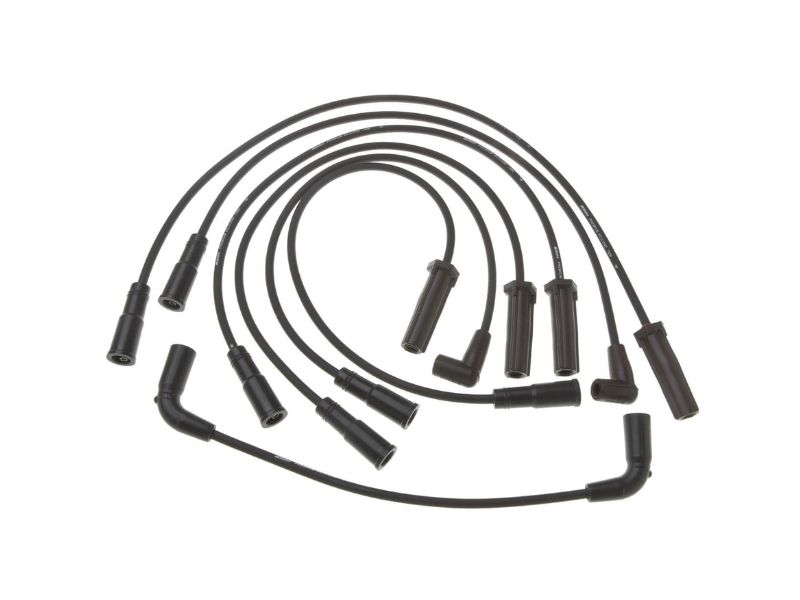
Key Features
- Vehicle-specific replacement wire set
- Designed for compatible 4.3L Silverado and Sierra applications
- High-dielectric insulation
- High-temperature silicone construction
- Corrosion-resistant terminals
- Water-resistant distributor and plug boot design
- OE-style lengths and routing
The ACDelco 9746MM takes first place because it focuses on the characteristics that matter most in a stock 4.3 Vortec ignition system: correct fit, reliable insulation, secure terminal engagement, and proper routing.
ACDelco specifies that conductor design, wire length, and diameter are selected to provide appropriate spark delivery and protection. Its plug and distributor boots are shaped to produce proper installation and sealing, while the terminal design is intended to improve retention and corrosion resistance. The insulation uses high-dielectric materials to contain the ignition voltage.
Application data identifies 9746MM for 1999–2006 Silverado 1500 and Sierra 1500 4.3L V6 models, plus applicable 2007 Classic configurations. That distinction matters because earlier S10, Astro, Blazer, Express, and C/K applications can call for another ACDelco configuration even though the engine displacement remains 4.3 liters.
For a truck that remains close to factory condition, there is little reason to treat spark-plug wires as a horsepower modification. A wire’s real job is to transmit the coil’s high-voltage pulse without excessive leakage, arcing, terminal loss, or electrical interference.
What I Like
- Excellent OE-style construction
- Vehicle-specific routing
- Strong terminal retention
- High-temperature insulation
- Sensible choice for a stock daily driver
What I Do Not Like
- Does not cover every classic 4.3 Vortec application
- Less visually or technically aggressive than thick performance wires
Verdict: For a compatible Silverado or Sierra that still uses its factory-style distributor, exhaust manifolds, and ignition system, the 9746MM is the wire set I would trust first. Its advantage is not flashy wire diameter; it is that the boots, lengths, terminals, insulation, and routing philosophy are designed around factory-style operation. That matters on the 4.3 Vortec because poorly fitted wires can touch hot exhaust components, stretch around the distributor, or fail to seat completely on the cap. If you are servicing a work truck or daily driver and want to restore dependable ignition rather than experiment with universal performance parts, this is the most straightforward choice. Just verify the part number before ordering—especially on 1996–1998 trucks, S10/Blazer platforms, Astro/Safari vans, and later 4.3 applications where another wire configuration may be required.
2. JDMSPEED 8MM Spark Plug Wire Set
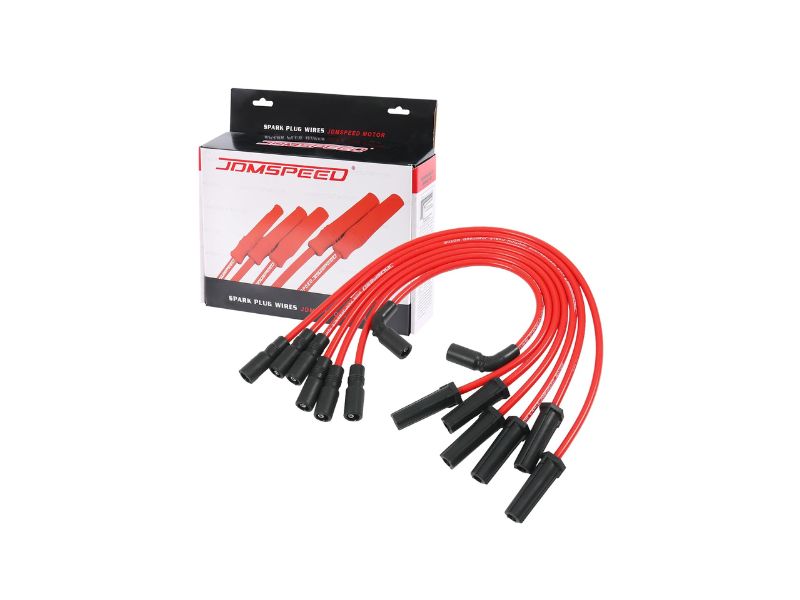
Key Features
- Seven-lead V6 ignition set
- 8 mm wire diameter
- Spiral-wound construction
- Kevlar core
- Nickel-wound conductor
- Silicone jacket and boots
- RFI suppression
- Listed for 1999–2007 Silverado/Sierra 4.3L
The JDMSPEED 8 mm set earns second place largely because it combines a relatively strong current customer-feedback history with an application that is clearly defined around 1999–2007 Silverado 1500 and Sierra 1500 4.3L V6 trucks.
Its construction differs from a conventional OE-style graphite wire. JDMSPEED describes a spiral-wound conductor supported by a Kevlar core, with silicone jacketing and boots for heat protection. It also specifies RFI suppression, which is important because ignition pulses can create electrical noise that affects nearby vehicle electronics and audio systems.
At 8 mm, it is slightly more performance-oriented in appearance than many factory-style sets without becoming an unusually thick wire that is difficult to fit through original separators and routing clips.
The biggest reason I prefer this particular JDMSPEED set over the brand’s broader 10.5 mm 4.3 Vortec listing is fitment clarity. The 8 mm listing identifies the Silverado/Sierra 1999–2007 4.3L application directly, while the broader 10.5 mm listing carries a compatibility-return warning despite claiming a much wider year range.
What I Like
- Good customer-feedback base for this niche application
- 8 mm size remains easy to route
- Kevlar-reinforced core
- Silicone insulation and boots
- Built-in RFI suppression
What I Do Not Like
- Not an OE manufacturer
- The performance-oriented marketing should not be interpreted as guaranteed added horsepower
Verdict: The JDMSPEED 8 mm set is a good choice when you own a compatible 1999–2007 Silverado or Sierra and want something more performance-oriented than a standard replacement wire without jumping to a much thicker 10.5 mm setup. The 8 mm jacket should remain manageable around factory wire looms, while the spiral conductor, Kevlar reinforcement, silicone insulation, and RFI suppression address real concerns such as vibration, heat, abrasion, and electrical noise. I would still choose the ACDelco first for an untouched factory truck because OE-like routing and terminal geometry have more practical value than wire thickness alone. For a truck that sees frequent maintenance, towing, or mild bolt-on modifications and where you want a durable aftermarket replacement with substantial buyer history, however, the JDMSPEED is a reasonable middle ground.
3. MSD 5577 Street Fire Spark Plug Wire Set
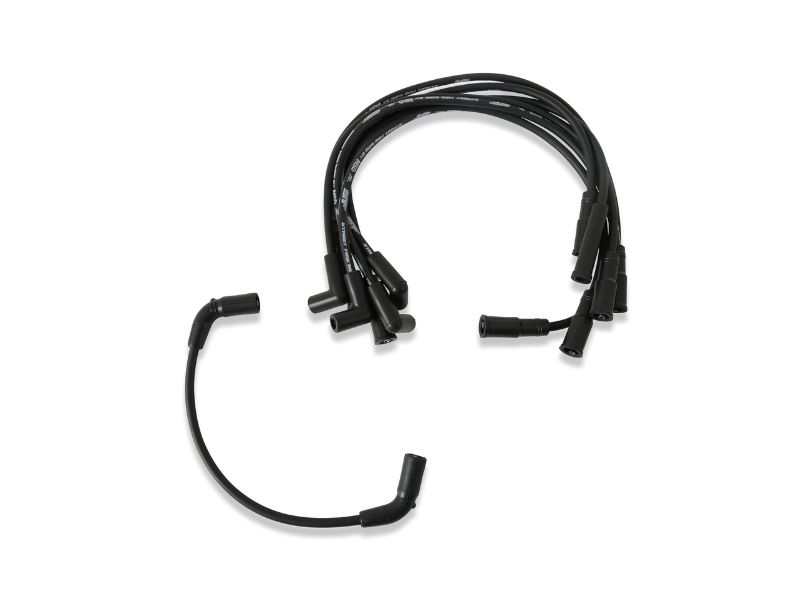
Key Features
- Specifically designed for 1996–2004 4.3L Vortec V6
- Seven-lead set including coil wire
- 8 mm silicone/synthetic jacket
- Helically wound conductor
- Approximately 500 ohms per foot
- Aramid/Kevlar-style reinforcing core
- RFI/EMI suppression
- Vehicle-specific wire lengths
MSD 5577 takes third place because its customer-feedback base is smaller, but technically it is one of the most purpose-built performance wire sets available for the classic 4.3 Vortec.
MSD identifies the 5577 as a stock-replacement Street Fire set specifically for 1996–2004 GM Vortec 4.3L V6 engines. The manufacturer uses a low-resistance helically wound conductor wrapped in an 8 mm heat-resistant jacket, with insulated boots covering the terminals.
Detailed specifications list approximately 500 ohms of resistance per foot, RFI suppression, silicone plug boots, and seven predefined wire lengths: six cylinder leads plus the ignition-coil wire. That is important because the 4.3 Vortec’s distributor location requires several substantially different wire lengths.
The spiral conductor design is especially attractive on a performance-oriented street truck. It lowers resistance while maintaining electrical-noise suppression rather than using an unsuppressed solid conductor that could create interference around engine-management electronics.
What I Like
- Designed specifically for the 4.3 Vortec
- Published resistance specification
- Strong EMI/RFI suppression
- Durable 8 mm jacket
- Vehicle-specific wire lengths
What I Do Not Like
- Smaller buyer-feedback base than the first two options
- Its 1996–2004 catalog range does not cover every later 4.3 application
Verdict: The MSD 5577 is the set I would choose when the 4.3 Vortec is still street-driven but you want a performance-oriented ignition wire with clearly published electrical specifications. Its roughly 500-ohm-per-foot conductor, helical winding, RFI suppression, silicone boots, and individual V6 wire lengths make it a technically stronger choice than a generic universal set that simply advertises a large outside diameter. It is especially appealing on a truck with a refreshed distributor, quality plugs, upgraded ignition components, or mild engine modifications where dependable spark delivery under load matters. It will not create horsepower by itself if the original wires are already healthy, but replacing cracked or high-resistance leads can restore ignition reliability that the engine has lost. For a 1996–2004 application where MSD explicitly catalogs the 5577, it is one of the most credible performance-oriented alternatives to OE-style wires.
Spark Plug Wire Comparison
| Product | Main Application | Diameter | Conductor Style | Best Use |
| ACDelco 9746MM | Compatible Silverado/Sierra 4.3L | OE-style | OE replacement design | Stock daily driver |
| JDMSPEED 8MM | 1999–2007 Silverado/Sierra 4.3L | 8 mm | Spiral wound | Aftermarket replacement |
| MSD 5577 | 1996–2004 GM Vortec 4.3L | 8 mm | Helically wound, ~500 ohms/ft | Performance-oriented street use |
The table shows why fitment should come before ranking. A 2000 Silverado may have several valid choices here, while a 1997 Blazer or 2006 Sierra may immediately eliminate one or more sets because of application range.
Which 4.3 Vortec Does This Guide Cover?
This article primarily addresses the classic 4.3L/262-cubic-inch Vortec V6 with distributor ignition, especially the mid-1990s through 2000s truck, SUV, and van applications covered by these wire sets. MSD specifically catalogs its 5577 for 1996–2004 Vortec V6 applications, while ACDelco 9746MM is associated with 1999–2007-class Silverado and Sierra applications.
Common vehicles from the broader classic 4.3 Vortec era include:
- Chevrolet Silverado 1500
- GMC Sierra 1500
- Chevrolet S10
- GMC Sonoma
- Chevrolet Blazer
- GMC Jimmy
- Chevrolet Astro
- GMC Safari
- Chevrolet Express
- GMC Savana
- Earlier C/K-series trucks
Not every product reviewed here fits every vehicle in that list.
Do Not Confuse the Classic 4.3 Vortec With the Newer LV3
The newer 4.3L EcoTec3/LV3 used in later GM full-size trucks is a different engine architecture and ignition system.
If your truck is from the newer generation and uses individual coils rather than the classic distributor arrangement, this guide is not the correct starting point.
The easiest visual check is the ignition system.
A classic distributor-equipped 4.3 has:
one ignition coil → distributor cap → six plug wires
A modern coil-near-plug engine has individual ignition coils controlled electronically without the traditional Vortec distributor arrangement.
Why the 4.3 Vortec Has Seven Wires
The engine has six cylinders, but a distributor-style ignition set normally contains seven high-voltage leads.
Six wires connect:
distributor → spark plugs
The seventh connects:
ignition coil → distributor
MSD’s published 5577 specifications explicitly list six cylinder wires plus a separate 16-inch coil lead.
That is why a six-wire package should immediately make you verify whether it actually includes everything required for your version of the engine.
How the Distributor Ignition Works
The ignition coil generates high voltage.
That voltage travels through the coil wire to the center terminal of the distributor cap.
The rotor turns inside the distributor and directs the voltage sequentially to six terminals around the cap.
Each terminal connects to one spark-plug wire.
The complete path is:
Ignition coil → coil wire → distributor cap → rotor → plug wire → spark plug
A problem anywhere in that chain can create a misfire.
This means new spark-plug wires cannot compensate for a worn rotor, badly corroded distributor cap, failing coil, or fouled spark plug.
What Makes a Good 4.3 Vortec Plug Wire?
A good wire has several jobs.
Carry High Voltage Reliably
The insulation needs enough dielectric strength to keep the ignition pulse inside the wire.
ACDelco specifically emphasizes high-dielectric insulation in its Professional/Gold wire-set construction.
Control Electrical Noise
Ignition systems generate high-frequency electrical energy.
RFI/EMI suppression helps limit interference with electronic systems.
Both MSD and JDMSPEED explicitly specify suppression-oriented conductor designs.
Resist Heat
Spark-plug wires route near exhaust manifolds.
Silicone jackets and boots are widely used because they remain flexible and electrically insulating at elevated engine-compartment temperatures.
Fit the Engine Properly
Wire length matters.
Too short creates tension.
Too long leaves wire loops near hot exhaust or moving components.
Vehicle-specific sets are generally preferable on an otherwise stock engine.
Wire Diameter: 7 mm vs 8 mm vs 10.5 mm
Wire diameter receives more attention than it deserves.
A thicker wire can provide room for heavier insulation and reinforcing layers, but diameter alone does not measure electrical performance.
An 8 mm wire with a well-engineered spiral conductor can outperform a poorly made 10.5 mm wire.
The MSD 5577 is only 8 mm but publishes a low-resistance conductor design with approximately 500 ohms per foot and RFI suppression.
JDMSPEED similarly uses an 8 mm spiral-wound construction in its Silverado/Sierra-specific set.
For a stock 4.3, 8 mm is more than adequate when the complete wire is well designed.
Does Lower Resistance Mean Better?
Not automatically.
High wire resistance can waste ignition energy, but extremely low resistance without adequate suppression can increase electrical interference.
A street ignition wire therefore balances:
- Conductivity
- Resistance
- EMI/RFI suppression
- Durability
MSD achieves this balance with a helically wound conductor rather than simply using an unsuppressed solid wire.
For a street-driven electronic-fuel-injected Vortec, I would prioritize a quality suppressed conductor over a race-style wire chosen solely because its resistance number is extremely low.
What Is RFI Suppression?
RFI stands for radio-frequency interference.
Every time the ignition fires, a strong electrical pulse travels through the wire.
Without adequate suppression, that pulse can generate electrical noise.
Possible areas affected include:
- Radio reception
- Audio equipment
- Sensors
- Electronic engine controls
This is why street ignition wires commonly use spiral, graphite, or other suppression-oriented conductors.
Both the MSD and JDMSPEED sets reviewed here specifically address RFI suppression.
Why Boot Quality Matters
The boot protects the connection between the wire terminal and spark plug or distributor.
A good boot should:
- Grip securely
- Resist heat
- Reduce moisture entry
- Protect against electrical leakage
- Remain removable during future maintenance
ACDelco places particular emphasis on boot shape, sealing, and terminal retention in its wire-set design.
An expensive conductor is not very useful if the plug terminal barely clicks onto the spark plug.
Heat Damage Around the Exhaust
Exhaust heat is one of the most common physical threats to ignition wires.
Inspect the route carefully around:
- Exhaust manifolds
- Header tubes
- EGR plumbing
- Hot metal brackets
A wire that rests against an exhaust component can eventually develop:
- Hardened insulation
- Burn marks
- Cracks
- Electrical leakage
- Misfire
Always reinstall factory wire retainers and separators when available.
Do You Need Performance Wires on a Stock 4.3?
Usually not.
A high-quality OE-style set is perfectly capable of supporting a healthy factory ignition system.
Performance wires become more attractive when:
- Engine modifications increase ignition demand
- Exhaust heat is higher
- You prefer heavier insulation
- You want published resistance specifications
- The original routing has been altered
For a stock Silverado work truck, the ACDelco set is usually the simpler choice.
For a modified 1996–2004 Vortec, the MSD becomes more interesting.
Do Spark Plug Wires Add Horsepower?
Do not expect a healthy engine to gain meaningful horsepower just because the wires are thicker or a different color.
If the old wires are failing, new ones can restore performance being lost through:
- Misfire
- Voltage leakage
- Excessive resistance
- Poor terminals
Restoring lost power is not the same as creating additional power beyond the engine’s normal output.
This distinction is important when evaluating aftermarket marketing.
Signs Your 4.3 Vortec Plug Wires May Be Bad
Possible symptoms include:
- Rough idle
- Hard starting
- Misfire
- Hesitation under acceleration
- Check-engine light
- Visible arcing
- Cracked insulation
- Burned plug boots
ACDelco similarly identifies rough running, misfires, hard starting, acceleration problems, and visible cracking or fraying as common signs that ignition wires may need inspection or replacement.
However, none of these symptoms proves the wires are responsible.
Other Causes of a 4.3 Vortec Misfire
The distributor-equipped 4.3 has several ignition components that deserve inspection:
- Spark plugs
- Distributor cap
- Rotor
- Ignition coil
- Plug wires
Fuel and mechanical problems can also cause misfire, including:
- Injector faults
- Fuel-pressure problems
- Vacuum leaks
- Compression loss
Do not replace expensive ignition parts blindly based on one trouble code.
Distributor Cap and Rotor Inspection
Whenever I replace the wires on an older 4.3 Vortec, I would inspect the distributor cap and rotor at the same time.
Look for:
- Green or white corrosion
- Carbon tracking
- Cracks
- Burned terminals
- Moisture
- Worn rotor contact
New wires connected to a badly corroded distributor cap may not solve the original ignition problem.
Why Firing Order Matters
The 4.3 Vortec’s six distributor leads must connect to the correct cylinders in the correct sequence.
If two wires are swapped, the engine can:
- Misfire severely
- Backfire
- Run rough
- Fail to start correctly
The easiest way to avoid a routing error is to replace one wire at a time.
Remove one old lead.
Match its length to the corresponding new lead.
Install the replacement.
Then move to the next cylinder.
How to Install 4.3 Vortec Spark Plug Wires
1. Let the Engine Cool
The exhaust manifolds can remain hot long after shutdown.
2. Photograph the Original Routing
This gives you a reference if something becomes confusing.
3. Replace One Wire at a Time
This preserves firing order.
4. Compare Wire Lengths
Use a new lead that closely matches the original route.
5. Grip the Boot
Do not remove the old wire by pulling directly on the cable.
6. Seat the New Terminal Fully
You should feel secure engagement at both the distributor and plug.
7. Use the Original Retainers
Keep the wires separated and away from exhaust heat.
8. Replace the Coil Wire
Do not forget the seventh lead.
9. Start the Engine
Listen for smooth operation and verify that no wire is loose.
Dielectric Grease on Spark Plug Boots
A small amount of appropriate dielectric grease inside the boot can help with moisture sealing and make future removal easier when used correctly.
It should not be treated as conductive paste.
The metal terminal still needs direct mechanical engagement with the plug terminal.
Use only a small amount and follow the wire or vehicle manufacturer’s service guidance.
Keep Plug Wires Separated
High-voltage ignition wires should remain in their intended separators.
The factory routing keeps them:
- Away from hot components
- Away from moving parts
- Properly spaced
- Organized around the distributor
Do not bundle all seven wires tightly together with one zip tie just because it looks clean.
Follow the designed routing wherever possible.
ACDelco vs JDMSPEED
This comparison mainly comes down to OE-style design versus aftermarket construction.
Choose ACDelco when you prioritize:
- Factory-like fit
- Stock routing
- Proven terminal geometry
- Conservative replacement design
Choose JDMSPEED when you prioritize:
- 8 mm spiral construction
- Kevlar reinforcement
- Silicone outer materials
- Strong customer-feedback volume for an aftermarket set
For a factory Silverado or Sierra, I still prefer ACDelco.
For a budget-conscious aftermarket replacement, JDMSPEED is reasonable when exact compatibility is confirmed.
ACDelco vs MSD
This is a more interesting comparison.
ACDelco focuses on OE-like replacement.
MSD focuses on a helically wound low-resistance performance conductor while retaining street-friendly RFI suppression.
For an untouched work truck:
ACDelco wins.
For a compatible modified 1996–2004 truck:
MSD becomes more attractive.
Neither choice needs to be considered an automatic upgrade over the other; they are designed around somewhat different priorities.
MSD vs JDMSPEED
Both are 8 mm performance-oriented alternatives in the configurations reviewed here.
JDMSPEED has a larger current customer-feedback base for its Silverado/Sierra-specific listing, while MSD publishes more detailed technical conductor information and has a narrower manufacturer-verified 1996–2004 Vortec application.
I would choose:
- JDMSPEED for a straightforward 1999–2007 aftermarket replacement
- MSD when published electrical specifications and performance-oriented construction matter more
Common Mistakes When Buying 4.3 Vortec Wires
Assuming Every 4.3 Uses the Same Wires
Different platforms and years use different sets.
Confusing Classic Vortec With Newer EcoTec3
They use different ignition architectures.
Buying by Diameter Alone
A 10.5 mm cable is not automatically electrically superior.
Ignoring the Coil Wire
Distributor systems require the seventh lead.
Replacing All Wires at Once Without Marking Them
This makes firing-order mistakes much easier.
Pulling Wires by the Cable
Grip the boot.
Letting New Wires Touch the Exhaust
Proper routing matters regardless of brand.
Expecting Horsepower From New Wires
Healthy replacement wires mainly preserve reliable ignition.
Ignoring the Distributor Cap
A cracked or corroded cap can mimic bad wires.
Trusting a Broad Compatibility Claim
Verify the exact year, model, and engine configuration.
Frequently Asked Questions
1. What are the best spark plug wires for 4.3 Vortec engines?
ACDelco 9746MM is my first choice for compatible Silverado and Sierra 4.3L applications because it emphasizes OE-style fit, sealing, insulation, and terminal quality.
For a performance-oriented 1996–2004 Vortec application, MSD 5577 is the stronger alternative.
2. How many spark plug wires does a 4.3 Vortec use?
A distributor-equipped 4.3 V6 normally uses seven high-voltage leads: six plug wires and one ignition-coil wire.
MSD’s 5577 specifications list six individual cylinder lengths plus a separate 16-inch coil wire.
3. Does ACDelco 9746MM fit every 4.3 Vortec?
No.
Application data primarily identifies it with 1999–2007-class Silverado and Sierra 1500 4.3L configurations, so earlier trucks, vans, and S-series vehicles should be checked separately.
4. Is MSD 5577 good for a 4.3 Vortec?
Yes, particularly for compatible 1996–2004 engines.
MSD specifically identifies 5577 as a stock-replacement Street Fire wire set for the GM 4.3L Vortec V6.
5. What resistance does MSD 5577 use?
The published specification is approximately 500 ohms per foot.
Its helically wound conductor is designed to maintain spark delivery while suppressing electromagnetic and radio-frequency noise.
6. Is JDMSPEED good for a 4.3 Vortec?
The reviewed 8 mm version is a reasonable aftermarket option for compatible 1999–2007 Silverado and Sierra 4.3L trucks.
It uses a spiral-wound conductor, Kevlar core, silicone jacket, and RFI suppression.
7. Are 8 mm spark plug wires big enough?
Yes. Wire quality and conductor engineering matter more than chasing the largest outside diameter.
Both MSD and JDMSPEED use 8 mm constructions in the products reviewed here.
8. Are 10.5 mm wires better than 8 mm?
Not automatically.
A larger outside diameter can allow heavier insulation, but conductor resistance, suppression, heat resistance, terminals, and actual fit matter more.
9. Can spark plug wires cause a misfire?
Yes. Damaged insulation, high resistance, poor terminal contact, or arcing can contribute to misfire.
ACDelco identifies rough operation and misfire among common symptoms associated with deteriorated wires.
10. Should I replace the distributor cap with the plug wires?
Inspect it closely and replace it if worn, corroded, cracked, or due for service.
A distributor cap and rotor are integral parts of the same high-voltage ignition path.
11. Do performance spark plug wires increase horsepower?
Not when they replace an already healthy wire set on an otherwise unchanged engine.
Their value is maintaining dependable spark delivery and resisting conditions that can cause the original wires to fail.
12. Should I replace all plug wires at once?
Usually yes when the set is old.
All seven wires have experienced similar age, heat cycles, and vibration, so replacing the complete matched set is generally more sensible than replacing one deteriorated lead at a time.
13. What is the firing order on a 4.3 Vortec?
Use the verified service information for your exact engine before rerouting distributor wires.
The simplest way to avoid mistakes is to replace one wire at a time rather than disconnecting the entire distributor at once.
14. Should I use dielectric grease?
A small amount inside the boot can be useful when recommended for the application.
Do not coat electrical terminals heavily or assume dielectric grease improves conductivity.
15. How can I tell if my 4.3 is the older Vortec?
Look at the ignition layout and verify the vehicle year and engine identification.
The engines covered by these products use a conventional distributor with multiple long high-voltage plug wires rather than a modern individual-coil ignition system.
16. Can I use MSD wires on a stock 4.3 Vortec?
Yes, when MSD 5577 is cataloged for the exact vehicle.
It is specifically described as a stock-replacement set despite its performance-oriented conductor construction.
17. Which wires are best for a 2000 Silverado 4.3?
ACDelco 9746MM is my first choice for a factory-style setup, with JDMSPEED 8 mm and MSD 5577 providing aftermarket alternatives when their fitment is confirmed.
All three products overlap that general model-year range, but vehicle-specific verification should still be completed before purchase.
18. When should 4.3 Vortec spark plug wires be replaced?
Replace them when inspection or diagnosis shows deterioration rather than relying only on age.
ACDelco notes that wire life varies with climate and driving conditions and identifies cracks, fraying, misfire, rough running, and starting difficulty as reasons for inspection or replacement.
Conclusion
Choosing the best spark plug wires for 4.3 Vortec engines starts with correct application identification. The classic distributor-equipped 4.3 V6 uses vehicle-specific wire lengths and seven high-voltage leads, so fitting the right set is more important than buying the largest wire diameter.
For a compatible factory-style Silverado or Sierra, the ACDelco 9746MM is my first recommendation. Its high-dielectric insulation, corrosion-resistant terminals, properly formed boots, and application-specific routing make it a sensible replacement for a stock daily driver or work truck.
The JDMSPEED 8MM set is the alternative I would consider when you want spiral-wound aftermarket construction, Kevlar reinforcement, silicone insulation, and a substantial customer-feedback base while staying with a manageable 8 mm cable diameter. Its reviewed application is specifically aimed at 1999–2007 Silverado and Sierra 4.3L trucks.
The MSD 5577 Street Fire is the technically interesting choice for compatible 1996–2004 engines. Its 8 mm jacket, helically wound conductor, approximately 500-ohm-per-foot resistance, suppression characteristics, and vehicle-specific wire lengths make it particularly suitable for owners who want a more performance-oriented ignition component without moving to universal cut-to-fit wires.
Whichever set you choose, verify the year, model, engine configuration, distributor setup, and part-number fitment before ordering. During installation, replace one lead at a time, preserve the original routing, keep every wire clear of the exhaust, and inspect the distributor cap, rotor, coil, and spark plugs while you are already working on the ignition system.
On an older 4.3 Vortec, that complete-system approach is far more valuable than choosing spark-plug wires based on color or advertised diameter alone.