Finding the best spark plug wires for 6.0 Vortec engines starts with one detail many buyers overlook: GM did not use one identical ignition-wire setup across every 6.0L Vortec application.
The 6.0L family includes engines such as the LQ4, LQ9, LY6, and L96, installed across different generations of Chevrolet and GMC trucks, SUVs, and commercial vans. A 2003 Silverado 2500 HD and a much newer Silverado HD may both have a 6.0-liter gasoline V8, but their ignition coils and recommended wire sets do not necessarily match.
Unlike the older distributor-equipped 5.7 Vortec, these engines use coil-near-plug ignition. Each cylinder has an individual ignition coil connected to its spark plug by a short high-voltage wire. That makes correct wire length, coil-terminal compatibility, boot fit, resistance, and heat protection particularly important.
For a broad range of 1999–2013 GM truck applications, my primary recommendation is the MSD 32829 Super Conductor 8.5mm Spark Plug Wire Set. MSD specifies the set for GM trucks and SUVs using 4.8L, 5.3L, 6.0L, and 8.1L engines during that period. Its 8.5 mm construction combines very low resistance with a spiral-wound conductor designed to suppress electromagnetic interference.
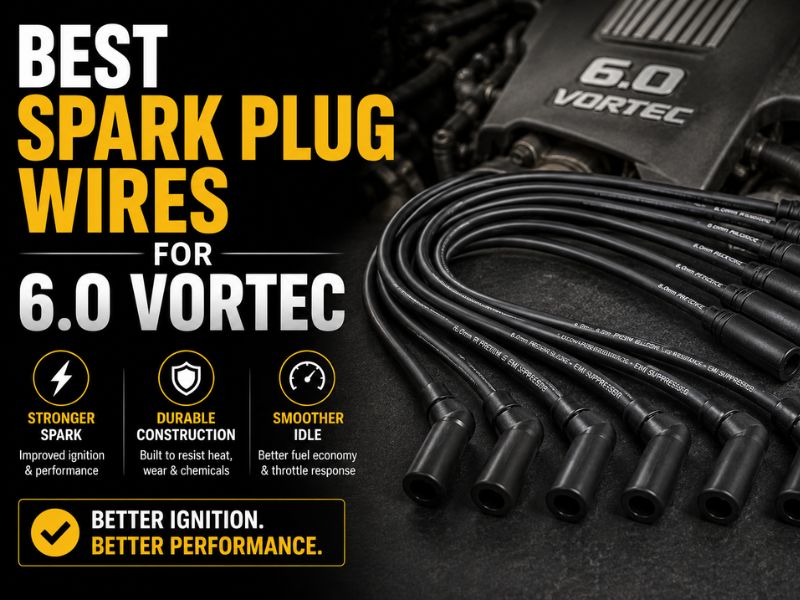
For many earlier stock LQ4 and LQ9 applications, the ACDelco Gold 9748HH Spark Plug Wire Set is a strong factory-style alternative. Chevrolet currently lists 9748HH across numerous 1999–2007-era Silverado, Suburban, Tahoe, and related applications, although coil style still needs to be confirmed.
Later 6.0L heavy-duty trucks often move into the ACDelco 9748UU application family instead. Chevrolet’s current catalog lists 9748UU across later Silverado 2500 HD, Silverado 3500 HD, Express, and other GM applications.
The practical lesson is simple: do not buy plug wires for a 6.0 Vortec by displacement alone.
3 Best Spark Plug Wires for 6.0 Vortec Engines
| Image | Product Name | Check Price |
|---|---|---|
Best Choice | MSD 32829 Super Conductor 8.5mm Spark Plug Wire Set | Check Price |
Second Best | ACDelco Gold 9748HH Spark Plug Wire Set | Check Price |
Third Choice | ACDelco Gold 9748UU Spark Plug Wire Set | Check Price |
These three sets cover the most useful buyer types rather than repeating three nearly identical products.
The MSD is the performance-oriented all-rounder. ACDelco 9748HH fits the factory-style needs of many earlier trucks, while 9748UU addresses a substantial number of later 6.0L heavy-duty applications.
1. MSD 32829 Super Conductor 8.5mm Spark Plug Wire Set
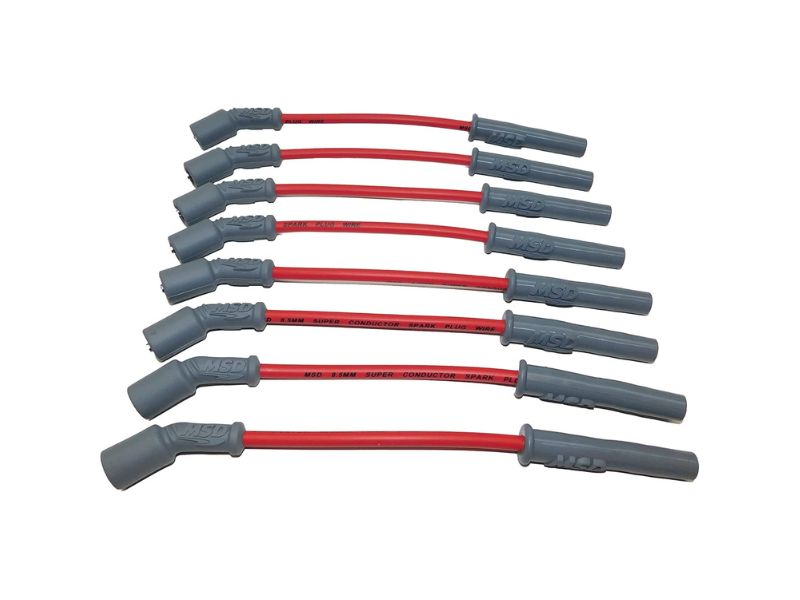
Key Features
- 8.5 mm Super Conductor construction
- Vehicle-specific GM truck wire lengths
- Roughly 40–50 ohms per 11-inch lead
- Spiral-wound copper-alloy conductor
- Ferro-magnetic EMI suppression
- Heat- and abrasion-resistant outer jacket
The MSD 32829 takes the first position because it offers a useful combination of fitment, insulation, low resistance, and electronic-noise control.
MSD specifies this set for 1999–2013 GM trucks and SUVs with several V8 applications, including the 6.0L. Rather than being a universal cut-to-fit kit, the wires arrive in lengths intended for the short coil-to-plug layout used on LS-based truck engines.
Its electrical construction is the standout feature. MSD states that an 11-inch Super Conductor lead has only around 40–50 ohms of resistance. The tightly wound conductor and ferro-magnetic core also act as an EMI choke, so the design does not achieve low resistance by giving up electrical-noise suppression.
That balance is useful on a computer-controlled Vortec engine. Sensors, the engine-control module, ignition electronics, and other systems all operate in the same environment as eight high-voltage ignition events.
The 8.5 mm jacket adds useful protection from engine heat and abrasion. This matters on Silverado HD or Sierra HD applications where the wires operate close to exhaust manifolds and may see long periods of elevated temperature while towing.
The main limitation appears when aftermarket headers place a primary tube extremely close to a spark-plug boot. MSD’s conventional performance boots handle substantial heat, but a very tight header installation may still benefit from thermal sleeves or ceramic-style protection.
What I Like
- Very low resistance without using unsuppressed solid-core wire
- Strong fit for many GM truck applications
- Thick insulation handles normal heat and abrasion well
- Good choice for stock and mildly modified engines
What I Do Not Like
- More expensive than a basic replacement set
- Extreme header heat may require extra boot protection
- Fitment still needs to be confirmed for later 6.0L generations
For many LQ4, LQ9, and other compatible 6.0L truck applications, the MSD 32829 provides the strongest overall mix of durability and ignition-wire construction.
2. ACDelco Gold 9748HH Spark Plug Wire Set
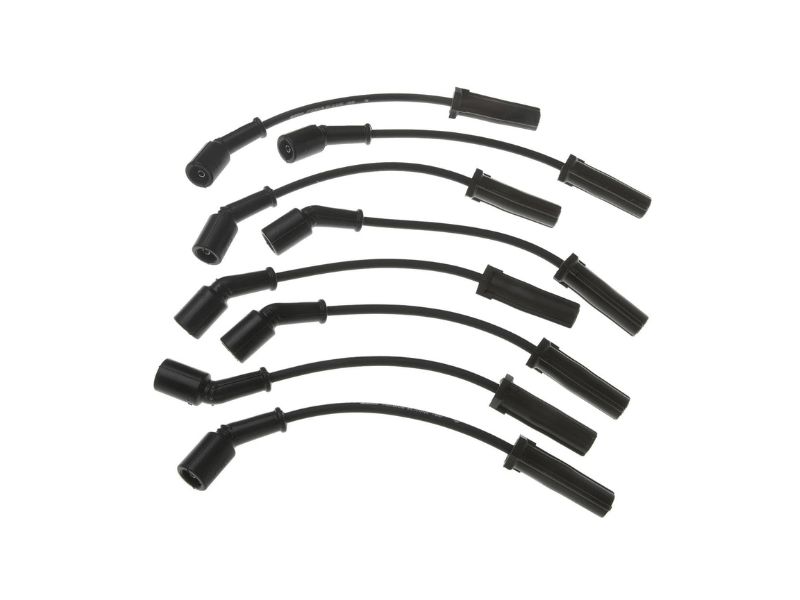
Key Features
- OE-style replacement construction
- Approximately 11-inch leads
- Silicone-rubber insulation
- Snap-lock plug terminals
- Noise-suppressing conductor
- Strong fitment relevance to earlier GM truck platforms
The ACDelco 9748HH makes the most sense when the goal is to keep an earlier 6.0 Vortec close to factory specification.
Chevrolet’s current parts catalog lists this wire set across many 1999–2006 Silverado, Tahoe, Suburban, and related models, with additional coverage extending into selected 2007 Classic applications.
The wire uses silicone insulation and a suppression-style conductor rather than chasing the extremely low resistance figures associated with performance wire sets.
That is perfectly reasonable on a stock engine.
Factory ignition coils are designed to work with an appropriate amount of wire and plug resistance. Lower resistance is useful when it comes with effective suppression, but a normal street truck does not need a racing-style electrical setup to produce a reliable spark.
The bigger issue with 9748HH is coil compatibility. Application data for some early 6.0L trucks distinguishes between wire sets according to the ignition coil installed on the engine. For example, fitment references identify 9748HH with specific coil numbers in certain Silverado 2500 HD applications.
That makes visual verification worthwhile on an older truck, especially if coils have been replaced in the past.
What I Like
- Factory-style wire length and routing
- Good match for many stock LQ4/LQ9-era trucks
- Silicone boots and insulation suit normal underhood heat
- Noise-suppressing construction works naturally with factory electronics
What I Do Not Like
- Coil style needs careful verification
- Not the correct set for every 6.0 Vortec
- Less specialized for high-heat header installations
For an earlier stock 6.0L with the correct coil configuration, ACDelco 9748HH is the straightforward choice for keeping the ignition system close to its original design.
3. ACDelco Gold 9748UU Spark Plug Wire Set
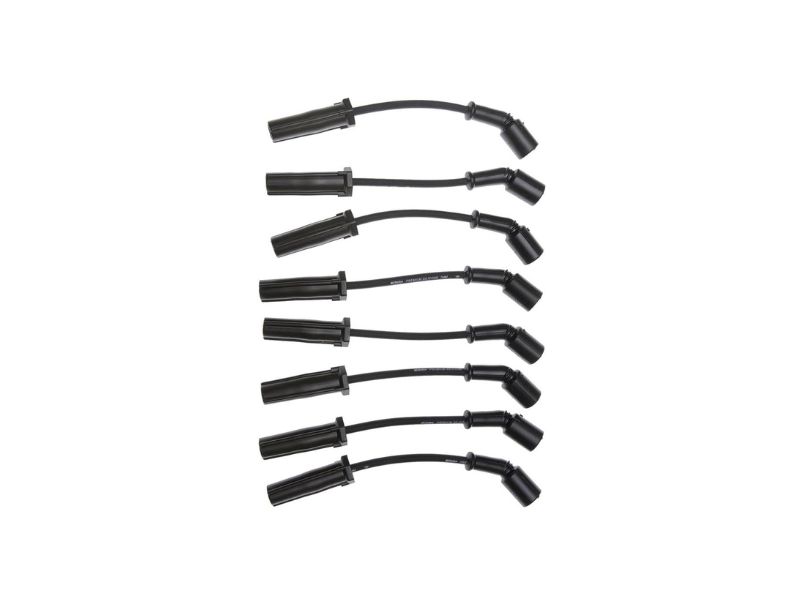
Key Features
- Eight-wire direct-fit set
- Silicone spark-plug boots
- Noise suppression
- Approximately 9-inch leads
- Snap-lock plug terminals
- Strong coverage across later GM HD applications
The ACDelco 9748UU is important because it prevents a common mistake: assuming an early LQ4 wire set is automatically correct for a later 6.0L truck.
Chevrolet currently lists 9748UU across numerous later applications, including Silverado 2500 HD models from 2009 through 2018 and several Express van applications. The official specifications list silicone boots, noise suppression, and approximately 9-inch individual leads.
Those shorter dimensions alone illustrate why early and later wire sets should not be treated as interchangeable.
The 9748UU is particularly relevant to later heavy-duty engines such as the L96, where owners often want a reliable OE-style replacement rather than a performance wire.
Its biggest strengths are direct fit and predictability. Properly sized wires are easier to keep away from exhaust components and do not leave unnecessary loops around the cylinder heads.
As with the 9748HH, this is not a universal 6.0L part number. Current vehicle fitment should be checked before ordering.
What I Like
- Strong OE-style choice for many later 6.0L applications
- Short application-specific leads simplify routing
- Silicone insulation handles everyday engine heat well
- Good fit for work trucks and commercial vans
What I Do Not Like
- Not a substitute for 9748HH in every early application
- No specialized ceramic heat protection
- Less performance-focused than MSD
For a later Silverado HD, Sierra HD, Express, or similar 6.0L application that cross-references correctly, the 9748UU is the most sensible stock-style choice of these three.
6.0 Vortec Spark Plug Wire Comparison
| Product | Wire Type | Application Focus | Resistance Approach | Heat Protection | Main Advantage |
| MSD 32829 | 8.5 mm spiral-core performance wire | Many 1999–2013 GM trucks/SUVs | Very low resistance with EMI suppression | Heavy-duty silicone/synthetic jacket | Strong all-around performance construction |
| ACDelco 9748HH | OE-style suppression wire | Many earlier LQ4/LQ9-era applications | Factory-oriented resistance | Silicone insulation | Factory-like fit and routing |
| ACDelco 9748UU | OE-style suppression wire | Many later 6.0L HD applications | Factory-oriented resistance | Silicone insulation | Better match for later applications |
The comparison highlights the main buying decision.
MSD makes sense when you want a heavier performance wire and broad earlier-truck coverage.
ACDelco makes more sense when you want the ignition system to stay close to the factory configuration—but selecting the correct ACDelco part requires knowing which generation and coil arrangement you have.
Which 6.0 Vortec Engine Do You Have?
The phrase “6.0 Vortec” can refer to several GM engines.
Knowing the engine code makes spark plug wire selection much easier.
LQ4
The LQ4 is one of the best-known early Vortec 6000 engines.
It appeared extensively in heavy-duty Chevrolet and GMC trucks, SUVs, and commercial applications.
The LQ4 uses an iron block and coil-near-plug ignition. It became especially popular in the enthusiast community because its strong factory foundation also works well for engine swaps and performance builds.
For plug-wire purposes, an original LQ4 should still be identified by the vehicle year and ignition-coil configuration.
A truck that has had the coils or brackets replaced may no longer exactly match what an application catalog expects.
LQ9
The LQ9 is closely related to the LQ4 but uses a higher-output configuration.
It appeared in selected performance-oriented GM trucks and SUVs.
Its ignition-wire requirements are still based primarily on coil configuration and physical fit rather than the additional factory horsepower.
That means there is little value in choosing a radically different plug wire simply because the engine is an LQ9.
A quality direct-fit suppression wire remains appropriate unless modifications create additional demands.
LY6
The LY6 belongs to a later Gen IV stage of the 6.0L truck family.
It brought newer cylinder heads and engine-control technology while retaining individual ignition coils and short plug wires.
This is where buying by engine displacement becomes increasingly unreliable.
The existence of an early 6.0L wire set does not prove it fits an LY6.
L96
The L96 continued the naturally aspirated 6.0L heavy-duty gasoline engine into later GM trucks and commercial vehicles.
It appears in many later Silverado HD, Sierra HD, Express, and Savana applications.
This later generation is where a wire family such as ACDelco 9748UU becomes particularly relevant.
Why Ignition Coil Style Matters
The coil is one of the most important fitment checks.
GM used several individual ignition-coil designs across LS-based engines.
They can differ in:
- Body shape
- Bracket location
- Coil height
- Terminal position
- Wire connection
- Distance from coil to plug
A wire that physically snaps onto one coil style may not fit another correctly.
Some application catalogs even distinguish between wire sets according to the part number stamped on the coil.
That is why looking under the hood can be more reliable than relying entirely on a broad “1999–2007 Chevy 6.0” description.
If the truck is decades old, previous owners may have changed:
- Coils
- Coil brackets
- Valve covers
- Cylinder heads
- Exhaust manifolds
- Headers
Those changes can alter the best wire choice.
How to Choose Spark Plug Wires for a 6.0 Vortec
A good spark plug wire set needs to satisfy several requirements at once.
Confirm the Model Year
Start with year, make, model, and engine.
A 2003 Silverado 2500 HD and a 2016 Silverado 2500 HD may both use a 6.0L gasoline V8, but they do not necessarily share identical ignition wiring.
Confirm the Engine Code
Identify whether the engine is an LQ4, LQ9, LY6, L96, or another 6.0L variant.
The engine code immediately narrows the generation.
Inspect the Existing Ignition Coils
Look at the shape of the coil and any visible part-number stamps.
If an application catalog specifies a particular coil number, confirm it before ordering.
This is especially helpful with older LQ4-era trucks.
Match Wire Length
The wire should reach comfortably without being stretched.
At the same time, excessive slack is undesirable.
A wire that is too long can sag toward the exhaust manifold.
A short lead that is pulled tight can place unnecessary stress on the coil and spark-plug terminals as the engine moves.
Correct-length replacement wires are easier to route properly.
Check the Spark Plug Boot
The boot must fully engage the spark-plug terminal.
A loose boot can allow arcing.
The boot material also needs enough heat resistance for its location beside the exhaust manifold.
Look at the Coil-Side Terminal
The coil end is just as important as the plug end.
It should connect securely without being forced.
If the terminal design looks significantly different from the original wire, stop and verify the part.
What Spark Plug Wire Resistance Actually Means
Wire resistance is often used as though it were the only measure of ignition-wire quality.
It is not.
Resistance affects how much electrical energy is dissipated while the high-voltage pulse travels through the wire, but suppression resistance also helps control electromagnetic noise.
Why MSD Uses Low Resistance
MSD’s Super Conductor design uses a tightly wound copper-alloy conductor.
The low resistance means relatively little ignition energy is lost in the cable.
At the same time, the ferro-magnetic core and winding pattern provide suppression.
That is why a performance spiral-core wire is very different from a basic solid metal cable.
Why ACDelco Uses More Conventional Resistance
OE-style wires are designed around the original ignition system.
The coil already has enough output to fire the specified spark plug through the factory-style wire resistance.
That means there is no automatic performance problem simply because an ACDelco wire measures more resistance than an MSD Super Conductor.
For a stock work truck, reliability and fit often matter more than obtaining the lowest resistance number possible.
Do Lower-Resistance Wires Add Horsepower?
Not automatically.
Imagine the stock ignition system already fires every spark plug consistently under maximum engine load.
Reducing wire resistance further does not create more oxygen, fuel, compression, or displacement.
The mixture was already igniting.
Where a better wire can make a noticeable difference is when the old set is deteriorated.
An aging wire may have:
- Excessive resistance
- Internal conductor damage
- Poor terminal contact
- Cracked insulation
- Heat damage
- Carbon tracking
Replacing that wire can restore ignition reliability and recover lost performance.
That is maintenance recovery, not a guaranteed horsepower upgrade.
Why EMI and RFI Suppression Matter
Every ignition coil generates a rapid high-voltage pulse.
That pulse can create electromagnetic and radio-frequency interference.
A modern GM truck contains electronic systems for:
- Fuel injection
- Ignition timing
- Engine sensors
- Transmission control
- Diagnostics
- Audio
- Vehicle communications
An ignition wire needs to contain its electrical energy without broadcasting unnecessary interference into those systems.
This is why solid-core racing wire is generally inappropriate for a normal EFI-equipped 6.0 Vortec.
Spiral-core and OE-style suppression wires provide a better balance.
Wire Diameter: Does Bigger Mean Better?
Not necessarily.
MSD uses an 8.5 mm outer diameter, while many OE-style wires are thinner.
A thicker wire can make room for:
- Additional insulation
- Reinforcement
- A larger conductor assembly
- Greater abrasion protection
But the spark does not automatically become stronger just because the outside jacket is bigger.
A high-quality thinner wire can operate perfectly on a stock engine.
Diameter becomes more useful when extra insulation is needed around high heat or a demanding aftermarket ignition setup.
Heat Is a Major Enemy of 6.0 Vortec Plug Wires
Each short wire runs close to the exhaust.
During normal driving, the exhaust manifold repeatedly heats and cools the nearby boot.
Over thousands of cycles, that can affect the insulation.
Possible heat-related damage includes:
- Hardened silicone
- Cracked boots
- Discoloration
- Reduced dielectric strength
- Carbon tracking
- Electrical arcing
Heavy-duty use can make the environment harsher.
A Silverado 2500 HD pulling a trailer uphill generates sustained exhaust heat that a lightly driven pickup may rarely experience.
That is one reason wire condition deserves attention on tow vehicles.
What Changes When You Install Headers?
Headers can make plug-wire heat significantly more challenging.
Factory exhaust manifolds are designed around factory engine packaging.
Aftermarket header tubes may route much closer to the spark plug.
That creates two different risks.
Radiant Heat
The wire does not have to touch the header to overheat.
A primary tube can radiate enough heat into a nearby boot to harden or damage it over time.
Direct Contact
Direct contact is much worse.
A silicone boot or cable resting against a header tube can fail quickly.
If the truck has headers, look at every cylinder individually.
Possible solutions include:
- High-temperature boot sleeves
- Ceramic spark-plug boots
- Different boot angles
- Longer wires that allow safer routing
- Wire separators or retaining clips
Do not assume one solution is necessary for all eight cylinders.
One primary tube may create far less clearance than the others.
Signs Your 6.0 Vortec Spark Plug Wires May Be Bad
Rough Idle
A weak connection or leaking wire can cause one cylinder to fire inconsistently.
The engine may shake or feel uneven at idle.
Hesitation
A damaged wire may become more noticeable when accelerating.
The engine can hesitate or stumble as load increases.
Misfire Under Load
This is one of the most important ignition symptoms.
Higher cylinder pressure makes the spark harder to establish.
A marginal ignition wire that works at idle may begin leaking voltage during heavy acceleration or towing.
Hard Starting
Several deteriorated wires can contribute to difficult starting.
Moisture around damaged boots can make the situation worse.
Flashing Check-Engine Light
A severe active misfire may cause the malfunction indicator to flash.
That should not be ignored because sustained misfire can send unburned fuel into the exhaust and damage the catalytic converter.
P0300
P0300 identifies a random or multiple-cylinder misfire.
Bad plug wires can contribute to the condition, but the code does not prove they are responsible.
Cylinder-Specific Misfire
A code identifying one cylinder narrows the search.
The spark plug, wire, coil, injector, wiring, and cylinder compression all remain possible causes.
Why a 6.0 Vortec Can Misfire While Towing
Towing increases engine load.
With greater throttle opening, cylinder pressure rises.
That generally increases the voltage needed to establish the spark across the plug gap.
A weak point in the ignition system may therefore remain hidden during unloaded driving.
Possible weak points include:
- Worn spark plug
- Excessive spark-plug gap
- Damaged wire
- Weak coil
- Poor terminal connection
Fuel and mechanical problems can create the same symptom.
Do not assume towing misfire always means plug wires.
How to Inspect 6.0 Vortec Spark Plug Wires
Begin with a completely cool engine.
Look along every wire from the coil to the spark plug.
Check for:
- Cracks
- Burns
- Melted insulation
- Oil contamination
- Loose terminals
- Hard or brittle boots
- Carbon tracking
- Damaged retaining clips
Pay particular attention to the plug end because it sits closest to the exhaust.
Look Inside the Boot
Remove the boot and inspect its interior.
A dark line or burned path can indicate electrical tracking.
Voltage may have been traveling along that conductive path instead of through the plug.
Check the Spark Plug Ceramic
Carbon tracking may also appear on the spark plug’s porcelain insulator.
If both the wire boot and plug are heavily tracked, replacing only the wire may not be enough.
How to Test Spark Plug Wire Resistance
A digital multimeter can check continuity and resistance.
Remove the wire from both ends.
Touch one meter probe to each terminal.
The exact reading should be interpreted according to the wire design.
An MSD Super Conductor should show much lower resistance than an OE-style graphite suppression wire.
That does not mean the ACDelco is faulty.
The useful questions are:
- Is the wire open-circuit?
- Is resistance dramatically different from what its design specifies?
- Is one wire abnormal compared with similar wires from the same set?
Wire length matters too.
A longer wire naturally has more total resistance when the conductor specification is measured per foot.
Coil Swap Testing
If one cylinder repeatedly misfires, the ignition coil can sometimes be moved to another cylinder for diagnosis.
If the misfire follows the coil, the coil becomes a much stronger suspect.
If the misfire stays on the same cylinder, continue checking:
- Plug
- Wire
- Injector
- Wiring
- Compression
Do not replace all eight coils simply because one cylinder has a code.
How to Replace Spark Plug Wires on a 6.0 Vortec
The job is straightforward on many trucks because each wire is short and connects only one coil to one plug.
1. Let the Engine Cool
The wires sit beside the exhaust manifolds.
A cool engine protects your hands and makes the boots easier to handle.
2. Verify the New Set
Before removing anything, compare the new connectors with the existing wires.
Make sure the coil ends and plug boots look correct.
3. Work One Cylinder at a Time
Remove one wire and immediately install its replacement.
This makes matching lengths simple.
4. Twist the Old Boot
Spark-plug boots can stick to the ceramic insulator.
Twist gently to break the seal.
5. Pull From the Boot
Do not yank the cable.
Pulling directly on the wire can separate the internal conductor from the terminal.
Chevrolet’s current ACDelco maintenance guidance likewise advises removing plug wires by holding the boot rather than the cable.
6. Inspect the Spark Plug
Look for:
- Cracked porcelain
- Carbon tracking
- Oil contamination
- Heavy deposits
- Loose terminal
If the plug is near its replacement interval, changing plugs and wires together can make sense.
7. Inspect the Coil
Look at the high-voltage terminal.
Corrosion or burning should be addressed before the new wire is installed.
8. Compare Wire Length
Place the old and new lead beside each other.
A large difference may indicate that the wrong wire or wrong set has been selected.
9. Attach the Spark-Plug End
Push the boot firmly onto the plug.
The terminal should engage securely.
10. Attach the Coil End
Connect the other end to the ignition coil.
Again, make sure it is fully seated.
11. Check Exhaust Clearance
Look underneath and around the boot.
A wire that seems clear from above may still be resting against the manifold.
12. Use Retainers
Factory clips keep the short wires from moving into hot or abrasive areas.
Replace broken retainers when necessary.
13. Inspect All Eight
Once the job is complete, make one final pass along both cylinder banks before starting the engine.
Should You Use Dielectric Grease?
A small amount inside the sealing area of a spark-plug boot can be useful.
It can help:
- Reduce moisture intrusion
- Prevent the boot from sticking to the plug
- Make future removal easier
Dielectric grease is electrically insulating.
Its purpose is not to improve metal-to-metal conductivity.
Do not pack the terminal with a large amount of grease.
A light application around the inner boot surface is enough when the wire manufacturer permits it.
Do You Need Heat Sleeves?
With stock exhaust manifolds and good wire clearance, not necessarily.
Quality silicone wires are designed for significant engine-bay heat.
Heat sleeves become more useful when:
- Long-tube headers are installed
- A primary tube sits close to a boot
- A previous wire has already burned
- Exhaust heat is unusually high
- The wire cannot be routed farther away
A sleeve reduces radiant heat exposure.
It should not be used as permission to let the wire physically rest on the exhaust.
Should You Replace Spark Plugs With the Wires?
Not automatically.
Spark plugs and wires have different failure patterns.
However, replacing both can make sense when:
- Maintenance history is unknown
- Both have high mileage
- Spark-plug gaps are significantly worn
- Carbon tracking is present
- The engine already needs a complete ignition refresh
Worn spark plugs can increase ignition demand.
As electrode wear enlarges the gap, the coil must generate more voltage to fire it.
That puts additional stress on marginal wires.
Should You Replace All Eight Ignition Coils?
No.
Ignition coils are not routine replacement items simply because plug wires are being serviced.
Eight functioning factory coils can continue operating normally.
Replace a coil when diagnosis identifies a problem.
Useful evidence includes:
- Misfire follows the coil during a swap
- Cracked coil housing
- Burned terminal
- Electrical connector damage
- Confirmed poor output
Replacing all eight coils without diagnosis can become expensive very quickly.
MSD vs ACDelco Spark Plug Wires for a 6.0 Vortec
Both approaches make sense.
They simply prioritize different things.
Why Choose MSD?
MSD is attractive when you want:
- Lower resistance
- Thick 8.5 mm construction
- Strong EMI suppression
- Durable performance-style terminals
- A wire set suited to mild engine modifications
It also works perfectly well on many stock engines when fitment is correct.
Why Choose ACDelco?
ACDelco is attractive when you want:
- Factory-like fit
- Original-style wire lengths
- OE-oriented resistance
- Simple installation
- Less uncertainty on a stock truck
For an unmodified work vehicle, there is nothing inherently inferior about staying with a factory-style suppression wire.
Which One Is Better?
For a compatible modified or enthusiast-owned earlier truck, MSD is the stronger all-around recommendation.
For a completely stock truck where exact OE-style fit matters most, ACDelco may be the more logical purchase.
Stock 6.0 Vortec vs Modified 6.0 Vortec
A stock engine does not place extraordinary demands on plug wires.
The factory ignition system was designed to fire the original spark plug specification under heavy truck use.
Modified engines can change that equation.
Examples include:
- Forced induction
- Nitrous oxide
- Higher compression
- Different plug gaps
- Colder spark plugs
- Headers
- Higher-rpm operation
- Aftermarket ignition coils
Boost is particularly relevant.
Higher cylinder pressure makes the spark gap harder to fire.
A low-resistance performance wire may provide greater electrical margin, but plug gap and coil output matter too.
No wire can compensate for an ignition system that is incorrectly tuned for the engine.
Common Mistakes When Buying 6.0 Vortec Spark Plug Wires
Buying by “6.0L” Alone
The LQ4 and L96 are both 6.0L engines but belong to different stages of GM truck development.
Check the actual application.
Ignoring the Coil Style
This is particularly important on older engines.
Different coils can change the required wire.
Assuming Thicker Is Always Better
An 8.5 mm wire may have excellent insulation, but diameter alone does not determine quality.
Buying Only by Resistance
Low resistance is useful when combined with appropriate suppression and fitment.
Using Solid-Core Racing Wires
Solid-core wires can create substantial electromagnetic interference and are not the ideal choice for a normal EFI truck.
Letting Wires Touch the Exhaust
This dramatically shortens insulation and boot life.
Ignoring Header Clearance
Factory-style wires may need additional heat protection after headers are installed.
Pulling on the Cable
Always pull from the boot.
Mixing Different Wire Types
A complete matching set provides consistent construction and makes diagnosis easier.
Replacing All Eight Coils First
Check the plug, wire, and individual coil before turning one cylinder misfire into a complete ignition-system replacement.
Ignoring Carbon Tracking
A visible tracking path can continue creating arcing even after another component is changed.
Expecting New Wires to Add Major Horsepower
They can restore lost ignition performance.
They do not create new engine airflow.
Frequently Asked Questions
1. What are the best spark plug wires for 6.0 Vortec engines?
MSD 32829 is my strongest overall recommendation for many 1999–2013 GM 6.0L truck applications. ACDelco sets are excellent when OE-style fit is the priority.
The exact ACDelco part depends on the vehicle generation and ignition coil. Many earlier applications use the 9748HH family, while 9748UU appears across numerous later heavy-duty GM applications.
2. Do all 6.0 Vortec engines use the same spark plug wires?
No. LQ4, LQ9, LY6, and L96 engines span different years and ignition configurations.
Model year and engine displacement narrow the search, but coil design can still matter. That is why a wire set that fits an early Silverado 2500 HD should not automatically be ordered for a much later 6.0L HD truck.
3. How many spark plug wires does a 6.0 Vortec have?
A 6.0 Vortec V8 uses eight short spark plug wires—one for each cylinder.
Each wire connects an individual ignition coil to its corresponding spark plug. There is no single central distributor wire like the one found on older distributor-based Chevrolet V8 engines.
4. Why does a 6.0 Vortec have spark plug wires if it has eight coils?
The coils sit near the spark plugs rather than directly on top of them, so a short high-voltage lead is still required.
This arrangement is commonly called coil-near-plug ignition. The short wires still need secure terminals, adequate insulation, and proper heat resistance.
5. Are MSD wires good for a 6.0 Vortec?
Yes. MSD 32829 is specifically designed for many 1999–2013 GM truck and SUV applications, including 6.0L engines.
Its main advantages are low resistance, effective EMI suppression, an 8.5 mm protective jacket, and vehicle-specific lead lengths. It is particularly appealing on an enthusiast-owned or mildly modified truck.
6. Are ACDelco spark plug wires good for a 6.0 Vortec?
Yes. They are a strong choice when the exact ACDelco wire set matches the vehicle and ignition-coil configuration.
ACDelco’s factory-style approach is especially attractive for stock trucks where correct length, terminal fit, and predictable routing matter more than having the lowest possible resistance.
7. What is the difference between ACDelco 9748HH and 9748UU?
They are different application families, not simply two versions of the same wire with different quality levels.
Chevrolet lists 9748HH across numerous earlier GM truck applications, while 9748UU covers many later vehicles including 2009–2018 Silverado 2500 HD applications. The official specifications also show different lead lengths.
8. What size spark plug wires are best for a 6.0 Vortec?
A correctly engineered OE-style wire is sufficient for a stock engine; an 8–8.5 mm performance wire can add insulation and durability for modified or demanding applications.
Outside diameter does not determine spark strength by itself. The conductor, terminals, resistance, insulation, fitment, and heat protection all matter.
9. Are lower-resistance plug wires better?
Lower resistance can reduce electrical loss, but only when the wire still provides proper EMI suppression and reliable insulation.
MSD is a good example: its Super Conductor design achieves very low resistance while using a ferro-magnetic core and tightly wound conductor to control electromagnetic interference.
10. Can bad spark plug wires cause a P0300 code?
Yes. One or more failing plug wires can contribute to a random or multiple-cylinder misfire.
P0300 does not identify the cause by itself. Spark plugs, coils, injectors, fuel delivery, wiring, intake leaks, and mechanical engine problems can produce the same general code.
11. Can a spark plug wire cause a single-cylinder misfire?
Yes. A damaged wire can affect only the cylinder it connects to.
Inspect the boot, terminal, and cable for heat damage or electrical tracking. The plug, coil, injector, and cylinder compression should also be checked before drawing a final conclusion.
12. Why does my 6.0 Vortec misfire under acceleration?
Higher cylinder pressure under load increases ignition-voltage demand and can expose a marginal plug, wire, or coil.
This is why an engine can idle smoothly but stumble when accelerating hard or climbing a hill. Fuel-delivery and mechanical problems should also remain part of the diagnosis.
13. Why does my 6.0 Vortec misfire while towing?
Towing raises engine load, which can make weak ignition components fail under conditions they tolerate during light driving.
Inspect spark-plug gaps, wires, coils, and terminals. If the ignition system checks out, fuel pressure, injectors, and compression also deserve attention.
14. Can plug wires fail without visible damage?
Yes. Internal conductor damage or a weak terminal connection can occur even when the outer jacket looks normal.
Resistance testing can help identify an open circuit or abnormal wire. Keep in mind that different brands intentionally use different resistance levels, so compare against the correct design specification.
15. Should I replace spark plug wires when changing the plugs?
Not every time, but replacing both can be sensible when maintenance history is unknown or both components have accumulated high mileage.
A worn spark plug with an enlarged gap raises ignition demand. That can expose an already marginal plug wire more quickly.
16. Should I replace all eight ignition coils with the wires?
No. Replace ignition coils when testing or diagnosis indicates that they are failing.
A complete set of functioning factory coils does not become a maintenance item simply because the wires are old. Testing cylinder-specific problems first usually saves money.
17. Do headers require different spark plug wires?
Sometimes. Headers can place hot primary tubes much closer to the spark-plug boots than factory manifolds do.
A performance wire may still work if there is adequate clearance. Tight applications may require thermal sleeves, a different boot angle, or ceramic heat protection.
18. Can performance plug wires increase horsepower?
They can restore lost performance if the original wires are damaged, but a healthy stock ignition system normally will not gain significant horsepower from wires alone.
Once the spark plug receives enough energy to ignite the mixture consistently, engine power depends primarily on airflow, fuel, compression, exhaust, camshaft behavior, and calibration.
19. Can new plug wires improve fuel economy?
They may restore fuel economy when damaged wires were causing misfires or incomplete combustion.
Do not expect a predictable MPG increase from replacing healthy factory wires. Vehicle weight, gearing, driving style, towing load, tires, and engine condition have much larger effects.
20. Can I replace 6.0 Vortec spark plug wires myself?
Yes. For many DIY owners, it is one of the simpler ignition jobs on the engine.
Work on a cool engine, replace one wire at a time, pull from the boot rather than the cable, compare wire lengths, and confirm that both ends fully engage before moving to the next cylinder.
Conclusion
Choosing the best spark plug wires for 6.0 Vortec engines becomes much easier once the engine generation and ignition coils are identified.
For a large group of 1999–2013 GM trucks and SUVs, MSD 32829 is the strongest overall choice in this guide. Its 8.5 mm construction, very low resistance, durable jacket, and effective EMI suppression make it suitable for stock trucks as well as many mildly modified LQ4 and LQ9 combinations.
For owners who prefer a factory-style replacement, ACDelco remains a strong route. The 9748HH family fits many earlier GM truck applications, while 9748UU is more relevant to numerous later heavy-duty trucks and vans. The two should not be treated as interchangeable simply because both can appear around 6.0L GM engines.
Before ordering, verify the model year, engine code, existing ignition-coil style, and wire length. If the truck has headers, inspect boot-to-header clearance before choosing a standard replacement set.
Installation should be just as deliberate. Keep every lead away from exhaust heat, make sure both terminals lock firmly into place, and inspect the spark plugs for carbon tracking while the wires are removed.
A good spark plug wire does not need to promise dramatic horsepower. Its real job is to deliver the coil’s ignition energy consistently—during cold starts, normal commuting, heavy acceleration, and the kind of towing and hauling work the 6.0 Vortec was built to handle.