Yes, Tesla vehicles come with factory glass that provides UV protection, and some models have noticeably tinted rear windows and glass roofs. However, not every Tesla comes with dark privacy tint on all its windows. The exact factory tint depends on the model, production year, trim, and market where the vehicle was sold.
For example, many Tesla Model Y vehicles have darker rear passenger windows and rear hatch glass, while their front side windows are comparatively light. The Model 3 generally has lighter side glass, although its panoramic roof is designed with built-in solar protection.
Tesla also uses specialized glass that can reduce ultraviolet exposure without looking noticeably dark. This is an important distinction because factory solar-control glass and aftermarket window tint film are not the same thing.
Some Tesla owners add ceramic window tint to improve cabin comfort, create a more uniform appearance, or increase privacy.
In this article, I explain which Tesla models have factory-tinted windows, how their glass roofs provide sun protection, and the differences between factory privacy glass and aftermarket tint. I also cover factory tint percentages, UV and heat rejection, additional tint options, legal restrictions, and whether tinting a Tesla is worth the cost.
Does Tesla Come With Tinted Windows on Every Model?
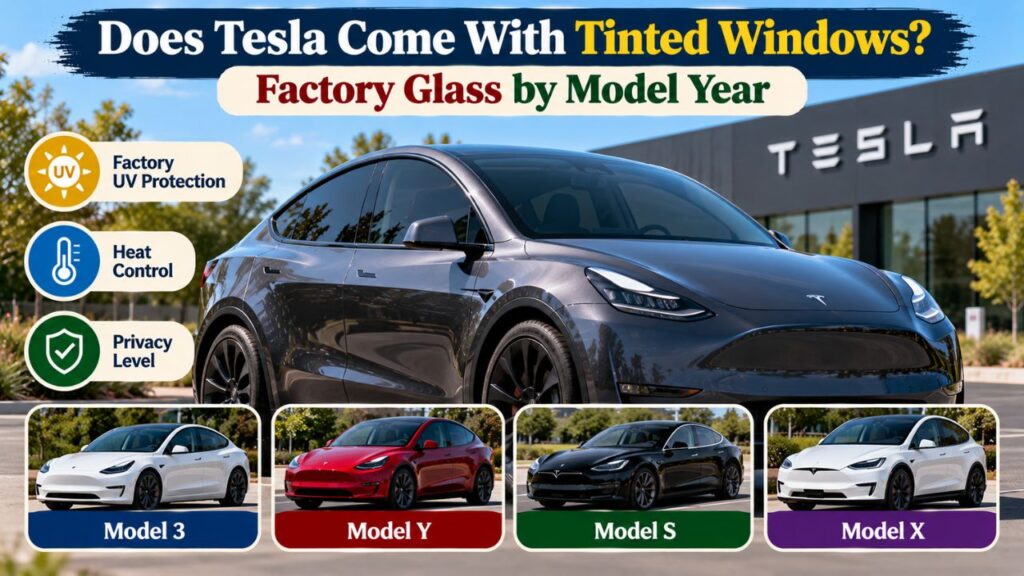
Tesla vehicles generally include some level of factory glass shading or solar protection, but the amount of visible tint varies between models and individual windows.
The windshield, front side windows, rear windows, and panoramic roof may use different types of glass.
Some are designed primarily for clear visibility.
Others incorporate darker privacy glass or specialized solar-control coatings.
A useful distinction is that UV protection does not necessarily mean visibly dark tint.
Even relatively clear automotive glass can reduce ultraviolet transmission.
Tesla Factory Window Tint Comparison
| Tesla model | Front side windows | Rear passenger windows | Roof or upper glass |
| Model 3 | Generally light factory glass | Usually lighter than Model Y privacy glass; varies by year and market | Factory solar-protective glass roof on applicable trims |
| Model Y | Generally light factory glass | Commonly darker privacy glass | Solar-protective roof glass; visibility and configuration vary by trim |
| Model S | Generally relatively light front glass | Factory shading varies by production year and specification | Solar-protective glass roof on applicable versions |
| Model X | Generally relatively light front glass | May have darker rear privacy glass depending on configuration | Large windshield and roof glass with UV protection |
| Cybertruck | Relatively light front glass | Factory rear privacy shading varies by glass and configuration | Glass roof with UV protection |
These are general characteristics, not fixed specifications for every model year.
Tesla updates vehicle designs and glass components, so the safest way to confirm factory tint is to inspect the specific vehicle or check its original equipment information.
Why Some Tesla Windows Look Darker Than Others
Tesla uses different glass technologies depending on window location.
A dark rear window may contain privacy-tinted glass, while a lighter front window may use glass designed to preserve driver visibility.
The panoramic roof may use specialized coatings to reduce solar energy transmission.
As a result, two windows can have different appearances even when both provide ultraviolet protection.
Key Takeaway: Tesla’s factory glass provides solar protection, but the visible darkness and privacy level are not uniform across every model or window.
Does the Tesla Model 3 Come With Tinted Windows?
The Tesla Model 3 comes with factory glass that provides ultraviolet protection, but its side windows are generally much lighter than the dark privacy glass found on many Model Y vehicles.
The Model 3 is designed to maintain a bright cabin with large glass surfaces.
Its panoramic glass roof includes built-in sun protection.
However, owners seeking darker side windows or greater daytime privacy often choose aftermarket tint.
Are Tesla Model 3 Front Windows Tinted?
The Model 3’s front side windows generally have relatively clear factory glass.
They do not typically have the dark appearance associated with aftermarket 20% or 35% tint.
However, relatively clear glass does not mean that it transmits all ultraviolet radiation.
Tesla specifies UV-protective characteristics for its automotive glass.
If you want darker front side windows, aftermarket film may be an option where permitted by state law.
Are Tesla Model 3 Rear Windows Tinted?
The rear passenger windows on many Model 3 vehicles are relatively light compared with the rear privacy glass commonly used on the Model Y.
However, factory specifications and glass appearance can vary by model year, market, and production configuration.
Some Model 3 rear windshields also have darker upper glass areas that blend visually with the roof.
This does not mean the entire rear windshield necessarily has the same tint percentage.
For a used Model 3, it is also possible that a previous owner installed aftermarket window film.
Inspect the vehicle rather than assuming every dark rear window came that way from the factory.
Is the Tesla Model 3 Glass Roof Already Tinted?
Yes. Model 3 vehicles equipped with the panoramic glass roof have built-in solar-protective glazing.
According to the Tesla Model 3 Owner’s Manual, the roof, windshield, and windows provide significant ultraviolet protection.
Tesla reports that these glass components score below 2 on the UV Index scale under its stated assessment.
However, the manual also reminds occupants to take appropriate sun-protection precautions.
The panoramic roof can therefore provide UV protection without requiring a separate aftermarket film.
Additional roof tint may still be considered for heat or glare management, but it is not automatically necessary.
Does the Tesla Model Y Come With Tinted Windows?
Yes, many Tesla Model Y vehicles come with noticeably darker rear privacy glass and a solar-protective roof, while the front side windows remain comparatively light.
This creates a visible difference between the front and rear sections of the vehicle.
It is one reason Model Y owners sometimes choose additional tint for the front side windows.
Are Model Y Rear Windows Tinted From the Factory?
Many Model Y configurations include darker rear passenger glass and rear hatch glass.
These windows provide increased daytime privacy compared with the lighter front side windows.
However, the precise darkness can differ between production years and regional specifications.
For example, equipment descriptions for certain earlier Model Y vehicles identify deep-tinted glass.
That description does not establish one universal VLT percentage across all Model Y versions.
If you want to match the front windows to the factory rear glass, measure the existing VLT first.
Do not assume a 20% aftermarket film will automatically match the rear windows.
Does the Model Y Glass Roof Have Built-In Tint?
Model Y roof glass is designed with solar protection.
Tesla’s January 2025 Model Y product information identifies tinted roof safety glass with an infrared-reflective coating on the updated version.
The same material describes laminated safety glass used in the vehicle.
This information appears in Tesla’s January 29, 2025, official vehicle update.
However, roof configurations differ between trims and production years.
Some newer versions have different interior roof treatments or headliner arrangements.
Check the actual vehicle before assuming every Model Y has the same visible panoramic glass area.
Should You Tint the Front Windows to Match the Rear?
That depends on your goals and local laws.
Owners sometimes want a consistent dark appearance across the side windows.
However, matching the rear windows visually may require a front tint darker than the law allows.
Factory glass also affects the final light transmission after film installation.
A better approach is to measure the front and rear glass, determine the legal front-window limit, and select a suitable film.
If heat rejection is the main goal, a lighter ceramic film may offer better value than pursuing an exact visual match.
Do Tesla Model S and Model X Come With Tinted Windows?
Tesla Model S and Model X vehicles also use factory glass with solar-protective properties.
However, their rear privacy glass appearance and roof configurations have changed over different production generations.
Tesla Model S Factory Tint
The Model S typically has relatively light front glass.
Rear-window shading depends on the model year and original glass configuration.
Some versions have darker rear glazing, while others may appear more transparent.
Glass roof designs have also changed over the Model S production history.
The current Tesla Model S Owner’s Manual provides model-specific glass and window information.
When buying a used Model S, inspect each window for existing aftermarket film.
Tesla Model X Factory Tint
The Model X has large glass surfaces, including its distinctive windshield and upper glazing arrangement.
Its rear passenger windows may have factory privacy shading, depending on the configuration.
The Model X glass is also designed to provide UV protection.
The large windshield and roof area make solar comfort important, but the factory glass and the need for additional tint should be evaluated separately.
Because of the Model X’s unusual glass geometry, windshield and roof film installation requires particular care.
Does the Cybertruck Come With Tinted Windows?
Cybertruck uses factory glazing with UV-protective characteristics, and its rear glass may provide greater privacy than the front windows.
Exact factory shading depends on the window and configuration.
The Tesla Cybertruck Owner’s Manual confirms that the windshield, windows, and roof glass provide significant UV protection.
Owners seeking additional glare reduction or privacy can consider compatible aftermarket film, subject to local laws and glass requirements.
What Is the Difference Between Tesla Factory Tint and Aftermarket Tint?
Factory privacy glass and aftermarket window tint can look similar, but they are not necessarily constructed the same way.
Factory Privacy Glass
Factory privacy glass usually gets its darker appearance from the glass itself or its manufacturing process.
It is part of the original vehicle glazing.
This means the darkness is not necessarily created by an adhesive film applied to the interior surface.
Factory privacy glass commonly provides:
- A darker exterior appearance
- Increased daytime privacy
- Reduced visible light transmission
- Some solar protection, depending on its design
However, privacy glass does not automatically offer the same infrared heat rejection as a high-performance ceramic film.
The actual performance depends on the glass construction.
Aftermarket Window Tint Film
Aftermarket tint is a separate film applied to the glass after manufacture.
It can provide additional benefits such as:
- Increased privacy
- Reduced visible glare
- Additional UV protection
- Improved infrared heat rejection
- Lower total solar energy transmission
- A more consistent appearance between windows
The exact benefits depend on the selected film.
Some films focus mainly on darkness.
Others use ceramic or multilayer technology to improve heat rejection while preserving relatively high visible light transmission.
Factory Glass vs. Aftermarket Film
| Feature | Tesla factory glass | Aftermarket window tint |
| Installed during vehicle production | Yes | Usually installed later |
| UV protection | Built into Tesla glazing | Depends on film specifications |
| Dark privacy appearance | Available on certain windows and models | Available in different VLT options |
| Infrared heat control | Depends on glass and coatings | Depends on film technology |
| Color selection | Determined by factory specification | Multiple shades available |
| Easy to remove | Glass normally must be replaced to change intrinsic shade | Film can generally be removed |
| Legal considerations | Factory vehicle glazing requirements apply | Installed VLT and other local rules apply |
| Warranty considerations | Covered according to factory warranty terms | Depends on film, installer, and related damage |
Key Takeaway: Factory privacy glass is not automatically equivalent to premium ceramic tint. A window may already look dark yet still benefit from a well-chosen heat-rejecting film.
What Percentage Tint Does Tesla Come With?
Tesla does not publish one universal VLT percentage for every window across all models and production years.
The factory tint level varies by glass location and vehicle configuration.
Why Exact Factory Tint Percentages Are Difficult to Generalize
Visible Light Transmission measures the percentage of visible light passing through the glass.
A lower VLT indicates darker glazing.
For example:
| VLT percentage | General appearance |
| 80% | Relatively clear |
| 70% | Very light |
| 50% | Light to moderate |
| 35% | Noticeably dark |
| 25% | Dark privacy appearance |
| 20% | Very dark |
| 5% | Extremely dark |
These values describe general appearances, not Tesla’s official factory specifications.
A Model Y rear window may appear much darker than its front side window, but visual appearance alone cannot identify the exact VLT.
Different glass colors, interior lighting conditions, and vehicle angles can affect the impression.
How to Check Your Tesla’s Factory Tint Percentage
The most reliable method is to use a suitable VLT meter.
An automotive tint installer can measure the existing glass before applying additional film.
You can also:
- Identify the vehicle’s model year and trim.
- Check its original equipment information.
- Inspect the glass markings.
- Look for signs of existing aftermarket film.
- Ask Tesla or a qualified glass specialist about the original glazing.
- Request a measured VLT reading.
Avoid treating measurements from another owner’s Tesla as a guaranteed specification for your vehicle.
Does Tint Film Add to Factory Tint?
Yes. Adding aftermarket film reduces the total light transmitted through the glass.
The combined VLT is not calculated by subtracting the film percentage from the factory percentage.
Instead, a simplified formula is:
Combined VLT = Glass VLT × Film VLT
For example, suppose a Tesla window has 70% VLT and you apply a film with 50% VLT.
0.70 × 0.50 = 0.35
The approximate combined VLT becomes 35%.
If the original glass transmits only 25% and a 50% film is added:
0.25 × 0.50 = 0.125
The combined VLT would be approximately 12.5%.
These are illustrative calculations. Actual installed measurements can vary based on product specifications and testing conditions.
This is why dark factory rear glass should be measured before additional tint is installed.
Does Tesla Factory Glass Block UV Rays?
Yes. Tesla’s official owner documentation identifies UV protection as a feature of its automotive glass.
This protection is not limited to windows that look dark.
Tesla Roof Glass UV Protection
Tesla’s panoramic roof glass is designed to reduce ultraviolet exposure.
In the Model 3 and Model Y manuals, Tesla states that the glass components provide substantial UV protection.
However, UV protection does not mean the roof blocks all incoming solar heat.
Visible and infrared radiation also contribute to cabin heating.
A glass roof can therefore provide good UV protection while still allowing occupants to experience warmth in direct sunlight.
Do Clear Tesla Windows Block UV?
Yes. Tesla’s owner documentation identifies UV-protective properties across the vehicle’s glass, not just the dark rear windows.
This is an important reason not to assume that clear glass offers no sun protection.
However, ultraviolet protection and infrared heat rejection are different measurements.
The amount of heat entering through a particular window depends on its glazing and coatings.
Does Tesla’s Factory Tint Prevent Sun Damage?
Factory glass can reduce UV exposure, which may help limit UV-related damage.
However, it does not eliminate every form of solar exposure or interior fading.
Sunlight, temperature, and material characteristics can still affect interior components over time.
Passengers should continue following appropriate sun-protection precautions.
Do Tesla Windows Block Heat Without Additional Tint?
Tesla vehicles use different forms of glazing and solar-control technology.
Some glass surfaces incorporate specialized coatings intended to reduce solar heat.
However, the performance is not identical across every window.
Factory Heat Rejection vs. Privacy Glass
A window’s visible darkness is not a direct measure of its heat rejection.
For example, a dark rear privacy window may transmit less visible light than a clear front window.
But a lighter window with specialized infrared-control technology may reject a substantial amount of solar heat.
To compare actual performance, look for Total Solar Energy Rejection (TSER) and related technical specifications.
Without comparable test data, it is difficult to determine how much additional heat rejection a particular aftermarket film will provide.
Does the Glass Roof Get Hot?
Tesla glass roofs can become warm in strong sunlight.
Their solar-control properties reduce some energy transmission, but they do not eliminate heat absorption or heat transfer.
Cabin temperature depends on:
- Outdoor temperature
- Sunlight intensity
- Parking duration
- Vehicle orientation
- Roof construction
- Interior materials
- Climate-control operation
A reflective sunshade can be a practical alternative when additional shade is needed.
Never assume factory tint makes a parked vehicle safe for unattended children or pets.
Will Tinting Tesla Windows Improve Driving Range?
Additional heat-rejecting film may reduce some solar load on the cabin.
In hot conditions, this can reduce the work required from the climate-control system.
However, the effect on driving range depends on many variables.
Window film should not be purchased based on an assumed percentage increase in battery range.
Cabin comfort and solar protection are more predictable reasons to consider it.
Can You Add Window Tint to a Tesla?
Yes. Tesla vehicles can be fitted with compatible aftermarket automotive window film.
However, the film must meet applicable legal requirements and be suitable for the specific glazing.
Tesla also offers or facilitates professional window tint installation through certain programs and markets.
For example, Tesla’s official XPEL Window Tint offering describes professionally installed ceramic tint with UV protection, heat rejection, and product warranty coverage.
Availability, vehicle eligibility, pricing, and installation arrangements can vary.
Best Type of Window Tint for Tesla
A quality nonmetallic ceramic film is worth considering when heat rejection is the main goal.
Advantages may include:
- Strong infrared control
- Good UV rejection
- Multiple VLT options
- Low risk of radio-frequency interference
- Good optical clarity
- A neutral appearance
However, not every ceramic film performs equally.
Compare manufacturer specifications rather than choosing solely by the ceramic label.
Should You Tint Tesla Front Windows?
Front side windows are often the first areas owners consider because they may look noticeably lighter than the rear glass.
Adding film can improve visual consistency and solar comfort.
However, the final installed VLT must comply with state law.
It may be impossible to match dark rear privacy glass while maintaining the legally required front-window transparency.
In that situation, prioritize legal compliance and outward visibility.
Should You Tint the Rear Windows?
Additional rear tint can be useful if greater privacy or solar heat rejection is desired.
However, factory rear glass may already be relatively dark.
Adding film can reduce nighttime visibility substantially.
Measure the original VLT before choosing another layer.
For heat rejection without excessive darkness, consider a suitable high-transmission ceramic film.
Should You Tint the Tesla Glass Roof?
Not automatically.
Tesla panoramic roof glass already has built-in solar-protective characteristics.
Additional film may provide some benefits, but the improvement depends on the roof’s original construction and the selected film.
Roof tinting also requires careful consideration of thermal compatibility.
Certain film-and-glass combinations may increase thermal stress.
Before adding film, ask Tesla or a qualified specialist whether the particular film is approved or appropriate for the exact roof glass.
A removable roof sunshade may be a simpler option when the primary concern is direct sunlight.
Does Window Tinting a Tesla Void the Warranty?
Installing aftermarket tint does not automatically mean every part of the Tesla vehicle warranty becomes invalid. However, damage or failures caused by an incompatible film or improper installation may not be covered.
Warranty treatment depends on the warranty terms, applicable law, and the cause of the problem.
Potential Warranty Concerns
Tint installation can involve:
- Glass surface damage
- Window-seal damage
- Defroster damage
- Excess application liquid near electronics
- Sensor interference
- Thermal stress from unsuitable film
- Improper film removal
If an installer damages a component, responsibility for the repair may fall outside normal factory warranty coverage.
For that reason, choose a professional who is familiar with the specific Tesla model.
What About Tesla’s Own Tint Services?
Tesla’s official tint programs may include specific warranty arrangements.
For example, Tesla’s XPEL offering describes warranty coverage and film replacement provisions when qualifying glass replacement is required under the vehicle’s limited warranty.
Check the written terms for your region.
Do not assume the same coverage applies to an unrelated aftermarket installation.
What if the Tesla Is Leased?
Leased Tesla vehicles require additional caution.
Tesla’s lease-end guidance states that aftermarket modifications, including changes to original factory window tint, must be removed before vehicle return.
Failure to restore the vehicle may result in additional charges.
Check the current lease terms before installing aftermarket film.
What Should Tesla Owners Consider Before Tinting?
Tesla vehicles have several glass and electronic features that require careful installation.
Cameras and Driver-Assistance Systems
Tesla vehicles use cameras for visibility and driver-assistance functions.
Do not apply film in a way that obstructs camera viewing areas.
Even a film marketed as optically clear should not automatically be assumed compatible with every sensor or camera.
For windshield applications, follow Tesla’s current restrictions and obtain guidance from a qualified installer.
Large Rear Windshields
Some Tesla models have large, curved rear glass.
The film may require careful heat shaping.
Improper installation can produce creases, distortion, or damage to glass-mounted components.
A shop experienced with Tesla rear windshields is generally preferable.
Frameless Door Windows
Several Tesla models use frameless door glass that automatically lowers slightly when a door is opened.
Freshly installed tint requires adequate curing time.
Follow the film manufacturer’s and installer’s instructions for opening, closing, and operating the windows.
The installer should account for the normal automatic glass movement.
Tint Laws
Window tint requirements vary across the United States.
Rules can differ for front side windows, rear windows, and windshields.
Some states also regulate reflectivity or film colors.
Factory glass contributes to the final VLT after aftermarket film is installed.
Check the requirements for the vehicle’s registration jurisdiction before selecting a tint percentage.
Is Aftermarket Window Tint Worth It on a Tesla?
Aftermarket tint can be worthwhile when it provides a benefit not already delivered by the factory glass.
However, there is no need to tint every window simply because other Tesla owners do.
When Additional Tint Makes Sense
Additional film may be useful when:
- Front side windows allow uncomfortable solar heat.
- You want greater daytime privacy.
- A darker, more uniform appearance is important.
- You drive frequently in hot, sunny conditions.
- You want stronger solar control without substantially reducing visible light.
- A particular factory glass surface does not meet your comfort preferences.
When Factory Glass May Be Enough
You may not need additional film when:
- You are satisfied with the factory privacy level.
- The cabin feels comfortable in normal driving conditions.
- The panoramic roof provides adequate protection.
- Nighttime visibility is a high priority.
- The vehicle is leased and modifications are inconvenient.
- Additional tint would violate local laws.
For some owners, a removable sunshade or another comfort measure may be more practical than permanent aftermarket film.
How Much Does Tesla Window Tint Cost?
Costs depend on film type, coverage, vehicle configuration, and installer.
Tesla-specific glass shapes can affect installation labor.
An installation limited to the two front side windows will generally cost less than a full-vehicle ceramic tint package.
Specialized windshield or roof work can increase the total cost.
Rather than relying on a fixed price, request a written quote identifying the exact film series, covered windows, warranty, and any special glass considerations.
How to Tell if a Used Tesla Already Has Aftermarket Tint
A used Tesla may have factory privacy glass, aftermarket film, or a combination of both.
This distinction matters before purchasing additional tint.
Look for Film Edges
Aftermarket tint is usually installed on the interior side of the glass.
On certain windows, a thin film edge may be visible near the upper boundary.
However, a professional installation may have very clean edges that are difficult to notice.
Do not use this method alone to determine whether film is present.
Inspect for Film Defects
Possible signs of older aftermarket film include:
- Peeling corners
- Bubbles
- Adhesive residue
- Scratches on the film surface
- Uneven color
- Visible film boundaries
However, the absence of defects does not prove the glass is untinted.
Measure the Existing VLT
A tint shop can measure how much visible light passes through the window.
The reading helps determine the current darkness.
However, a VLT meter does not by itself identify whether the shading comes from factory glass or aftermarket film.
For the most reliable answer, combine measurement with inspection and original vehicle specifications.
Conclusion
Does Tesla come with tinted windows? Yes, Tesla vehicles have factory glass with UV-protective properties, and many models also include tinted roof glass or darker rear privacy windows. However, not every Tesla has dark side windows, and the factory tint configuration varies by model, trim, production year, and market.
The Model Y commonly features darker rear privacy glass, while the Model 3 generally has lighter side windows and a solar-protective panoramic roof. Model S, Model X, and Cybertruck configurations also vary.
For drivers who want additional heat rejection, a properly selected ceramic film may improve cabin comfort without requiring extremely dark glass.
However, Tesla’s existing solar-protective glazing should be evaluated before paying for additional tint.
I recommend checking the exact vehicle’s factory glass, measuring its current VLT, and comparing the heat performance of compatible aftermarket films.
Choose an installer familiar with Tesla glass, cameras, and window mechanisms, and confirm that the finished tint meets local regulations.
FAQs About Does Tesla Come With Tinted Windows
Does Tesla Model 3 Come With Factory-Tinted Windows?
The Model 3 has factory glass with UV protection and a solar-protective panoramic roof on applicable configurations.
However, its side windows are generally relatively light compared with the darker rear privacy glass found on many Model Y vehicles.
The exact appearance depends on the model year and market.
Does the Tesla Model Y Have Factory-Tinted Rear Windows?
Yes. Many Model Y vehicles have darker rear passenger windows and rear hatch privacy glass.
However, the exact tint percentage can vary by production configuration.
Measure the specific vehicle before purchasing film intended to match its factory rear glass.
Are Tesla Front Windows Tinted From the Factory?
Tesla front side windows generally have a relatively light appearance rather than dark privacy tint.
However, Tesla’s factory glass offers UV-protective properties even when it looks clear.
Aftermarket tint may be added where permitted by law.
Does Tesla Come With Ceramic Window Tint?
Tesla’s factory solar-control glass is not automatically equivalent to an aftermarket ceramic window tint film.
Some factory glass uses specialized coatings or laminated constructions.
Tesla also offers professional aftermarket ceramic window tint services in certain markets and programs.
Check the exact vehicle and product specifications.
Do Tesla Glass Roofs Block UV Rays?
Yes. Tesla’s owner manuals identify significant UV protection in the roof glass of applicable models.
However, UV protection does not mean the roof blocks every type of solar energy.
Additional shading may still be useful for some occupants.
Should I Tint My Tesla if It Already Has Factory Tint?
Not necessarily.
If the factory glass provides enough privacy and comfort, additional film may offer limited value.
If heat rejection is the main concern, compare the existing glass with the documented solar-control performance of a compatible film.
Does Tinting a Tesla Void the Warranty?
Tinting does not automatically invalidate every part of the vehicle warranty.
However, damage caused by improper installation or an incompatible product may not be covered.
Check Tesla’s warranty terms, the installer’s liability coverage, and any special restrictions on glass or sensor areas.
Can Tesla Factory Tint Be Removed?
If the darkness is part of the original glass construction, it cannot simply be peeled away like aftermarket tint film.
Changing that appearance generally requires replacing the relevant glass with a compatible alternative.
Aftermarket adhesive film can usually be removed, although the process requires care around defrosters and other glass-mounted features.
Does Tesla Offer Window Tint Installation?
Yes, in certain markets and through selected programs.
Tesla has offered professional window tint packages using products from established film manufacturers, including XPEL.
Availability, pricing, vehicle eligibility, and warranty conditions vary, so check the current Tesla Shop or service information for your region.