If you are considering buying or already own a portable jump starter, you may wonder, “How long does a jump starter last?” The answer depends on whether you mean how long the jump starter can provide power during an emergency or how many years its internal battery can remain usable.
A good-quality jump starter can typically last several years with proper care. However, its battery gradually loses capacity over time. How frequently you use it, how often you recharge it, storage temperature, battery type, and overall build quality can all affect its lifespan.
A jump starter that is regularly maintained and stored correctly can remain useful for years, while one exposed to extreme heat or left completely discharged for long periods may deteriorate much faster.
How Long Does a Jump Starter Last?
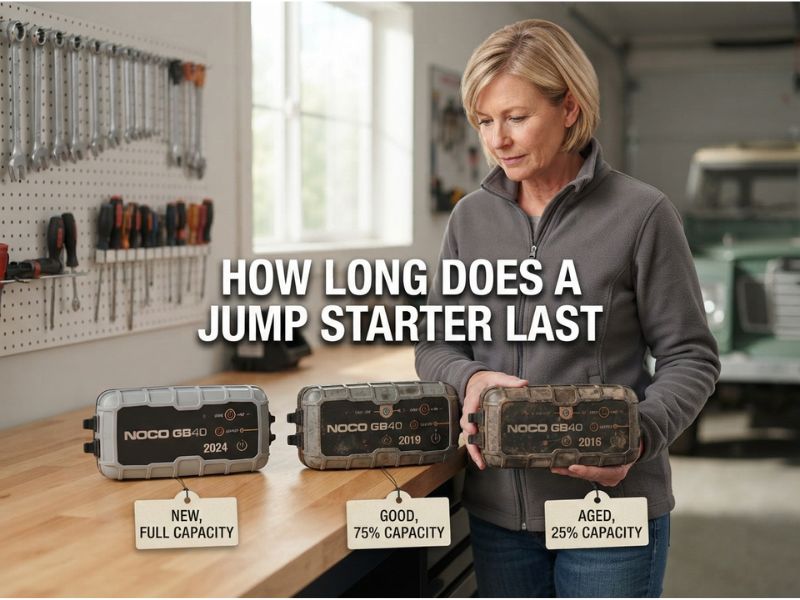
A typical portable jump starter can last approximately 3 to 5 years, although some units may provide useful service for longer or fail sooner depending on battery quality and maintenance.
There are two different types of lifespan to consider:
Service life: How many years the jump starter remains usable.
Jump-start capacity: How many vehicle starts it can provide from a particular charge.
These are not the same thing. A jump starter might be capable of performing several jump starts on one full charge, but its internal rechargeable battery can still gradually lose capacity as it ages.
Modern lithium-ion jump starters generally offer good energy density and compact designs, making them popular for emergency roadside use.
How Many Times Can a Jump Starter Jump a Car?
The number of jump starts available from one charge varies considerably between models.
A small portable jump starter might provide only a few successful starts before needing to be recharged, while a larger high-capacity unit may provide more.
The actual number depends on several factors, including:
- Battery capacity
- Engine size
- Vehicle battery condition
- Temperature
- Jump starter efficiency
- Starting current
- Condition of the vehicle’s electrical system
- How long the starter motor needs to crank
For example, starting a small gasoline engine with a moderately discharged battery generally requires less energy than repeatedly cranking a large engine with a severely depleted battery.
Manufacturers sometimes advertise a specific number of starts per charge, but real-world performance can vary.
How Long Does a Jump Starter Battery Last?
The internal jump starter battery is usually the component that determines the device’s overall lifespan.
Many modern portable models use lithium-ion batteries because they can store substantial energy in a relatively small package. Over time, repeated charging and discharging causes battery capacity to decline.
A battery may still function after several years but hold less energy than when it was new.
This means an older jump starter might:
- Hold less charge
- Provide fewer jump starts
- Require more frequent charging
- Take longer to charge
- Lose charge faster while stored
Eventually, the battery may no longer provide enough power to start a vehicle reliably.
How Long Does a Jump Starter Last on One Charge?
A jump starter can remain charged for weeks or months when stored, but the exact amount of time depends on the model and battery condition.
Rechargeable batteries naturally experience self-discharge, even when the device is not being used. Modern electronics can also consume a small amount of power while the device is stored.
For this reason, you should not assume that a jump starter will remain fully charged indefinitely.
If you keep one in your vehicle as emergency equipment, check its battery level periodically. A jump starter that shows only a small remaining charge may not have enough energy for a reliable engine start.
How Often Should You Recharge a Jump Starter?
Most portable jump starters should be checked and recharged periodically, even if you have never used them.
A practical approach is to inspect the battery level every few months and recharge it when necessary. Always follow the specific maintenance recommendations supplied by the manufacturer.
Regular charging helps ensure that the jump starter is ready when you need it.
This is especially important if the unit spends most of its life stored in a vehicle. You may not notice a gradual loss of charge until an emergency occurs.
Does Using a Jump Starter Reduce Its Lifespan?
Yes, repeated use can contribute to battery wear, but occasional emergency use is generally what these devices are designed for.
Rechargeable batteries have a limited number of charge cycles. A charge cycle represents the equivalent of using and replacing a substantial portion of the battery’s stored energy.
You do not necessarily complete one full cycle every time you use a jump starter. For example, using a small amount of its capacity and then recharging it contributes only partially toward a full cycle.
Frequent heavy use can therefore accelerate battery degradation compared with occasional use.
However, storage conditions and battery maintenance can be just as important as the number of jump starts.
Does Heat Shorten the Life of a Jump Starter?
Yes. Extreme heat can significantly affect rechargeable batteries.
This is particularly relevant for people who keep a jump starter inside their vehicle. A parked vehicle can become extremely hot under direct sunlight, and prolonged exposure to high temperatures can accelerate battery degradation.
High temperatures may cause the battery to lose capacity more quickly and can shorten its overall service life.
Whenever possible, store a jump starter in a cool, dry, temperature-controlled location when it is not needed in the vehicle.
If you must keep it in your car, avoid placing it where it will receive direct sunlight or excessive heat.
Does Cold Weather Affect Jump Starter Life?
Cold temperatures can affect the performance of a jump starter, even if they do not necessarily cause permanent damage from a brief exposure.
A cold lithium-ion battery can temporarily deliver less power than it would at a moderate temperature. This can be particularly noticeable when attempting to start a vehicle during winter.
Extremely cold conditions can therefore reduce available performance at the exact moment you need maximum starting power.
Allowing the jump starter to return to a suitable operating temperature before use, when practical, can help. Always follow the manufacturer’s specified operating-temperature range.
How Long Do Lithium Jump Starters Last?
Lithium-ion jump starters can commonly provide several years of useful service when properly maintained.
Their actual lifespan depends on:
- Battery quality
- Number of charge cycles
- Storage temperature
- Charging habits
- Depth of discharge
- Manufacturing quality
- Long-term storage conditions
Lithium batteries do not suddenly become useless after a fixed number of years. Instead, their usable capacity generally decreases gradually.
A five-year-old jump starter may still work, but it may not deliver the same performance it provided when new.
Do Jump Starters Expire?
A jump starter does not normally have a simple expiration date like food or certain chemical products.
However, its internal battery ages and eventually loses enough capacity that the device becomes unreliable.
Some manufacturers provide recommended replacement periods or storage guidelines. If your jump starter is several years old, inspect its performance rather than assuming it is still capable of delivering its original starting power.
Warning signs that an older jump starter may be reaching the end of its useful life include:
- Battery drains unusually quickly
- Charging takes much longer than before
- Device will not reach full charge
- Battery indicator drops rapidly
- Jump-start performance becomes inconsistent
- Device shuts down under load
- Battery casing becomes swollen
A swollen or physically damaged battery should not be used.
How Do You Know When a Jump Starter Is Bad?
A jump starter may be nearing the end of its useful life if it repeatedly fails to hold a charge or cannot provide enough power to start a vehicle despite being fully charged.
Before replacing it, rule out other problems.
For example, check whether:
- The charging cable is working
- The charger is compatible
- The jump starter is actually fully charged
- The clamps are connected correctly
- The vehicle battery has a separate mechanical or electrical problem
- The jump starter is rated appropriately for the engine
If the jump starter consistently fails despite correct operation and adequate charging, its internal battery may have degraded.
Can a Jump Starter Go Bad From Sitting?
Yes. A jump starter can deteriorate even if it is rarely used.
Rechargeable batteries gradually lose capacity during storage. Leaving a jump starter completely discharged for an extended period can also contribute to battery degradation.
This is why emergency equipment should be inspected periodically.
Simply purchasing a jump starter and leaving it untouched in a garage for several years is not a reliable maintenance strategy.
Check the charge level regularly and follow the manufacturer’s storage recommendations.
How to Make a Jump Starter Last Longer
Proper maintenance can significantly improve the useful life of a jump starter.
Keep the Battery Charged
Avoid storing the device with a completely depleted battery for long periods. Check the battery indicator periodically and recharge it according to the manufacturer’s instructions.
Avoid Extreme Temperatures
Heat is particularly harmful to rechargeable batteries. Store the jump starter away from direct sunlight and excessive heat whenever possible.
Use the Correct Charger
Use the recommended charging cable and power adapter. An incompatible charging setup can result in poor charging performance or potentially damage the device.
Keep It Dry
Moisture can damage electronic components and electrical connections. Store the jump starter in a dry environment.
Avoid Unnecessary Deep Discharges
You do not need to repeatedly drain the jump starter completely just to recharge it. Recharge it according to the manufacturer’s guidance.
Inspect It Regularly
Check the device for physical damage, swelling, damaged cables, corrosion, or unusual odors. If the battery appears damaged, stop using the unit.
How Long Should You Leave a Jump Starter Charging?
Charging time depends on the battery capacity, charging technology, charger output, and remaining battery level.
Some modern USB-C jump starters can recharge relatively quickly, while larger models may require several hours.
The safest approach is to follow the charging time and indicator information provided by the manufacturer.
Do not assume that leaving a jump starter connected longer will make it perform better. Modern units may include charging-management and overcharge-protection systems, but you should still follow the manufacturer’s instructions.
Is It Worth Replacing an Old Jump Starter?
Replacing an old jump starter can be worthwhile if you depend on it for emergency roadside assistance.
The main issue with an aging jump starter is not simply that it is old. The concern is whether its battery capacity and starting performance are still adequate.
If the device no longer holds a reliable charge, takes unusually long to recharge, or repeatedly fails to start vehicles that are within its rated specifications, replacement is sensible.
A jump starter is emergency equipment, so reliability is more important than squeezing a few additional years out of an aging battery.
How Long Does a Jump Starter Last in Storage?
A jump starter can remain stored for months, but it should not be treated as maintenance-free emergency equipment.
Its stored charge gradually decreases through self-discharge and standby power consumption. The rate varies by model and battery condition.
For long-term storage, follow the manufacturer’s recommended storage charge and temperature range.
Check the battery periodically rather than waiting until you need the device during a roadside emergency.
Can You Replace the Battery in a Jump Starter?
Battery replacement depends on the design of the jump starter.
Some devices have batteries that are not intended to be user-replaceable. Opening the unit yourself can expose you to electrical and battery-related hazards, particularly when dealing with a lithium-ion battery.
If the battery is no longer holding a charge, check whether the manufacturer offers a replacement battery, repair service, or warranty support.
Do not attempt to dismantle a swollen, damaged, leaking, or overheating lithium battery.
Jump Starter Lifespan vs. Car Battery Charger
A jump starter and a car battery charger have different jobs.
A jump starter is designed to provide a high burst of electrical power to help crank an engine. A battery charger is designed to gradually restore energy to the vehicle’s battery.
If your primary need is emergency starting, a jump starter is useful.
If your goal is maintaining or recharging a vehicle battery, a dedicated battery charger or battery maintainer may be more appropriate.
Using each device for its intended purpose can help prevent unnecessary wear and improve reliability.
What Affects Jump Starter Lifespan the Most?
Several factors influence how long a jump starter remains useful.
| Factor | Effect on Lifespan |
| Battery quality | Higher-quality cells generally provide better longevity |
| Extreme heat | Can accelerate battery degradation |
| Frequent heavy use | Increases charge-cycle wear |
| Deep discharge | Can contribute to battery stress |
| Poor storage | May reduce battery performance |
| Incorrect charging | Can cause charging problems or damage |
| Long-term neglect | Increases the chance of finding a dead battery during an emergency |
Among these factors, temperature, battery quality, charging habits, and storage conditions are particularly important.
Final Answer: How Long Does a Jump Starter Last?
So, how long does a jump starter last? A quality portable jump starter can often provide around 3 to 5 years of useful service, although actual lifespan varies significantly depending on battery quality, usage, charging habits, and storage conditions.
The number of jump starts available from a single charge is a separate issue. A fully charged unit may provide multiple starts, but engine size, battery condition, temperature, and the jump starter’s capacity all affect the result.
To maximize its lifespan, keep the rechargeable battery adequately charged, avoid extreme temperatures, use the correct charger, and inspect the unit periodically. If it stops holding a charge or consistently fails to deliver sufficient starting power, replacing it is usually better than relying on an aging device during an emergency.
A jump starter is most valuable when you need it unexpectedly, so maintaining it before an emergency is the best way to ensure it actually works when required.