Choosing the right jump starter can be confusing because manufacturers advertise peak amps, starting amps, battery capacity, and engine-size compatibility. If you’re wondering what amp jump starter do I need, the answer depends mainly on your vehicle’s engine size, fuel type, battery condition, and the manufacturer’s recommendations.
For many everyday cars with gasoline engines, a jump starter rated around 400 to 800 starting amps can be sufficient. Larger vehicles, trucks, SUVs, and diesel engines generally benefit from a more powerful unit, often 800 to 1,500+ starting amps.
However, higher advertised peak amps do not automatically mean a jump starter is better. Understanding the difference between peak amps and starting amps is important when choosing a reliable portable jump starter.
What Amp Jump Starter Do I Need?
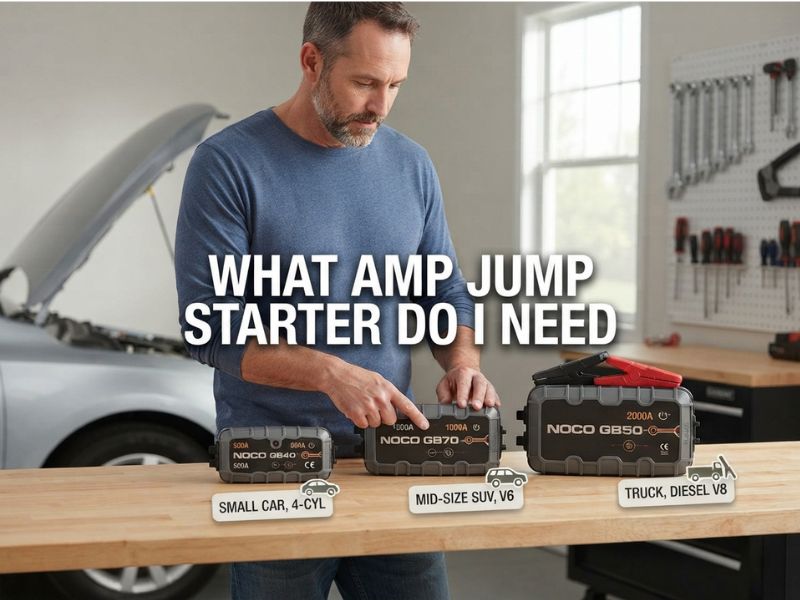
The appropriate jump starter depends on your vehicle. As a general guideline, you can use the following ranges:
| Vehicle Type | Recommended Starting Amps | Suggested Peak Amps |
| Small gasoline car | 300–500 amps | 600–1,000 amps |
| Sedan or midsize gasoline SUV | 400–700 amps | 800–1,200 amps |
| Large gasoline SUV or truck | 600–1,000 amps | 1,000–2,000 amps |
| Small diesel vehicle | 600–1,000 amps | 1,000–2,000 amps |
| Large diesel truck/SUV | 800–1,500+ amps | 1,500–3,000+ amps |
These are general guidelines rather than universal requirements. Always check the jump starter manufacturer’s stated engine-size compatibility before purchasing.
For a typical gasoline sedan, you usually don’t need an extremely large jump starter. For a large diesel truck, choosing a higher-output model provides more starting capability.
What Are Jump Starter Amps?
Amps, or amperes, measure electrical current. In a jump starter, the amp rating indicates how much electrical current the device can deliver under specified conditions.
Starting an engine requires a substantial amount of current because the starter motor must turn the engine’s crankshaft against compression and mechanical resistance.
A weak battery may not be able to provide enough current by itself. A jump starter supplements that available power, helping the starter motor crank the engine.
The important point is that the amp rating shown on a product box can represent different measurements.
Peak Amps vs. Starting Amps
One of the biggest mistakes when shopping for a jump starter is looking only at the peak amp rating.
Peak amps represent the maximum current a jump starter can potentially deliver for a very short period under specified conditions.
Starting amps, sometimes called cranking amps depending on the manufacturer, are more relevant to the jump starter’s ability to provide sustained current during engine starting.
For example, a product advertised as having 2,000 peak amps does not necessarily provide 2,000 amps continuously while starting an engine.
Because manufacturers use different testing methods and specifications, comparing products solely by peak amps can be misleading.
When possible, look at:
- Starting or cranking amp rating
- Peak amp rating
- Recommended engine size
- Gasoline and diesel compatibility
- Internal battery capacity
- Manufacturer’s vehicle recommendations
The manufacturer’s stated compatibility is often more useful than the peak-amp number alone.
How Many Amps Do I Need for a Gasoline Car?
Most ordinary gasoline-powered cars do not require an extremely powerful jump starter.
For a compact car with a small four-cylinder engine, a jump starter capable of approximately 300–500 starting amps may be adequate, depending on the vehicle and battery condition.
For midsize sedans, crossovers, and SUVs, something in the 400–700 starting-amp range can provide a useful margin.
If you want one portable jump starter that can cover several gasoline vehicles, choosing a model with around 600–1,000 starting amps can provide additional flexibility.
Keep in mind that the actual requirement varies by engine design, temperature, battery condition, and the manufacturer’s specifications.
How Many Amps Do I Need for a Truck?
Trucks generally require more starting power than small passenger cars, particularly when equipped with larger engines.
For a gasoline pickup truck, a jump starter with around 600–1,000 starting amps is a reasonable general target.
Large trucks with big-displacement engines may benefit from a higher-output jump starter.
If the truck has a diesel engine, requirements can be higher because diesel engines typically have higher compression ratios and may require substantial cranking power.
For a truck you depend on for work or towing, it is generally better to choose a jump starter with enough capacity and output for the manufacturer’s recommended engine size rather than selecting the smallest compatible model.
How Many Amps Do I Need for a Diesel Engine?
Diesel engines generally require more starting power than comparable gasoline engines.
A small diesel vehicle may work well with a jump starter providing approximately 600–1,000 starting amps, while larger diesel trucks and SUVs may require 800–1,500 or more starting amps.
Diesel engines can be particularly difficult to start in cold weather because engine oil becomes more viscous and the battery’s available performance can decrease.
For a diesel vehicle, pay close attention to the manufacturer’s engine-size recommendation and the jump starter’s stated diesel compatibility.
A jump starter that works well for a small gasoline car may not be appropriate for a heavy-duty diesel truck.
How Many Amps Do I Need for an SUV?
The appropriate jump starter for an SUV depends on the engine.
A small four-cylinder gasoline SUV may only require a moderate-output jump starter. A larger V6 or V8 SUV may benefit from a more powerful device.
As a general guide:
- Small gasoline SUV: 400–600 starting amps
- Midsize gasoline SUV: 500–800 starting amps
- Large gasoline SUV: 600–1,000+ starting amps
- Diesel SUV: 600–1,500+ starting amps
These figures are general starting points rather than exact electrical requirements.
Always compare the jump starter’s recommended engine size with your SUV’s engine.
Is 500 Amps Enough to Jump Start a Car?
For many smaller gasoline vehicles, 500 amps can be enough if the jump starter’s rating represents appropriate starting or cranking capability.
A compact four-cylinder vehicle with a moderately discharged battery may start successfully with a 500-amp jump starter.
However, 500 amps may not provide enough starting capability for larger engines, diesel vehicles, or extremely cold conditions.
If you’re purchasing one jump starter for general emergency use, choosing a somewhat higher-rated model can give you more flexibility.
Is 1000 Amps Enough for a Car?
For many passenger cars, a 1,000-amp jump starter provides substantial starting capability.
It can be suitable for many four-cylinder, six-cylinder, and some larger gasoline engines, depending on the manufacturer’s specifications.
A 1,000-amp unit can also be a practical choice if you want one device that works with multiple family vehicles.
However, don’t assume that a 1,000-amp rating guarantees compatibility with every vehicle. Always check the product’s recommended engine size and fuel type.
Is 2000 Amps Too Much for a Car?
A 2,000-amp jump starter is generally more powerful than necessary for many ordinary passenger cars, but having a higher-rated jump starter does not automatically mean it will damage the vehicle.
A properly designed jump starter supplies power when needed rather than forcing the vehicle to consume its maximum advertised current.
The main issue is not that the jump starter has “too many amps.” Instead, you should make sure the device is designed for your vehicle and has appropriate voltage, safety protections, and connection instructions.
A 2,000-amp model can make sense if you also need to start larger SUVs, trucks, or diesel vehicles.
Does a Higher Amp Jump Starter Work Better?
Not necessarily.
A higher amp rating can provide greater starting capability, but it doesn’t automatically mean the jump starter is better in every respect.
Other specifications matter, including:
- Battery capacity
- Starting-current rating
- Cable and clamp quality
- Safety protections
- Charging speed
- Size and weight
- Cold-weather performance
- Engine-size compatibility
- Warranty
- USB and accessory features
A compact 1,000-amp jump starter from a reputable manufacturer may be a better choice for a small car than a poorly designed 3,000-amp device.
The goal is to choose an appropriately rated jump starter rather than simply buying the highest number.
What Size Jump Starter Do I Need for a 4-Cylinder Engine?
For many four-cylinder gasoline engines, a jump starter rated around 300–600 starting amps can be adequate.
If you want additional reserve capacity, a model in the 600–1,000 peak-amp range or higher may be a practical choice, depending on its actual starting-current specification.
For emergency use, having some extra capacity can be useful because battery performance can decline in extreme temperatures.
However, bigger is not always necessary. A quality jump starter that meets the manufacturer’s engine-size recommendation is more important than buying the largest model available.
What Size Jump Starter Do I Need for a V6?
A V6 engine generally requires more starting power than a small four-cylinder engine.
A jump starter providing approximately 500–800 starting amps can be suitable for many gasoline V6 vehicles.
For larger V6 engines, trucks, or cold-weather applications, selecting a higher-rated model can provide additional reserve.
Again, check the jump starter’s engine-size recommendation rather than relying only on the vehicle’s cylinder count.
What Size Jump Starter Do I Need for a V8?
For a gasoline V8 engine, a jump starter with approximately 600–1,000 starting amps can be a reasonable general target.
Large-displacement V8 engines may require more.
If you regularly drive a full-size pickup, large SUV, or performance vehicle with a high-displacement V8, selecting a higher-output jump starter can provide greater flexibility.
For a V8 diesel, look at the manufacturer’s diesel-engine recommendation because diesel starting requirements can be substantially different.
Do Cold Temperatures Affect Jump Starter Performance?
Yes. Cold temperatures can make engine starting more difficult and reduce battery performance.
When temperatures fall, the chemical reactions inside a lead-acid battery slow down, reducing its ability to deliver current. Engine oil can also become thicker, increasing the effort required by the starter motor.
This is one reason a jump starter that works easily in mild weather may have more difficulty starting a vehicle in extreme cold.
If you live in a cold climate, choosing a quality jump starter with sufficient starting capacity can provide an important safety margin.
Does Battery Size Determine the Jump Starter Amps You Need?
Battery size matters, but it isn’t the only factor.
The amount of starting current required depends on the vehicle’s engine, starter motor, battery condition, temperature, electrical system, and other factors.
A larger battery does not automatically mean you need a jump starter with an identical amp rating.
The jump starter’s purpose is to provide enough supplemental current to help crank the engine.
For this reason, engine size and manufacturer compatibility are usually more useful starting points when selecting a jump starter.
What Other Features Should You Look For?
Amp rating should not be the only consideration.
A good portable jump starter may include several useful features.
Reverse-Polarity Protection
Reverse-polarity protection can help prevent damage if the clamps are accidentally connected to the wrong battery terminals.
Short-Circuit Protection
This feature can reduce the risk associated with an unintended electrical short during connection.
Overcurrent Protection
Overcurrent protection helps control excessive current and can improve the safety of the device.
Battery Capacity
Internal battery capacity determines how much stored energy the jump starter has available. A higher-capacity unit may support more starting attempts before it needs to be recharged.
Heavy-Duty Clamps and Cables
Good-quality clamps should make secure contact with the battery terminals. Cable quality also matters, particularly for higher-current applications.
USB Charging Ports
Many portable jump starters can also function as power banks, allowing you to charge phones and other USB devices during an emergency.
Built-In Flashlight
An integrated flashlight can be useful when connecting the jump starter at night or in poor visibility.
Should You Buy More Amps Than You Need?
Buying some additional capacity can be sensible, particularly if you want the jump starter to work with more than one vehicle.
For example, if your current car is a small four-cylinder gasoline vehicle but you may eventually use the jump starter on a larger SUV or truck, a moderately higher-capacity model can provide greater versatility.
However, there is little reason to choose a massive heavy-duty jump starter if you only need it for a small commuter car.
Consider vehicle compatibility, starting amps, battery capacity, portability, and reliability together.
Common Mistakes When Choosing a Jump Starter
One of the most common mistakes is selecting a product solely because it has the highest advertised peak-amp number.
Another mistake is ignoring the difference between gasoline and diesel applications.
You should also avoid assuming that every jump starter with the same amp rating performs identically. Internal battery technology, electrical design, cable quality, and testing standards can vary between products.
Other common mistakes include:
- Ignoring the manufacturer’s engine-size recommendation
- Buying a unit that is too large to carry conveniently
- Forgetting to recharge the jump starter after use
- Storing it in unsuitable temperatures
- Assuming peak amps equal continuous starting power
- Using a jump starter with an incompatible vehicle
- Ignoring safety instructions
How Often Should You Recharge a Jump Starter?
A portable jump starter should be kept sufficiently charged so it is ready when you need it.
Many manufacturers recommend checking the device periodically and recharging it when its battery level becomes low.
If you keep a jump starter in your vehicle for emergencies, check its charge periodically rather than assuming it will remain fully charged indefinitely.
Extreme temperatures can also affect lithium-ion battery performance and longevity, so follow the manufacturer’s storage recommendations.
What Amp Jump Starter Is Best for Emergency Use?
For general emergency use, a jump starter in the 600–1,000 starting-amp range can be a practical choice for many gasoline passenger vehicles.
If you need to cover larger trucks or diesel engines, consider a model with 800–1,500+ starting amps, depending on the vehicle manufacturer’s requirements.
The best choice isn’t necessarily the highest-rated jump starter. It is the one that provides adequate starting power while remaining reliable, portable, and compatible with your vehicle.
Frequently Asked Questions
Is 400 amps enough to jump start a car?
It can be enough for some small gasoline vehicles, particularly when the battery is only moderately discharged. Always check the jump starter’s stated engine-size compatibility.
Is 600 amps enough to jump start an SUV?
It may be sufficient for many smaller gasoline SUVs. Larger engines and diesel SUVs may require more starting power.
Is 1000 amps enough for an SUV?
A 1,000-amp jump starter can provide substantial starting capability for many gasoline SUVs. Check the manufacturer’s recommended engine size before purchasing.
How many amps does a car need to start?
The starting current varies widely depending on engine size, engine type, temperature, battery condition, and starter design. There is no single amp number that applies to every car.
Are peak amps or starting amps more important?
Starting or cranking capability is generally more useful for evaluating engine-starting performance than the maximum peak-amp number. Compare the manufacturer’s specifications carefully because terminology and testing can vary.
Can a jump starter be too powerful?
A properly designed jump starter with a higher current rating is not automatically harmful simply because its maximum rating is higher. What matters is using a compatible device according to the manufacturer’s instructions.
Do diesel engines need more amps?
Generally, yes. Diesel engines often require greater cranking power, particularly in cold weather, so a higher-output jump starter is usually appropriate.
Conclusion: What Amp Jump Starter Do I Need?
So, what amp jump starter do I need? For many ordinary gasoline cars, around 400–800 starting amps can be sufficient. Larger gasoline trucks and SUVs may benefit from 600–1,000+ starting amps, while diesel vehicles often require 800–1,500+ starting amps, depending on engine size and manufacturer recommendations.
Don’t choose a jump starter based only on its advertised peak amps. Check the starting-current rating, engine-size compatibility, gasoline or diesel support, battery capacity, safety features, and overall build quality.
For most drivers, choosing a quality jump starter with some additional starting capacity is a better strategy than simply buying the highest amp rating available. The right device should give you enough power to start your vehicle reliably while remaining practical to carry and maintain.