
Choosing the right jump starter can be confusing because manufacturers advertise products using different numbers, including peak amps, cranking amps, battery capacity, and recommended engine size. If you are wondering, what size jump starter do I need, the answer depends mainly on your vehicle’s engine size, fuel type, battery condition, and the jump starter’s starting-current rating.
For most ordinary passenger cars with gasoline engines, a portable jump starter rated around 1,000 to 1,500 peak amps is often a practical range. Larger SUVs, pickup trucks, and vehicles with bigger engines may benefit from 1,500 to 2,000+ peak amps. Diesel engines generally require more starting power, especially in larger trucks and cold weather.
However, peak amps alone should not determine your purchase. A jump starter advertised with a very high peak-amp number is not automatically better for every vehicle. You should also look at cranking amps, starting amps, battery capacity, voltage, engine-size compatibility, cable quality, and safety features.
This guide explains how to choose the appropriate jump starter size for your vehicle and what the different ratings actually mean.
Quick Answer: What Size Jump Starter Do I Need?
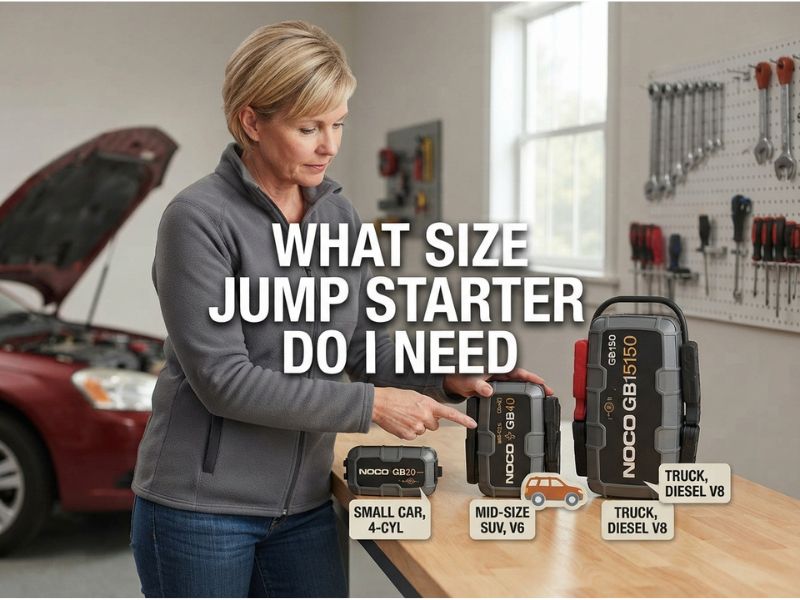
For many drivers, a 1,000- to 1,500-peak-amp jump starter is enough for a typical gasoline-powered car. If you drive a larger SUV, pickup truck, or vehicle with a larger engine, choosing a unit rated at 1,500 to 2,000 peak amps or more provides additional starting capacity.
Diesel engines generally benefit from a more powerful jump starter because diesel engines can require greater starting current.
Here is a general starting point:
| Vehicle Type | Typical Jump Starter Size |
| Motorcycle | 300–800 peak amps |
| Small 4-cylinder car | 600–1,000 peak amps |
| Average 4-cylinder car | 800–1,200 peak amps |
| 6-cylinder car/SUV | 1,000–1,500 peak amps |
| Large gasoline SUV/truck | 1,500–2,000+ peak amps |
| Small diesel vehicle | 1,000–1,500+ peak amps |
| Large diesel truck | 1,500–3,000+ peak amps |
| Heavy-duty vehicle | 2,000+ peak amps |
These are general guidelines rather than universal requirements. Always compare the jump starter’s specifications with your vehicle and the manufacturer’s recommendations.
What Size Jump Starter Do I Need for My Car?
For a typical gasoline-powered passenger car, you generally do not need an enormous jump starter.
A compact 4-cylinder gasoline engine can often be started with a portable jump starter in the 600- to 1,000-peak-amp range, assuming the battery is simply discharged rather than physically damaged.
For additional reserve power, many drivers choose a unit around 1,000 to 1,500 peak amps. This provides more flexibility if the battery is heavily discharged or the vehicle needs more starting current.
If your vehicle has a 6-cylinder engine, a larger SUV, or a pickup truck, moving toward 1,500 peak amps or more can be a sensible choice.
The important point is that engine size is only one factor. A 1,000-amp jump starter from one manufacturer may not perform identically to a 1,000-amp unit from another manufacturer because the actual current delivery, battery chemistry, cable design, and testing methods can differ.
How Many Amps Do I Need for a 4-Cylinder Car?
A 4-cylinder gasoline engine generally has relatively modest starting-power requirements compared with larger engines.
For many 4-cylinder cars, a jump starter rated between 600 and 1,000 peak amps can be adequate.
If you want more flexibility, a 1,000- to 1,500-peak-amp jump starter is a good general-purpose range.
A larger unit may be useful if:
- The vehicle battery becomes deeply discharged.
- You regularly drive in very cold weather.
- The battery is older.
- You want to use the same jump starter on another vehicle.
- You own multiple vehicles.
- You want additional reserve starting power.
There is generally little reason to buy the smallest possible jump starter if the price and portability of a slightly larger model are acceptable.
How Many Amps Do I Need for a 6-Cylinder Engine?
A 6-cylinder engine typically requires more starting power than a small 4-cylinder engine.
For many gasoline-powered 6-cylinder cars and SUVs, a jump starter rated around 1,000 to 1,500 peak amps is a reasonable starting point.
If the vehicle has a large-displacement V6, a large SUV, or a pickup truck, choosing a jump starter with 1,500 to 2,000 peak amps can provide additional reserve.
The vehicle’s battery and starter system also matter. Two vehicles with similar engine sizes can have different electrical requirements.
Rather than choosing solely by cylinder count, check the jump starter’s stated engine-size compatibility.
How Many Amps Do I Need for a V8?
A V8 engine generally requires more starting current than a small 4-cylinder or 6-cylinder engine.
For many gasoline V8 vehicles, a jump starter rated around 1,500 to 2,000 peak amps is a reasonable range.
Some smaller V8 engines may work with less, while large-displacement engines may benefit from a more powerful unit.
If you own a full-size pickup, large SUV, performance vehicle, or vehicle with a high-capacity battery, it can make sense to choose a jump starter with additional capacity rather than buying the minimum-rated unit.
For frequent roadside use, having extra starting capability can be more useful than saving a small amount of money by purchasing an undersized model.
What Size Jump Starter Do I Need for a Truck?
The right jump starter for a truck depends on whether the truck has a gasoline or diesel engine, as well as its engine displacement.
For a gasoline pickup truck, a jump starter in the 1,500- to 2,000-peak-amp range can be a practical choice for many applications.
For larger trucks, especially those with diesel engines, you may want 2,000 peak amps or more, depending on the manufacturer’s engine-size rating.
If you want one jump starter for both a family car and a pickup truck, choosing a higher-capacity model can provide more versatility.
However, bigger does not always mean better. A very large jump starter can be heavier, more expensive, and less convenient to keep in a vehicle.
What Size Jump Starter Do I Need for an SUV?
SUVs come with a wide range of engine sizes, so there is no single jump starter size that works for every SUV.
A compact SUV with a 4-cylinder gasoline engine may work well with a 1,000- to 1,500-peak-amp jump starter.
A larger SUV with a V6 or V8 engine may be better matched with a 1,500- to 2,000+ peak-amp unit.
If your SUV has a diesel engine, consider a model specifically rated for diesel applications.
The best approach is to identify your engine type and displacement first and then compare that information with the jump starter manufacturer’s recommended engine size.
What Size Jump Starter Do I Need for a Diesel?
Diesel engines generally require substantial starting current because of their higher compression ratios and the power needed to crank the engine.
For a small diesel car or SUV, a jump starter rated around 1,000 to 1,500 peak amps or higher may be appropriate.
For larger diesel pickups and trucks, consider a unit rated at 1,500 to 3,000 peak amps or more, depending on the vehicle.
Cold weather can make diesel starting more demanding. Engine oil becomes more viscous at low temperatures, while the battery itself can deliver less usable starting current.
For that reason, diesel owners who regularly operate in cold climates may want more starting reserve than someone driving the same vehicle in a warm environment.
Peak Amps vs. Cranking Amps: Which Matters More?
One of the biggest sources of confusion when choosing a jump starter is the difference between peak amps and cranking amps.
Peak amps represent the maximum current the device can deliver for a very short period under specified conditions.
Cranking amps are more relevant to the jump starter’s ability to provide sustained current while the starter motor is turning the engine.
Because manufacturers do not always use identical testing methods, comparing products solely by peak amps can be misleading.
For example, a jump starter advertised as having 2,000 peak amps is not necessarily twice as capable as a 1,000-peak-amp model.
When comparing products, look for information about:
- Peak current
- Cranking current
- Starting current
- Recommended engine size
- Gasoline and diesel compatibility
- Battery capacity
- Voltage
- Operating temperature range
If a manufacturer provides a clear cranking-current specification, it can be particularly useful when comparing jump starters.
Do More Peak Amps Mean a Better Jump Starter?
Not necessarily.
A higher peak-amp rating can provide additional starting capability, but the number alone does not tell you everything about the device.
A good jump starter should also have a capable internal battery, quality cables, reliable clamps, appropriate safety protections, and enough stored energy to perform when needed.
For example, a compact lithium jump starter advertised at a high peak current may be much smaller than an older lead-acid jump box. That does not automatically mean one is universally better.
Consider the complete specification rather than focusing on one marketing number.
How Does Engine Size Affect Jump Starter Size?
Engine size affects the amount of power required to crank the engine.
Generally, larger engines require more starting power because they contain more mass that the starter motor must rotate.
However, engine displacement is not the only consideration.
Other factors include:
Fuel type: Diesel engines typically require substantial starting power.
Engine design: Different engines have different starting characteristics.
Temperature: Cold temperatures can make starting more difficult.
Battery condition: A severely discharged battery may require more assistance.
Oil viscosity: Cold, thick engine oil increases resistance to cranking.
Vehicle electrical system: Modern vehicles may have additional electronic systems that affect the starting process.
For these reasons, engine size should be treated as a starting point rather than an exact formula.
What Size Jump Starter Do I Need for a 2.0L Engine?
A 2.0L gasoline engine is generally considered a relatively moderate engine size.
For many 2.0L gasoline vehicles, a jump starter rated around 800 to 1,200 peak amps may be sufficient.
A 1,000- to 1,500-peak-amp model can provide additional reserve and may be a practical choice if you want one portable jump starter for multiple vehicles.
For a 2.0L diesel engine, consider a more powerful unit and pay close attention to the manufacturer’s diesel-engine rating.
What Size Jump Starter Do I Need for a 3.0L Engine?
For a 3.0L gasoline engine, a 1,000- to 1,500-peak-amp jump starter can be a reasonable starting point.
For a 3.0L diesel engine, choosing a unit with higher starting capability may be appropriate.
Again, the manufacturer’s recommended engine size is more useful than simply assuming that every 3.0L engine requires the same amount of current.
What Size Jump Starter Do I Need for a 5.3L Engine?
A 5.3L engine is common in larger trucks and SUVs.
For a gasoline-powered 5.3L engine, a jump starter rated around 1,500 to 2,000 peak amps is a reasonable range for many applications.
If you frequently use the vehicle in cold weather or want additional reserve capacity, selecting a higher-rated unit may be worthwhile.
Always verify the manufacturer’s engine-size recommendation before buying.
What Size Jump Starter Do I Need for a 6.0L Engine?
A 6.0L gasoline engine is relatively large and can require significant starting current.
A jump starter rated around 1,500 to 2,000 peak amps or more can be appropriate for many 6.0L applications.
For a diesel engine of similar displacement, a higher-capacity jump starter may be preferable.
If the jump starter is intended for emergency use on multiple vehicles, choosing a model with a higher engine-size rating can provide additional flexibility.
Does Battery Capacity Matter in a Jump Starter?
Yes.
Jump starter capacity is commonly expressed in mAh or Wh, depending on the product.
Battery capacity tells you how much energy the internal battery can store, while the peak and cranking current ratings indicate how quickly that energy can be delivered.
A jump starter with a large capacity but poor high-current output may not be ideal for starting an engine.
Conversely, a high-current device with a very small battery may have limited ability to perform multiple jump starts.
For vehicle starting, the ability to deliver sufficient current is particularly important.
Therefore, do not buy a jump starter based solely on its mAh rating.
Is a 1000-Amp Jump Starter Enough?
For many small and medium-sized gasoline cars, a 1,000-amp jump starter can be enough.
It can be particularly suitable for 4-cylinder vehicles and some smaller 6-cylinder vehicles.
However, whether it is sufficient depends on what the manufacturer means by “1,000 amps” and whether that number refers to peak current or another specification.
A 1,000-amp unit may be perfectly adequate for your daily driver but less suitable for a large V8 truck or diesel pickup.
If you want one unit for several different vehicles, consider a higher-rated model.
Is a 2000-Amp Jump Starter Enough?
A 2,000-amp jump starter provides substantial starting capability for many passenger vehicles, SUVs, and gasoline-powered trucks.
For many drivers, this level provides more than enough capacity for normal emergency starting.
It may also be useful for larger engines and provides a larger margin when the vehicle battery is heavily discharged.
However, the same rule applies: 2,000 peak amps does not guarantee that the unit can start every 2,000-amp-rated application.
Check the manufacturer’s actual engine-size and fuel-type specifications.
Is a 3000-Amp Jump Starter Too Big?
A 3,000-amp jump starter is not necessarily too large, but it may be unnecessary for a small passenger car.
For someone who owns a 4-cylinder sedan, a 3,000-amp unit may add weight and cost without providing much practical benefit.
For large diesel trucks, commercial vehicles, heavy-duty applications, or people who want one powerful unit for multiple vehicles, a 3,000-amp model can make more sense.
The goal should be to buy enough power for your application without paying for capacity you are unlikely to use.
What Voltage Jump Starter Do I Need?
Most conventional cars use a 12-volt electrical system, so a 12V jump starter is appropriate for typical passenger vehicles.
Some larger commercial vehicles and heavy-duty trucks use 24-volt electrical systems.
Never assume that a 12V jump starter can be used on a 24V vehicle.
Using the wrong voltage can cause serious electrical damage.
Before buying a jump starter, verify your vehicle’s electrical-system voltage and make sure the device is explicitly compatible with it.
Lithium-Ion vs. Lead-Acid Jump Starters
Modern portable jump starters are commonly built around lithium-ion batteries, while traditional jump boxes often use lead-acid batteries.
Lithium-ion models are usually smaller and lighter, making them convenient to keep in a vehicle.
Many modern lithium jump starters also include USB ports, LED flashlights, digital displays, and other emergency features.
Traditional lead-acid jump boxes can be much larger and heavier but may provide substantial starting capability.
For most individual drivers looking for a portable emergency device, a lithium jump starter is often more convenient.
However, the battery chemistry is less important than whether the device has sufficient starting-current capability for your vehicle.
Should I Buy the Smallest Jump Starter That Works?
Buying the smallest possible jump starter is not always the best strategy.
If the device is barely powerful enough for your vehicle under ideal conditions, it may struggle when the battery is deeply discharged or temperatures are extremely low.
A little extra capacity can provide useful safety margin.
For example, if your vehicle technically works with a 1,000-amp jump starter, choosing a reliable 1,200- or 1,500-amp model may give you greater flexibility without becoming excessively large.
The best jump starter is generally one that is adequately sized, reliable, portable, and properly maintained.
Should I Buy a Bigger Jump Starter Than I Need?
There is nothing inherently wrong with buying a more powerful jump starter than your current vehicle requires.
A larger unit may be useful if:
- You plan to change vehicles.
- You own multiple vehicles.
- You want to help family members or friends.
- You occasionally drive trucks or SUVs.
- You travel long distances.
- You live in a cold climate.
- You want additional starting reserve.
The trade-off is size, weight, cost, and storage space.
For an emergency device that remains in your car, portability matters. A jump starter that is so large that you leave it at home is not very useful when the battery dies away from home.
What Other Features Should I Look For?
Once you have selected the appropriate starting power, look at the jump starter’s additional features.
Reverse-Polarity Protection
Reverse-polarity protection can warn you if the clamps are connected incorrectly.
This is one of the most useful safety features because reversing positive and negative connections can damage electrical components.
Short-Circuit Protection
Short-circuit protection can help reduce the risk of damage if the clamps accidentally come into contact or another electrical fault occurs.
Overcurrent Protection
This feature helps protect the jump starter and vehicle electrical system when excessive current is detected.
Smart Clamps
Some portable jump starters include smart jumper cables that monitor the connection and provide warnings for incorrect polarity or poor contact.
LED Flashlight
A built-in flashlight can be useful when dealing with a dead battery at night.
Some units include an emergency flashing or SOS mode.
USB Charging
USB ports allow the jump starter to charge phones and other small electronic devices.
This is useful during roadside emergencies but should be considered an additional feature rather than the primary reason for choosing a jump starter.
Battery-Level Indicator
A clear battery-level indicator makes it easier to determine whether the jump starter is ready for emergency use.
Can a Jump Starter Be Too Powerful for a Car?
A properly designed jump starter does not simply force its maximum rated current into the vehicle continuously.
The vehicle’s starter and electrical system draw the current they require.
However, compatibility still matters. You should only use a jump starter that is designed for your vehicle’s voltage and application.
Do not connect an unsuitable high-voltage device simply because it has a higher amp rating.
The key distinction is between higher current capacity and higher voltage. Having more available current capacity is not the same thing as applying excessive voltage.
Always follow the jump starter manufacturer’s instructions.
Does Cold Weather Change the Jump Starter Size I Need?
Yes.
Cold temperatures can make starting an engine more difficult.
The vehicle battery becomes less effective in cold weather, while engine oil becomes thicker. Both conditions increase the effort required from the starter motor.
If you live in an area with harsh winters, choosing a jump starter with additional starting reserve can be beneficial.
A model that performs comfortably under normal conditions may have a harder time when the vehicle battery is extremely cold and discharged.
If cold-weather reliability is important, pay attention to the manufacturer’s stated operating temperature range as well as the current rating.
What If My Car Battery Is Completely Dead?
A jump starter can sometimes start a vehicle with a severely discharged battery, but there is an important distinction between a discharged battery and a failed battery.
A discharged battery may simply have insufficient charge because the headlights were left on or the vehicle was not driven for a long time.
A failed battery may have an internal defect, damaged cell, severe corrosion, or other physical problem.
A jump starter cannot repair a failed battery.
Some smart jump starters may also have difficulty detecting a battery when its voltage is extremely low. Certain models include a manual boost mode for this situation.
Only use such a feature according to the manufacturer’s instructions.
Does the Age of My Car Matter?
The age of the vehicle itself does not determine jump starter size.
However, older vehicles may have older batteries, worn starter motors, corroded battery terminals, or other electrical issues.
A weak battery may require more assistance than a healthy battery of the same size.
If your vehicle repeatedly needs a jump start, the best solution is not necessarily a larger jump starter.
Instead, have the battery and charging system tested.
A failing alternator can prevent the battery from being properly recharged, while a parasitic electrical drain can discharge a healthy battery when the vehicle is parked.
How Many Jump Starts Can a Portable Jump Starter Provide?
The number of jump starts depends on several factors.
These include:
- Internal battery capacity
- Vehicle engine size
- Battery condition
- Ambient temperature
- Starting current required
- Number of previous jump starts
- Condition of the jump starter
A manufacturer may advertise a certain number of vehicle starts under specific testing conditions, but real-world performance can vary.
If you regularly help other drivers, choose a higher-capacity model rather than assuming a compact emergency jump starter will handle repeated starts.
How Often Should I Charge My Jump Starter?
A jump starter should be kept sufficiently charged so it is ready when needed.
The exact charging schedule depends on the device’s battery chemistry and manufacturer instructions.
Modern lithium jump starters generally have a battery-level indicator that makes monitoring easier.
Check the charge periodically, especially before long road trips or during seasons when battery failures are more common.
Do not wait until the device is completely empty before thinking about charging it.
A jump starter is an emergency tool, so maintaining it is just as important as choosing the correct size.
Can I Keep a Jump Starter in My Car?
Yes, many portable jump starters are designed specifically for vehicle storage and emergency use.
However, extreme temperatures can affect rechargeable batteries.
Avoid leaving the device exposed to prolonged excessive heat or freezing conditions if the manufacturer does not permit it.
The ideal storage conditions depend on the battery chemistry and manufacturer’s specifications.
Keep the jump starter in a secure location where it will not be damaged by other objects in the vehicle.
It should also be accessible when you need it rather than buried underneath luggage or equipment.
Common Mistakes When Choosing a Jump Starter
One common mistake is focusing entirely on the peak amp rating.
A high peak-amp number can look impressive, but it does not provide a complete picture of performance.
Another mistake is choosing a jump starter based solely on engine displacement.
Fuel type, battery condition, temperature, and starting-current requirements also matter.
Some drivers also buy an extremely small device because it is inexpensive and portable, only to discover that it is not rated for their truck or diesel engine.
Another common mistake is ignoring voltage compatibility.
Before purchasing, check the vehicle’s voltage, engine type, engine size, and the manufacturer’s recommended jump starter specifications.
A Simple Way to Choose the Right Jump Starter
If you want a straightforward purchasing process, follow these steps.
First, identify your vehicle’s engine size.
Next, determine whether it uses gasoline or diesel.
Then check the vehicle manufacturer’s recommendations and compare them with the jump starter’s stated engine-size compatibility.
After that, compare peak amps and cranking amps.
Finally, consider battery capacity, portability, safety features, cable quality, warranty, and additional features.
For a typical gasoline passenger car, around 1,000 to 1,500 peak amps is often a practical general-purpose range.
For larger gasoline trucks and SUVs, consider approximately 1,500 to 2,000+ peak amps.
For diesel vehicles, particularly larger diesel trucks, look for a model specifically rated for diesel engines and consider 1,500 to 3,000+ peak amps, depending on the application.
These ranges are guidelines rather than strict requirements.
Jump Starter Size Chart by Vehicle
The following chart provides a simple reference when deciding what size jump starter to consider.
| Vehicle | Suggested Peak-Amp Range |
| Motorcycle | 300–800 amps |
| Small 4-cylinder gasoline car | 600–1,000 amps |
| Typical 4-cylinder gasoline car | 800–1,200 amps |
| 2.5–3.0L gasoline vehicle | 1,000–1,500 amps |
| V6 gasoline SUV | 1,000–1,500 amps |
| V8 gasoline car | 1,500–2,000 amps |
| Large gasoline SUV | 1,500–2,000+ amps |
| Gasoline pickup truck | 1,500–2,000+ amps |
| Small diesel vehicle | 1,000–1,500+ amps |
| Diesel SUV | 1,500–2,000+ amps |
| Diesel pickup | 1,500–3,000+ amps |
| Heavy-duty diesel truck | 2,000–3,000+ amps |
Remember that these figures are general starting points. Actual requirements vary by vehicle and jump starter design.
Frequently Asked Questions
What size jump starter do I need for a normal car?
For many normal gasoline-powered cars, a 1,000- to 1,500-peak-amp jump starter is a practical choice. Smaller 4-cylinder vehicles may require less, while larger engines may require more.
Is a 1000-amp jump starter enough for a 4-cylinder?
In many cases, yes. A 1,000-amp jump starter can be suitable for many 4-cylinder gasoline engines, provided the manufacturer’s specifications support your vehicle.
Is 2000 amps enough to jump-start a truck?
A 2,000-peak-amp jump starter can be suitable for many gasoline-powered trucks. Larger diesel trucks may require a higher-rated unit.
What size jump starter do I need for an SUV?
Many SUVs can use a 1,000- to 2,000+ peak-amp jump starter, depending on engine size and fuel type.
What size jump starter do I need for a diesel truck?
Diesel trucks generally benefit from a more powerful jump starter. Depending on engine size, a 1,500- to 3,000+ peak-amp model may be appropriate.
Does a higher amp jump starter charge the car battery faster?
No. A jump starter’s starting-current rating primarily describes its ability to provide power for starting the engine. It does not mean the vehicle battery will recharge faster after the engine starts.
Is a 3000-amp jump starter better than a 1000-amp model?
Not necessarily. A 3,000-amp model has greater rated starting capability, but a 1,000-amp model may be perfectly adequate for a small car. The best choice depends on your vehicle and intended use.
Can I use a 2000-amp jump starter on a small car?
A properly designed and voltage-compatible jump starter can generally be used on a smaller vehicle even if it has more available current capacity than the vehicle normally requires. Always follow the manufacturer’s compatibility instructions.
What is more important, peak amps or battery capacity?
For starting a vehicle, starting-current capability is particularly important. Battery capacity also matters because it determines how much energy the jump starter stores. Ideally, look at both rather than choosing based on a single number.
How do I know if my jump starter is powerful enough?
Check the jump starter manufacturer’s recommended engine size and fuel type. Then compare those specifications with your vehicle’s engine displacement and fuel type.
Do diesel engines need bigger jump starters?
Generally, yes. Diesel engines often require more starting power than comparable gasoline engines, so a jump starter specifically rated for diesel applications is usually a better choice.
Can a jump starter start a car with a bad battery?
A jump starter may start a vehicle if the battery is simply discharged. However, if the battery has an internal failure or physical damage, a jump starter may not be able to start the vehicle and should not be considered a repair.
Final Thoughts
If you are asking what size jump starter do I need, start by checking your vehicle’s engine size, fuel type, voltage, and manufacturer’s recommendations. For many everyday gasoline cars, a 1,000- to 1,500-peak-amp jump starter provides a useful balance of power and portability.
Larger SUVs, V8 vehicles, and pickup trucks may be better suited to 1,500 to 2,000+ peak amps, while diesel vehicles often require more starting capability. Large diesel trucks may benefit from 2,000 to 3,000+ peak amps, depending on their engine and operating conditions.
Most importantly, do not choose a jump starter based only on its advertised peak amps. Check cranking amps, engine-size compatibility, battery capacity, voltage, safety protection, cable quality, and operating temperature range.
The right jump starter is not necessarily the most powerful model available. It is the one that provides enough starting power for your vehicle, has appropriate safety features, is reliable when you need it, and is portable enough that you will actually keep it in your vehicle.