The battery jump starter you need should match your vehicle’s battery voltage, engine size, and fuel type, with enough extra starting capacity for cold weather and a weak battery. For most drivers, the manufacturer’s stated gasoline or diesel engine-size rating is more useful than choosing a unit simply because it advertises the highest peak amps.
A compact jump starter that works well on a four-cylinder gasoline sedan may be undersized for a large diesel pickup, while buying an oversized professional booster for a small commuter car can add unnecessary cost and weight.
The goal is not to buy the most powerful unit available. It is to find a portable jump starter with enough real cranking capability for the hardest starting conditions your vehicle is likely to face.
Start With Your Vehicle, Not the Jump Starter
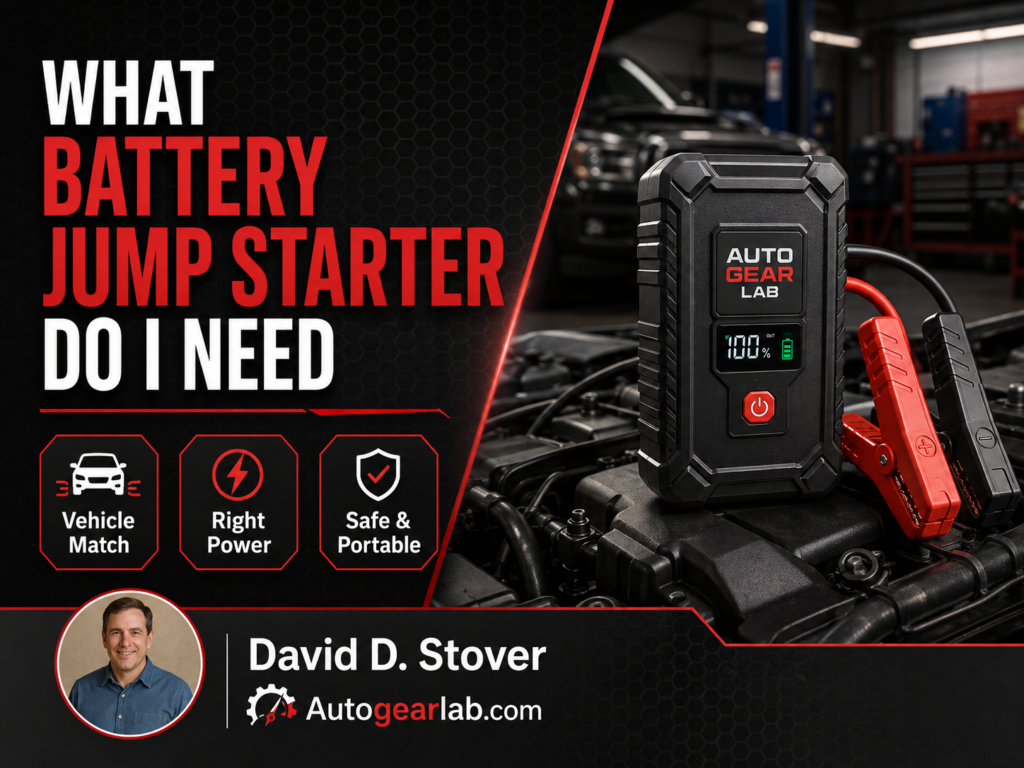
Before comparing brands or amp ratings, identify four details about your vehicle: its battery-system voltage, engine displacement, gasoline or diesel fuel type, and normal climate.
For most U.S. passenger cars, SUVs, and light trucks, the electrical system is 12 volts. Larger commercial vehicles and some specialized equipment may use 24V systems, so voltage compatibility should always be confirmed before connecting a booster.
Next, find the engine displacement. It may be listed as 2.0L, 3.5L, 5.7L, 6.7L, or a similar figure.
Then confirm whether it is a gasoline or diesel engine.
This matters because diesel engines generally require greater starting effort than similarly sized gasoline engines. As a real-world example, NOCO rates its current 1,000A GB40 for gasoline engines up to 6.0L but diesel engines only up to 3.0L. Its 1,500A GB50 increases those limits to 7.0L gasoline and 4.5L diesel.
That difference is why buying only from an amp number can be misleading.
A Simple Jump Starter Size Guide
The table below is best used as a general shopping framework, not as a universal engineering specification. Actual capability depends on the jump starter’s design, battery chemistry, cables, temperature, and manufacturer testing.
| Vehicle Type | Sensible Starting Point | What to Verify |
| Motorcycle, ATV, small powersport engine | Compact 12V booster | Manufacturer vehicle compatibility |
| Small gasoline car | Roughly 500–1,000A class | Engine-size rating |
| Typical sedan or crossover | Roughly 1,000–1,500A class | Gas-engine capacity |
| Large gasoline SUV or pickup | Roughly 1,500–2,000A+ class | Engine displacement and cold-weather margin |
| Small or midsize diesel | Roughly 1,500–2,000A+ class | Specific diesel rating |
| Large diesel pickup | Higher-output heavy-duty unit | Diesel displacement and cranking performance |
| Fleet or professional use | Professional AGM or high-output lithium unit | Cranking amps, cables, duty cycle |
The most important column is the last one. Always verify the manufacturer’s stated engine compatibility for the specific jump starter.
A 1,250A Schumacher lithium unit, for example, is currently rated for gasoline engines up to 6.0L and diesel engines up to 3.0L.
That is much more actionable than assuming every product labeled “1,250 amps” performs identically.
How Many Amps Does Your Jump Starter Really Need?
Jump starter listings commonly emphasize peak amps, often in very large numbers.
Peak amps describe short-duration maximum output, but the number should not be treated as the only measure of performance. Different manufacturers may use different methods or terminology when describing peak capability, so direct comparisons can be imperfect.
For a personal vehicle, it is better to look at a combination of:
Manufacturer-rated engine size, published cranking amps or start-assist ratings where available, battery chemistry, cable quality, and operating temperature.
Professional-style boosters often publish more detailed starting specifications. Schumacher’s DSR167, for example, lists 2,250 peak amps, 525 cranking amps, and 350 cold cranking amps, illustrating how a manufacturer can distinguish short peak output from sustained starting capability.
The practical rule is: use peak amps as one specification, not the entire buying decision.
Gasoline and Diesel Engines Need Different Sizing
If you drive a gasoline vehicle, engine displacement gives you a useful starting point. Small four-cylinder engines generally require less booster capacity than large V6 or V8 engines.
Diesel engines need more careful sizing.
Higher compression and greater starting demand mean a jump starter capable of starting a large gasoline engine may support a considerably smaller diesel engine.
This is why product specifications often list separate limits such as:
Up to 6.0L gas / 3.0L diesel
rather than publishing one universal engine-size number.
If you own a diesel truck, prioritize the diesel displacement rating, not the gasoline rating and not merely the cylinder count.
A 6.7L diesel, for example, should not be matched to a booster simply because the same product is advertised for a 6.0L or 7.0L gasoline engine.
Should You Buy More Power Than the Minimum?
Usually, a reasonable amount of extra capacity is beneficial.
A jump starter is often needed under conditions that are harder than a normal warm-weather start. Your vehicle battery may be deeply discharged, the engine may be cold, battery terminals may be imperfect, and the booster itself may have been sitting unused for months.
A jump starter rated exactly at the edge of your engine size can therefore provide less margin than a slightly larger model.
You do not need to dramatically oversize it, but stepping up one capacity level can make sense when you have a large engine, diesel vehicle, severe winters, or an older vehicle with higher starting demand.
This is particularly important in cold regions.
Cold Weather Changes the Answer
Low temperature affects both sides of the starting system.
The vehicle battery produces less effective starting power while cold engine oil and mechanical resistance can make the engine harder to crank. The portable jump starter itself may also lose available performance at low temperature.
Clore Automotive notes that cold-weather jump starting places greater demand on booster batteries and publishes model-specific low-temperature performance for some of its units.
So if your winters routinely fall well below freezing, do not choose the smallest booster that technically covers your engine.
Look for a unit with documented cold-temperature operating specifications and some additional starting margin.
Also check the difference between operating temperature and charging temperature. A lithium jump starter may be allowed to operate below freezing while still requiring warmer conditions for safe charging.
Lithium or AGM: Which Type Do You Need?
For most private vehicle owners, a lithium jump starter is the easiest choice because it can deliver substantial starting power in a relatively compact package.
Lithium units are convenient for storing in a car, SUV, or pickup and often include USB charging and emergency lighting.
An AGM or sealed lead-acid booster is usually much heavier but can make sense for workshops, towing operations, fleets, dealerships, or anyone who repeatedly jump-starts vehicles.
Professional AGM models commonly use heavier cables, larger clamps, and purpose-built high-output batteries.
Clore Automotive recommends choosing partly according to how frequently the booster will be used, with heavier-duty models becoming more appropriate for repeated or daily starting work.
For occasional roadside emergencies, compactness usually matters more. For professional work, duty cycle and sustained cranking capability become more important.
Does Your Car Battery’s CCA Determine the Jump Starter Size?
Your vehicle battery’s cold cranking amps (CCA) can provide useful context, but you generally do not need to find a portable booster whose advertised number exactly matches the battery’s CCA.
The ratings describe different products and may use different testing methods.
CCA is a standardized battery rating describing how a starting battery performs under specified cold conditions. Portable jump starters may instead advertise peak amps, cranking amps, start-assist amps, or engine-size compatibility.
For consumers, the most straightforward approach is normally to use the jump starter manufacturer’s vehicle and engine-size rating.
If you are sizing a booster for commercial or technical use, then detailed cranking-current specifications become more valuable.
What About a Completely Dead Battery?
Some modern jump starters use smart battery detection and may not automatically activate if the vehicle battery voltage is extremely low.
Certain models include a manual override or force-start mode for this situation.
That feature can be useful, but it should not be treated casually. Manual override can bypass some normal safety protections, including battery-detection safeguards.
If you frequently work with deeply discharged batteries, look for a booster specifically designed to handle them and read the override procedure before you need it.
For an ordinary driver, clear automatic protection is more important than simply having an override button.
Safety Features Matter as Much as Power
A jump starter may be used in the dark, in bad weather, or by someone who rarely handles automotive batteries.
That makes reverse-polarity protection particularly valuable. A good smart-clamp system can detect incorrect connections and prevent normal output rather than immediately allowing current to flow.
Other worthwhile protections include short-circuit protection, over-temperature protection, overload protection, and spark-resistant connection logic.
NOCO’s current Boost models, for example, advertise spark-proof technology and reverse-polarity protection.
These features do not replace correct battery handling, but they provide an additional layer of protection against common mistakes.
Cable and Clamp Design Can Make or Break the Experience
A jump starter can have plenty of internal power and still be frustrating if its cables cannot reach your vehicle’s connection points.
Before buying, look at the battery location.
Some batteries are easily accessible under the hood. Others are located under seats, in trunks, or behind covers, while certain vehicles provide dedicated remote jump-start terminals.
Cable length and clamp opening become more important in these cases.
Also consider clamp quality. Strong springs and broad conductive surfaces help create a reliable electrical connection.
For a large truck or vehicle with awkward terminal access, better cables can be more valuable than an extra flashlight mode or oversized digital display.
If You Own Several Vehicles, Size for the Hardest One
Suppose your household has a 2.0L gasoline sedan, a 3.5L SUV, and a 5.7L pickup.
You do not need three different jump starters.
Buy one that comfortably covers the largest and most demanding vehicle you realistically expect to jump-start.
The same principle applies if one vehicle is diesel.
Size the booster around the diesel engine rather than the smaller gasoline cars.
This gives you one emergency tool that can move between vehicles without constantly checking whether it is powerful enough.
Don’t Confuse Battery Capacity With Starting Capability
Portable boosters often display battery capacity in mAh, Ah, or Wh.
Those figures describe stored energy, not necessarily the device’s ability to deliver the extremely high current required by a starter motor.
A large power-bank capacity can be useful if you want to charge phones and tablets, but it does not automatically mean the jump starter will crank a large engine.
Similarly, a purpose-built jump starter can provide excellent starting power without having enormous USB power-bank capacity.
If your main reason for buying the product is vehicle emergencies, prioritize starting performance first and accessory capacity second.
How Much Jump Starter Is Too Much?
For normal 12V passenger vehicles, buying a more powerful compatible jump starter generally provides additional capacity rather than forcing its maximum advertised amperage into the vehicle.
The starter motor draws current according to the electrical conditions of the starting circuit.
However, oversized units can be heavier and more expensive, and professional boosters may be inconvenient to keep in a small car.
There is little value in carrying a 25-pound shop booster if a compact lithium unit comfortably exceeds your engine requirements.
Choose adequate power with useful reserve, not maximum size for its own sake.
Frequently Asked Questions
What Size Jump Starter Do I Need for a 4-Cylinder Car?
A compact lithium jump starter is generally sufficient for most four-cylinder gasoline cars, but use the actual engine displacement and manufacturer compatibility rather than cylinder count alone. A reputable unit in roughly the 1,000A class commonly covers a broad range of passenger-car engines.
What Jump Starter Do I Need for a V6?
The answer depends on displacement and fuel type. For a typical gasoline V6, choose a jump starter whose stated gasoline-engine rating comfortably exceeds your engine size, particularly if you live in a cold climate.
What Size Jump Starter Do I Need for a V8?
Large gasoline V8 engines generally justify moving to a higher-capacity unit rather than choosing the smallest booster available. Verify the manufacturer’s engine rating because V8 displacement varies significantly between vehicles.
What Jump Starter Do I Need for a Diesel?
Choose by the published diesel-engine displacement rating. Diesel engines generally need more starting capability, so never rely on the product’s gasoline rating when sizing a booster for a diesel vehicle.
Is a 1,000-Amp Jump Starter Enough?
It can be enough for many passenger vehicles. One current NOCO 1,000A model is rated for gasoline engines up to 6.0L and diesel engines up to 3.0L, but that rating should not be assumed for every 1,000A product.
Is 2,000 Amps Too Much for a Car?
Not simply because the rating is high. A compatible 12V booster does not continuously force its full advertised peak output through the electrical system. The bigger questions are compatibility, quality, portability, and whether you actually need that much reserve.
Do I Need a Jump Starter With an Air Compressor?
Only if you want one device for both a weak battery and low tire pressure. A built-in inflator can be convenient, but it does not improve the jump starter’s cranking performance.
Should I Keep a Jump Starter in My Car?
That is where many owners keep one, but follow the manufacturer’s specified storage-temperature range and recharge schedule. Extreme temperatures and long storage periods can reduce available battery performance.
Is Lithium Better Than Lead-Acid for a Jump Starter?
Lithium is usually better for drivers prioritizing compact size and portability. AGM lead-acid jump starters remain useful for professional or repeated use where weight is less important than durability and sustained starting capability.
Should I Buy a Jump Starter Bigger Than My Engine Requires?
A modest amount of reserve is sensible, particularly for diesel vehicles and cold climates. You do not normally need to jump several categories above your actual requirement.
The Right Jump Starter Is the One Sized for the Worst Start
If you are asking “what battery jump starter do I need,” begin with your vehicle’s voltage, engine displacement, gasoline or diesel fuel type, and climate—not the largest peak-amp number you can find.
For most drivers, the simplest approach is to choose a reputable 12V lithium jump starter whose manufacturer-rated engine capacity comfortably exceeds your vehicle’s engine size. Add extra margin if you drive a diesel, regularly face subfreezing weather, or want one booster to serve several vehicles.
Pay attention to engine-size compatibility, cold-weather performance, smart-clamp safety, cable quality, and charging requirements before worrying about secondary features.
A correctly sized jump starter should be powerful enough to handle a weak battery under difficult conditions while still being practical enough to keep charged and carry in the vehicle. That balance—not the biggest number on the box—is what determines the right battery jump starter for you.