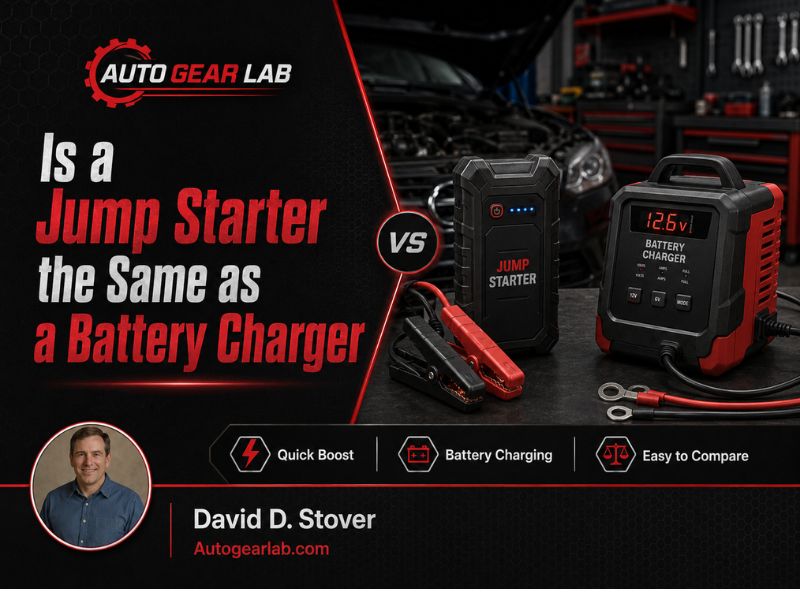
No, a jump starter is not the same as a battery charger. A jump starter provides a short burst of high current to crank the engine, while a battery charger gradually restores electrical energy to the vehicle battery over a longer period.
Both devices connect to a vehicle’s battery and may use similar-looking clamps, which explains the confusion. Their purpose, power delivery, operating time, and effect on a discharged battery are very different.
The easiest way to remember the distinction is this: a jump starter helps start the engine now; a charger restores the battery for later.
Jump Starter vs. Battery Charger at a Glance
| Feature | Jump Starter | Battery Charger |
| Main purpose | Start an engine | Recharge a battery |
| Power delivery | Very high current for a short time | Lower controlled current over time |
| Needs wall power during use | Usually no | Usually yes |
| Can fully recharge a dead battery | Usually no | Yes, if the battery is chargeable |
| Typical use time | Seconds | Hours |
| Portable | Usually | Depends on model |
| Useful when stranded | Excellent | Limited without AC power |
| Battery maintenance | No | Some chargers can maintain batteries |
| Helps diagnose a weak battery | Limited | Some smart chargers provide diagnostics |
| Best use | Emergency starting | Battery charging and maintenance |
Some products combine both functions, so always check the specifications rather than assuming every device belongs exclusively to one category. Schumacher, for example, offers equipment that combines battery charging, maintaining, and engine-starting functions in one unit.
Think of Them as Two Different Jobs
The difference becomes much clearer when you look at what happens electrically.
A Jump Starter Supplements Starting Power
The vehicle’s starter motor requires a large amount of current for a very short period.
If the battery is too weak to supply that current by itself, a portable jump starter connects in parallel and helps provide the energy needed to crank the engine.
Clore Automotive describes a jump starter as effectively extending the vehicle battery’s starting capability so the electrical system can deliver the sudden burst of energy required for engine starting.
Once the engine starts, the jump starter’s main job is finished.
It is not normally connected for hours to restore the battery.
A Battery Charger Replenishes Stored Energy
A car battery charger serves a different purpose.
It sends controlled electrical energy into the battery over time so the battery can regain its state of charge.
Depending on the charger and battery, this process may take several hours. Interstate Batteries notes that charging time varies with charger output and battery condition and that full recharging generally takes much longer than a jump start.
Modern smart battery chargers may also adjust voltage and current through multiple charging stages.
That controlled charging process is fundamentally different from the momentary high-current assistance provided by a jump pack.
Why a Jump Starter Doesn’t Fully Charge Your Car Battery
This is probably the most important misconception surrounding the two devices.
A successful jump start does not mean the battery is fully charged.
When you connect a portable booster and crank the engine, most of the immediate power is being used to operate the starter motor.
Interstate Batteries specifically explains that a portable jump starter cannot replace the sustained charging process needed to restore a discharged automotive battery.
After the engine starts, the vehicle’s charging system may begin replenishing the battery, but relying on the vehicle alone to restore a severely discharged battery is not always the best approach.
A proper battery charger can provide a much more controlled recharge.
Example
Suppose you leave your headlights on overnight.
By morning:
- The battery has enough voltage for the lights or dashboard to work weakly.
- The engine will not crank.
- You connect a portable jump starter.
- The engine starts immediately.
The jump starter solved the starting problem, but it did not replace all the energy that was removed overnight.
The battery may still be deeply discharged.
Connecting an appropriate battery charger afterward can restore the battery more completely.
Does Driving After a Jump Start Recharge the Battery?
The vehicle’s alternator does recharge the battery while the engine runs, but its primary role is supplying the vehicle’s electrical system and maintaining battery charge during normal operation.
A deeply discharged battery may need more controlled charging than a short drive provides.
Interstate advises that a jump does not fully recharge the battery and that a dedicated charger generally produces better long-term charging results.
This distinction matters if your battery repeatedly needs jump starts.
If you simply jump the vehicle, drive briefly, shut it off, and repeat the cycle, the battery may never return to a healthy state of charge.
What Is a Battery Maintainer?
A battery maintainer adds another term that can make the subject confusing.
A maintainer is designed to keep an already charged or mostly charged battery at an appropriate level during extended periods of storage.
Examples include vehicles that sit for weeks or months:
- Classic cars
- Seasonal vehicles
- Motorcycles
- Boats
- Recreational vehicles
- Backup vehicles
Many modern smart chargers include a maintenance or float mode that automatically reduces charging once the battery reaches full charge.
A jump starter normally does not perform this function.
So there are actually three distinct goals:
Jump starter: Get the engine running.
Battery charger: Restore battery energy.
Battery maintainer: Keep a charged battery from gradually becoming discharged.
Some smart products combine charging and maintaining functions, while a smaller number also include engine-start assistance.
Can You Use a Jump Starter Instead of a Battery Charger?
Only when your immediate goal is to start the engine.
A jump starter is a good substitute for jumper cables and another vehicle during a roadside emergency. It is not a substitute for proper charging when the battery itself needs to regain capacity.
Use a jump starter when:
- The engine will not crank because the battery is weak.
- You are stranded away from a power outlet.
- You need immediate starting assistance.
- The battery is compatible with the booster and is not physically damaged or frozen.
Use a battery charger when:
- The battery has been discharged.
- The vehicle has been sitting for a long time.
- You want to restore the battery before driving.
- The battery needs maintenance charging.
- You are evaluating whether a battery can still accept and retain a charge.
If a battery repeatedly needs jump starts after being fully charged, it may be nearing the end of its service life or the vehicle may have another electrical problem.
Can a Battery Charger Start a Car?
Sometimes—but only if the charger specifically includes an engine-start or boost mode.
An ordinary low-amperage battery charger is not designed to supply starter-motor current instantly.
For example, NOCO offers dedicated chargers in ratings such as 1A, 5A, and 10A, while jump starters are designed for much higher short-duration starting current.
Some larger shop chargers include a separate high-amperage engine-start function.
Schumacher offers models that combine normal battery charging with substantially higher-current starting assistance.
If your charger does not explicitly say engine start, boost, or a similar function, do not assume it can safely be used as a jump starter.
Can a Jump Starter Charge a Battery?
A typical portable jump starter should not be treated as a car battery charger.
Many jump packs have USB outputs that can charge:
- Phones
- Tablets
- Small electronics
That does not mean they are designed to recharge the vehicle’s starting battery.
Some specialized combination products may include both functions, but that capability must be stated by the manufacturer.
Also remember that a jump starter itself contains a battery that needs charging.
When a manufacturer says to “charge the jump starter,” it usually means charging the internal battery pack inside the booster, not using it to charge the vehicle battery.
Schumacher, for example, recommends periodically charging the internal battery of its portable power jump starters and after use.
Starting Current vs. Charging Current
The electrical difference between the devices is substantial.
Jump Starter Current
A jump starter is designed for high-current output.
The output may be described using terms such as:
- Peak amps
- Cranking amps
- Start-assist amps
- Engine-size rating
The power must travel through heavy clamps and cables with low resistance because voltage drop reduces effective starting capability.
The current is needed for only a relatively short starting attempt.
Battery Charger Current
A charger’s output may be described as:
- 1 amp
- 2 amps
- 5 amps
- 10 amps
- 20 amps
- Higher output on larger shop chargers
A charger applies its energy for much longer.
A 10A charger, for example, may spend hours restoring energy to a depleted automotive battery rather than delivering hundreds of amps for several seconds.
High current for seconds and moderate current for hours are two very different electrical tasks.
What About Smart Chargers?
A smart battery charger monitors battery conditions and controls the charging process automatically.
Depending on the model, it may recognize:
- Battery voltage
- Charge level
- Battery chemistry
- Charging stage
- Temperature conditions
- Faults or connection errors
Some support several battery chemistries such as:
- Flooded lead-acid
- AGM
- Gel
- Lithium-ion or LiFePO4
Battery chemistry matters more during charging than during ordinary jump starting because different battery types require appropriate charging profiles.
Clore notes that while compatible jump starters may be used across different starting-battery technologies when system voltage is correctly matched, chargers must deliver energy according to the requirements of the battery chemistry being charged.
That is another reason a jump starter should not be viewed as simply a “faster charger.”
Which One Do You Need?
For many vehicle owners, the best answer is actually both.
They solve different problems.
Buy a Jump Starter If You Want:
- Emergency roadside starting
- Independence from another vehicle
- Compact storage in the trunk
- Fast assistance when the battery is weak
- Portable USB emergency power
A portable lithium booster is particularly useful for someone who drives frequently or travels away from home.
Buy a Battery Charger If You Want:
- Proper battery recharging
- Maintenance during vehicle storage
- Help restoring an accidentally discharged battery
- Controlled charging for AGM or lithium batteries
- A garage-based battery-care solution
Own Both If:
- Your vehicle sometimes sits unused.
- You live in a cold climate.
- You maintain multiple vehicles.
- You want both emergency starting and proper battery maintenance.
A jump starter can get you home; a charger can help restore the battery once you get there.
Jump Starter, Charger, or Maintainer: Choose by Scenario
Your Car Won’t Start in a Parking Lot
Use: Jump starter.
You need immediate high-current starting power and probably do not have access to an AC outlet.
You Left the Lights On Overnight
Use: Charger if you have time; jump starter if you need to leave immediately.
A booster can start the engine, but the battery should still be properly recharged afterward.
Your Classic Car Sits All Winter
Use: Battery maintainer.
The goal is preventing gradual discharge, not providing an emergency crank.
Your Battery Is Completely Discharged in the Garage
Use: Appropriate smart battery charger.
If you need to move the vehicle immediately, a jump starter may help, but a proper recharge remains important.
You Need to Start Several Vehicles in a Workshop
Use: Professional jump starter or combination charger/engine starter.
Frequent shop use may justify heavier cables, larger internal batteries, and higher-duty-cycle equipment.
Safety Differences Matter Too
Both devices work around automotive batteries, so correct polarity and battery condition matter.
Before connecting either one:
- Identify the positive (+) and negative (-) terminals.
- Verify the correct system voltage.
- Check for a cracked, leaking, severely damaged, or frozen battery.
- Follow vehicle-specific jump or charging points where applicable.
- Keep sparks and flames away from lead-acid batteries.
- Read the equipment manufacturer’s connection procedure.
Do not attempt to jump-start a damaged or frozen battery. Jump-starter manufacturers such as NOCO specifically warn against doing so.
For charging, make sure the charger supports your battery chemistry and voltage.
Common Misconceptions
“My Jump Starter Says 2,000 Amps, So It Charges Faster”
No.
The large amp figure generally refers to short-duration starting capability, not continuous charging output.
“The Engine Started, So the Battery Is Charged”
No.
The jump starter provided enough energy to crank the engine. The battery can remain significantly discharged afterward.
“A Charger Can Always Jump-Start a Car”
Only chargers with a specific engine-start function can provide that capability.
“A Jump Starter and Jump Box Are Different”
The terms jump starter, jump box, battery booster, booster pack, and jump pack are commonly used for similar portable engine-starting devices.
“A Battery Maintainer Is Just a Weak Jump Starter”
No.
A maintainer provides controlled low-level charging to preserve battery state of charge. It is not designed to crank a starter motor.
Frequently Asked Questions
Is a Portable Jump Starter a Battery Charger?
Not usually. A portable jump starter provides short-duration starting current, whereas a battery charger gradually restores energy to the vehicle battery.
Will a Jump Starter Fully Charge a Dead Battery?
No, a conventional jump starter is not intended to fully recharge a vehicle battery. Use a compatible battery charger for proper recharging.
How Long Should You Drive After Using a Jump Starter?
There is no universal driving time that guarantees a full recharge because battery condition, alternator output, vehicle electrical load, temperature, and depth of discharge vary. A dedicated charger is more reliable when the battery has been deeply discharged.
Can You Leave a Jump Starter Connected Like a Charger?
Normally, no. Disconnect it according to the manufacturer’s instructions after the engine starts. A jump starter is not designed to function as a long-term battery maintainer.
Can a Battery Charger Fix a Dead Battery?
It can recharge a discharged but serviceable battery. It cannot restore a battery with severe internal damage, excessive degradation, a shorted cell, or other permanent failure.
Is a Trickle Charger the Same as a Battery Charger?
A trickle charger is a type of low-current charging device, but modern battery maintainers and smart chargers may regulate their output more intelligently than a traditional constant trickle charger.
Is It Better to Buy a Jump Starter or Battery Charger?
Choose a jump starter for emergency portability and a battery charger for proper recharging and maintenance. If you regularly maintain a vehicle and want roadside backup, owning both provides more complete coverage.
Can a Jump Starter Damage a Battery?
A correctly rated jump starter used according to instructions should provide starting assistance without functioning as a normal battery charger. Incorrect polarity, wrong system voltage, unsafe override use, or connecting to a damaged battery can create serious problems.
Does a Jump Starter Charge the Battery While Connected?
Its primary function is to support the starter motor rather than slowly replenish the battery. Do not leave it connected expecting it to perform a charger’s job.
Are There Devices That Work as Both?
Yes. Some professional and consumer products combine battery charging, maintaining, and engine-start assistance, but you must verify the specific model’s capabilities rather than assuming every jump starter does both.
The Bottom Line
A jump starter is not the same as a battery charger because the two devices solve different electrical problems. A portable jump starter supplies a short burst of high current to help crank the engine, while a battery charger delivers controlled energy over time to restore the battery’s state of charge.
If your car battery is weak and you are stranded, use a jump starter. If the battery has been discharged and you have time to restore it properly, use a compatible charger. For a vehicle stored for extended periods, a smart charger with maintenance mode may be the better tool.
A jump start can get the engine running, but it does not automatically make the battery healthy or fully charged. Use the jump starter for immediate starting and the battery charger for actual battery recovery and maintenance.