
You can clean car floor mats with a pressure washer safely if you shake out loose dirt first, use low pressure, keep the nozzle moving, and dry the mats completely before putting them back. Rubber mats tolerate more water, while carpet mats need gentler pressure and extra drying time.
Have your mats turned gray from road salt, muddy shoes, or spilled coffee? Are you worried that a pressure washer will fray carpet, force water through the backing, or leave your car smelling like a damp basement?
I learned that lesson after blasting a carpet mat too close to the surface. The top looked clean, but the backing curled at one corner like a potato chip, and I had to replace the mat. That’s a common mistake, not a dumb one.
I wrote this guide for anyone who wants a clean interior without buying special equipment or guessing at the right pressure. The goal is a simple, repeatable wash that works for rubber, vinyl, and fabric mats.
Get the process right, and you’ll remove gritty dirt, salt stains, and sticky residue without soaking the cabin. Rush the job, and trapped moisture can bring back odors, weaken the mat backing, or make a clean mat look uneven.
This takes about 8 minutes to read, and you’ll learn how to:
- Choose safe pressure and nozzle settings for each mat type.
- Wash carpet and rubber mats without damaging their surfaces.
- Remove stains, soap film, and stubborn grit with less scrubbing.
- Dry mats fully so musty smells don’t return.
- Decide when hand washing or a washing machine makes more sense.
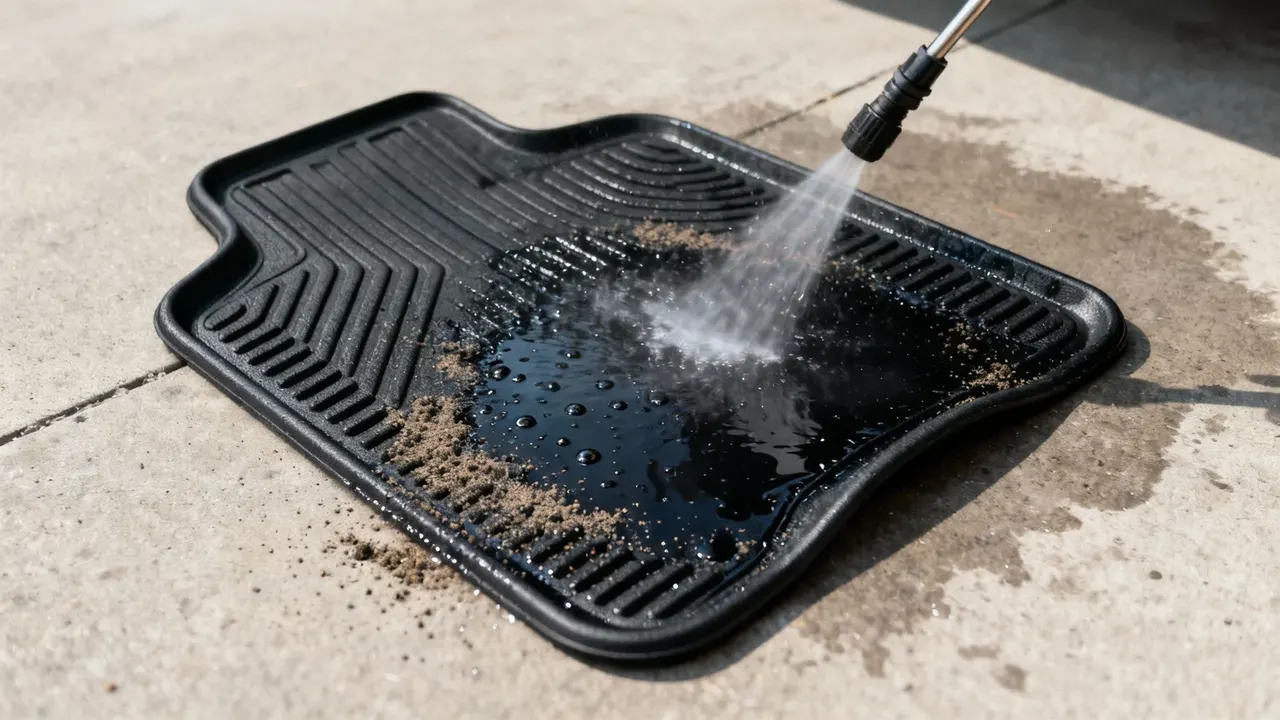
How to Clean Car Floor Mats with Pressure Washer
The safest method is to remove the mats, shake off dry dirt, pre-treat stains, pressure wash from a distance, rinse thoroughly, and dry both sides in moving air. A 25-degree nozzle at roughly 1,200 to 1,800 PSI works well for most rubber mats, while carpet mats need a wider spray, more distance, and lighter pressure.
Never pressure wash mats while they’re inside the car. Water can run beneath the carpet, reach wiring, soak seat mounts, or collect under the center console where drying becomes a real headache.
Follow these steps in order:
- Remove every mat from the vehicle. Lift slowly so loose grit doesn’t spill back into the footwell. Vacuum or sweep the footwells separately after the mats are out.
- Shake and brush off dry debris. Knock away sand, gravel, leaves, and dried mud before adding water. Pressure washing wet clumps can smear grime into carpet fibers.
- Read the mat material. Rubber and molded vinyl can handle a stronger rinse. Carpet mats with foam, fabric, stitched edges, or rubber backing need a softer spray.
- Apply a mild cleaner. Use a small amount of automotive interior cleaner or mild dish soap diluted in water. Strong degreasers can fade carpet and leave a slippery film on rubber.
- Let the cleaner work briefly. Give the soap about 3 to 5 minutes to loosen grime, but don’t let the surface dry in direct sun.
- Pressure wash from a safe distance. Start 2 to 3 feet away with a wide fan pattern. Move closer only if the material stays flat and the fibers aren’t lifting.
- Rinse until the water runs clear. Soap left in the mat attracts fresh dirt and may make rubber feel greasy.
- Drain and dry both sides. Hang mats over a railing or lay them on a clean surface with airflow underneath. Flip them after the top starts drying.
A pressure washer works by trading water volume and force against the surface. The closer the nozzle gets, the smaller the spray area becomes and the harder that water hits one spot. That concentrated force can separate carpet fibers, push dirt deeper, or peel a weak backing.
| Mat material | Starting pressure | Nozzle and distance | Main concern |
|---|---|---|---|
| Molded rubber | 1,500 to 2,000 PSI | 25-degree nozzle, 12 to 24 inches | Avoid lifting edges |
| Textured vinyl | 1,200 to 1,800 PSI | 25- or 40-degree nozzle, 18 to 30 inches | Prevent surface scuffing |
| Carpet with rubber backing | 800 to 1,500 PSI | 40-degree nozzle, 24 to 36 inches | Protect backing and seams |
| Carpet with foam backing | 600 to 1,200 PSI | 40-degree nozzle, 30 inches or more | Avoid soaking the foam |
| Delicate custom mats | Hand wash first | Wide spray only if allowed | Check the maker’s care label |
Those numbers are starting points, not permission to aim a narrow jet at the mat. A compact electric pressure washer may show less force at the spray tip than a larger gas machine, and nozzle size changes the pressure reaching the surface.
Can you use the strongest setting to finish faster? You can, but the extra force usually buys little and raises the chance of damage. A slower pass with a wide fan gets the surface clean without turning the mat into a science experiment.
Pro Tip: Test the spray on a hidden corner first. Wait a few minutes, then check for color loss, lifted fibers, warped rubber, or a sticky backing.
Keep The Spray Moving
A fan pattern spreads water across a larger area, while a zero-degree or turbo nozzle concentrates force into a tight stream. Never use a zero-degree nozzle on car floor mats, and skip turbo nozzles unless the mat maker clearly allows them.
Hold the wand at a shallow angle instead of pointing straight down. The angled spray pushes dirt toward an edge, while a straight blast can drive grit into the backing.
Work in overlapping passes from the cleanest area toward the dirtiest edge. That keeps loosened mud from flowing back across a section you already washed.
Washing Rubber, Vinyl, and Carpet Mats
Rubber and vinyl mats usually clean quickly because dirt sits on the textured surface instead of sinking deep into fibers. Carpet mats require more patience because the backing can hold water long after the top feels dry.
Rubber And Vinyl Mats
For rubber mats, rinse loose dirt first, spray on diluted cleaner, scrub grooves with a soft or medium nylon brush, then pressure rinse. Pay special attention to the channels where muddy water dries into a gritty brown line.
A rubber mat is flexible and water-resistant, but that doesn’t make every rubber surface indestructible. A sharp spray can cut soft edges, while harsh chemicals can leave a chalky finish or make the surface slick.
If your main concern is residue, rubber mat cleaning deserves a slightly different approach. The best result comes from using less soap than you think, brushing the grooves, and rinsing until your fingers no longer feel a film.
Keep the wand moving around raised logos, fastener holes, and thin outer lips. Those areas often flex under water pressure and can curl if you hold the spray there.
After rinsing, tap the mat against a clean surface to remove trapped water from the grooves. Don’t reinstall a rubber mat just because the top looks dry; the underside can still carry enough moisture to dampen the carpet underneath.
Carpet Mats
Carpet mats need a wider spray and a greater distance from the nozzle. Start with a 40-degree tip, use the lowest setting that moves the dirt, and work in short passes.
Brush carpet in one direction before rinsing, then brush it lightly again after washing. This lifts flattened fibers and helps the mat dry with a more even appearance.
Stubborn salt stains may need a second mild soap application rather than stronger pressure. A stiff brush can rough up the surface, especially on thin mats where the carpet pile is already worn.
I once rushed a set of carpet mats before a long drive and stacked them while they were still cool and damp underneath. The next morning, the car smelled sour, and I had to wash them again and leave them spread out all day. Drying is not the glamorous part, but it saves the whole job.
Important Tip: Don’t use a pressure washer on a mat with cracked backing, loose stitching, exposed foam, or peeling rubber. Hand washing is safer once the structure starts breaking down.
Washing Machine Versus Pressure Washer
A washing machine may suit some washable fabric mats, but machine agitation can damage rubber backing, stitched borders, or molded sections. If you’re comparing methods, washing machine mat care can help you decide based on the label, backing, and construction.
Pressure washing gives you more control over where the water goes, which helps with thick mud and heavily textured rubber. A washing machine can provide a more even soak for certain fabric mats, though the mat still needs a full dry cycle outside the vehicle.
Never put a mat in a washing machine just because it feels like ordinary cloth. Check the care label first, remove rigid inserts, and avoid machine washing mats with brittle or peeling backing.
Soap, Brushes, And Useful Gear
You don’t need a shelf full of detailing products. Gather the basic gear before turning on the washer:
- A pressure washer with a wide fan nozzle.
- Mild automotive cleaner or diluted dish soap.
- A hose or clean-water source for rinsing.
- A soft brush for carpet and a medium nylon brush for rubber grooves.
- A clean microfiber towel for wiping edges.
- A hanger, railing, or drying rack that supports the mat without folding it sharply.
- Rubber gloves if your skin reacts to cleaning products.
Avoid bleach, powdered laundry detergent, strong engine degreaser, and silicone dressing before driving. Those products can fade color, leave powder behind, or make the mat slippery under your feet.
A clean bucket helps with pre-rinsing and brushing, but don’t mix random cleaners in the bucket. If a product label gives a dilution ratio, follow that ratio instead of making the mixture extra strong.
Drying, Stains, and Common Problems
A fully dry mat feels dry on the top, underside, edges, and around every molded groove. The safest drying setup is shade, moving air, and enough time for the backing to release moisture.
Lean each mat so air reaches both sides. A box fan aimed across the surface can speed drying, but direct high heat from a heater or hair dryer may warp vinyl and stiffen rubber.
Sunlight can help with drying, but strong heat may fade carpet or curl flexible edges. If the mat becomes hot to the touch, move it into shade and keep the air moving.
How do you know a mat is ready to return to the car? Press a dry towel against the backing and edges, then bend the mat gently; if the towel picks up moisture or the mat feels cold and heavy, give it more time.
Fixing Common Cleaning Problems
| Problem after washing | Likely cause | Practical fix |
|---|---|---|
| Mat still feels greasy | Too much soap or dressing | Rinse with clean water and dry again |
| Musty smell returns | Backing stayed damp | Wash again and dry both sides with airflow |
| Carpet looks patchy | Uneven brushing or drying | Brush the pile in one direction while damp |
| Rubber looks cloudy | Cleaner residue or hard-water film | Rinse longer and wipe with a clean towel |
| Dirt remains in grooves | No pre-brushing | Scrub grooves before the final rinse |
| Edge curls upward | Too much heat or force | Flatten while damp and dry away from heat |
Road salt often leaves white marks that pressure alone won’t remove. Mild soap and a soft brush usually work better than turning up the PSI.
Oil, tar, and thick grease need a cleaner made for the mat material. Test the product on a hidden area first, because a solvent that works on rubber may stain carpet or loosen adhesive.
If a spill soaked through the mat, clean the vehicle’s carpet beneath it separately. Otherwise, the cabin can keep smelling even after the mat itself is fresh.
Safety Before Reinstalling Mats
A loose or wet driver’s mat can interfere with the pedals, so check the retention clips before putting the mat back. Make sure the mat sits in the factory position and cannot slide forward under the brake or accelerator.
Never stack a mat over another mat. Extra layers can change pedal clearance and may catch under a pedal during driving.
Keep pressure washer spray away from electrical connectors, airbag wiring, seat tracks, and door seals. Even when the mats are outside, a careless spray aimed into the open door can send water where it doesn’t belong.
Pro Tip: Wash mats on a clean driveway section or a plastic sheet. A dirty concrete surface can transfer fresh grit to the damp backing.
A pressure washer can also throw dirty water onto painted panels. Keep the vehicle several feet away, close the doors, and rinse the work area after finishing.
Key Takeaways:
- Use a wide nozzle, low starting pressure, and plenty of distance.
- Rubber mats handle stronger rinsing than carpet mats.
- Mild soap and brushing usually beat extra PSI.
- Dry both sides completely before reinstalling the mats.
- Check clips and pedal clearance before driving.
FAQs About How to Clean Car Floor Mats with Pressure Washer
Can I pressure wash carpet car mats?
Yes, carpet car mats can be pressure washed with a wide 40-degree nozzle, low pressure, and a distance of at least 24 to 36 inches. Carpet mats need gentle passes because strong spray can lift fibers, separate the backing, or force water into foam. Full drying may take a day or longer in humid weather.
What PSI should I use for car floor mats?
Start around 1,200 PSI for rubber mats and 800 to 1,200 PSI for carpet mats. The correct setting depends on the washer, nozzle, mat condition, and distance. Begin with less force and move closer only when the material remains flat, firm, and unchanged.
Can I use dish soap on car floor mats?
Yes, a small amount of mild dish soap diluted in water can clean rubber and many fabric mats. Too much dish soap leaves a film that catches dust and may make rubber slippery. Rinse until the water feels clean and the mat no longer feels slick.
How long do pressure-washed car mats take to dry?
Most mats need several hours in warm, dry, moving air, while thick carpet mats may need a full day or more. Drying time depends on backing thickness, humidity, temperature, and how much water the mat absorbed. Check the underside and edges before reinstalling.
Can a pressure washer remove salt stains from floor mats?
Yes, pressure washing can remove loose salt, but mild cleaner and brushing usually handle set-in white marks better. Salt residue may remain in carpet fibers after a quick rinse, so work the cleaner into the stain and rinse slowly until no cloudy water remains.
Should I pressure wash mats inside the car?
No, pressure washing mats inside the car can soak carpeting, wiring, seat hardware, and electrical connections. Remove every mat first and wash on a surface where dirty water can drain safely. Dry the mats away from the vehicle before putting them back.
A Cleaner Cabin Starts with the Right Pressure
Pressure washing car floor mats is a handy shortcut when you treat the mat material with respect. Wide spray, mild cleaner, steady passes, and complete drying will usually give you a cleaner result than brute force.
My recommendation is to start gentler than you think you need. If the mat still looks dirty, add a second soap-and-brush pass before adding pressure. That small bit of patience protects the backing, saves replacement money, and leaves your cabin fresh instead of wet and musty.
Clean one mat first, let it dry fully, and use that result to set the method for the rest. That’s the safest way to get a satisfying clean without turning a simple chore into a repair job.