Finding the best heavy duty car battery charger requires more than picking the charger with the largest amp number on the box. For regular garage use, I look for a combination of fast charging, automatic battery management, compatibility with common automotive battery types, strong clamps, useful diagnostic functions, and enough output to deal with deeply discharged batteries.
My primary recommendation is the Schumacher SC1281 6V/12V Fully Automatic Battery Charger and Engine Starter. Its combination of charging, 30A boost capability, 100A engine-start assistance, battery and alternator testing, and support for common automotive lead-acid batteries makes it one of the most versatile choices for cars, SUVs, pickups, and home garages.
For buyers who want a compact modern smart charger rather than a large engine-start unit, the NOCO GENIUS10 10A 6V/12V Smart Battery Charger is my second recommendation. It handles lead-acid and compatible lithium batteries, offers temperature compensation, repair and force modes, and can charge batteries up to 230Ah while remaining far smaller than conventional shop chargers.
The BLACK+DECKER BC15BD 15A Battery Charger with 40A Engine Start is another practical heavy-duty choice when you want faster 15A charging plus an emergency engine-start function. Its digital interface, automatic charging, battery reconditioning, and alternator-check capability make it particularly convenient for a multi-vehicle household.
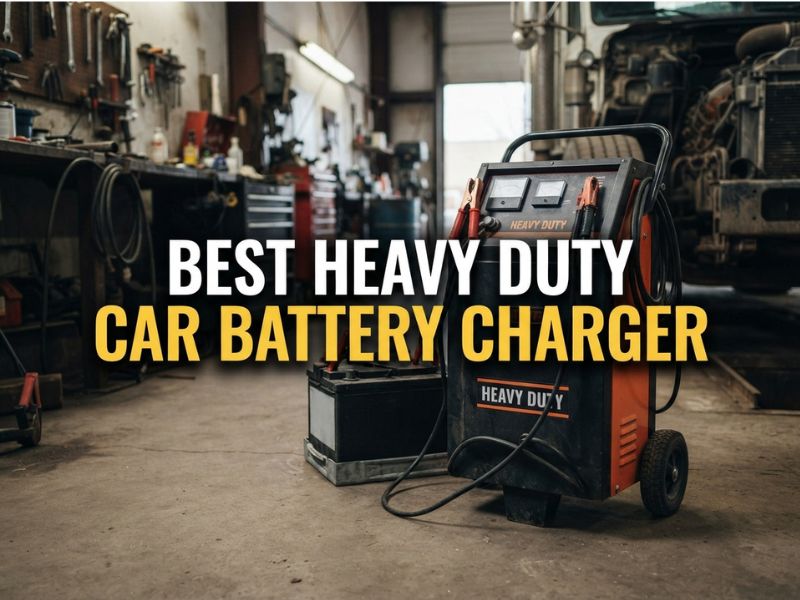
Best Heavy Duty Car Battery Charger
| Image | Product Name | Check Price |
|---|---|---|
Best Choice | Schumacher 6V/12V Battery Charger and Engine Starter | Check Price |
Second Best | NOCO GENIUS10 10A 6V/12V Smart Battery Charger | Check Price |
Third Choice | STANLEY BC15BS 15A Automatic Battery Charger | Check Price |
 | Clore Automotive Pro-Logix PL2320 20A Smart Battery Charger | Check Price |
1. Schumacher 6V/12V Battery Charger and Engine Starter – Best Overall

The Schumacher SC1281 earns my first position because it behaves more like a complete garage battery service tool than a basic charger.
Key Features
- 6V and 12V operation
- Automatic multi-stage charging
- 30A boost capability
- 100A engine-start assistance
- Standard, AGM, gel, and deep-cycle compatibility
- Battery tester
- Alternator tester
- Reverse-hookup protection
- Digital display and push-button controls
The biggest advantage is versatility. You can use it for normal charging, maintaining a healthy battery, boosting a substantially discharged battery, testing battery condition, checking alternator output, or providing engine-start assistance.
That makes it particularly useful when you maintain several vehicles instead of buying a charger solely for occasional emergency use.
Its automatic charging system monitors the connected battery and changes charging behavior as necessary. This reduces the constant supervision associated with old manual chargers.
The 30A boost function is useful when a battery is significantly discharged and you do not want to wait through a long low-current charging session. When more immediate help is needed, the 100A engine-start mode provides additional starting assistance.
I also like that the SC1281 supports both 6V and 12V batteries. Most modern automobiles are 12V, but 6V support adds value for owners of older vehicles and certain specialty equipment.
The main disadvantage is size. This is a substantially heavier charger than compact electronic units such as the NOCO GENIUS10.
What I Like
- Strong heavy-duty feature set
- 100A engine-start mode
- Useful 30A boost function
- Automatic charging
- Multiple lead-acid battery types supported
- Battery and alternator testing
- Suitable for cars, trucks, and SUVs
- Large established customer-feedback history
What I Do Not Like
- Larger and heavier than compact smart chargers
- Does not offer the broad lithium support of NOCO
- More features mean a slightly busier control panel
Verdict: The Schumacher SC1281 is my best overall choice for a home garage because it combines everyday charging with the additional functions needed for deeply discharged batteries and starting assistance.
2. NOCO GENIUS10 10A 6V/12V Smart Battery Charger – Best Smart Charger
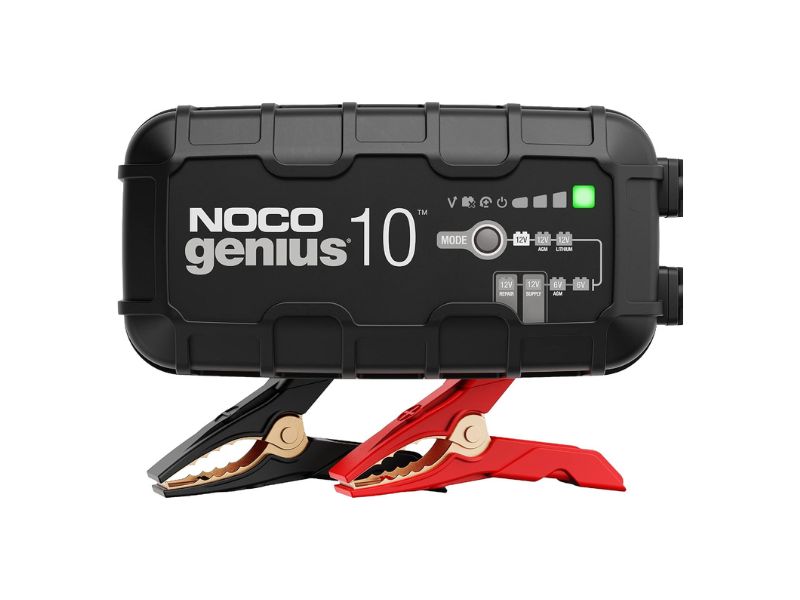
The NOCO GENIUS10 proves that a heavy-duty car battery charger does not necessarily need to be physically large.
It produces up to 10 amps of charging current while supporting batteries with capacities up to approximately 230Ah. That makes it suitable for a wide range of automotive, truck, marine, powersports, and deep-cycle applications.
Key Features
- 10A charging output
- 6V and 12V operation
- Up to 230Ah charging capacity
- Lead-acid and compatible lithium support
- AGM-specific mode
- Temperature compensation
- Force mode
- 12V repair mode
- 12V supply mode
- Automatic maintenance
- IP65 housing protection
Battery compatibility is one of its biggest strengths.
The GENIUS10 supports common flooded, AGM, gel, maintenance-free, enhanced flooded, and compatible lithium battery types.
Its integrated temperature sensor adjusts charging behavior according to ambient temperature. This is useful because charging requirements change between a cold winter garage and hot summer conditions.
Force Mode is another valuable feature. Conventional smart chargers may refuse to recognize an extremely low-voltage battery because they cannot detect enough voltage to begin charging. NOCO provides a manual mode intended for these exceptionally discharged batteries.
The 12V Repair mode is designed for certain old or sulfated lead-acid batteries. It should not be viewed as a guaranteed battery-restoration feature—a battery with damaged cells or major physical deterioration still needs replacement—but it can be useful when dealing with batteries that have remained undercharged.
Unlike the Schumacher SC1281, however, the GENIUS10 does not provide a 100A engine-start function. It is primarily a sophisticated charger and maintainer.
What I Like
- Compact 10A smart charger
- Massive customer-feedback history
- Works with many battery chemistries
- Supports batteries up to 230Ah
- Temperature-compensated charging
- Repair and Force modes
- Automatic maintenance
- Excellent safety protections
- IP65-rated housing
- Easy to store
What I Do Not Like
- No dedicated high-amp engine-start mode
- 10A charging is slower than large 15A–30A garage chargers
- Advanced modes require reading the instructions carefully
Verdict: Choose the NOCO GENIUS10 when you want sophisticated battery management and broad compatibility in a compact package rather than a conventional high-current engine-start charger.
3. BLACK+DECKER BC15BD 15A Battery Charger with 40A Engine Start – Best 15A Charger
The BLACK+DECKER BC15BD provides a useful middle ground between compact smart chargers and much larger garage machines.
Its 15A charging output is strong enough to restore a typical automotive battery significantly faster than a low-output maintainer.
Key Features
- 15A automatic charging
- 12V battery support
- 40A engine-start function
- Automatic maintenance
- Battery reconditioning
- Alternator check
- Digital display
- Cable clamps
- Automatic charging control
The 15A output is the biggest reason to consider this model.
For an average automotive starting battery, 15 amps provides useful charging speed without requiring the large wheeled housing associated with traditional commercial chargers.
The 40A engine-start feature can provide additional assistance when a vehicle battery does not have enough energy to crank the engine normally.
A digital display makes it easy to monitor charging status and battery information, while automatic operation means the charger can transition through its charging stages without constant manual adjustment.
The reconditioning function is intended to help certain batteries suffering from sulfation. As with every battery-repair feature, it cannot fix a battery with a shorted cell or serious internal damage.
The main limitation is battery compatibility. It is a 12V-focused automotive charger rather than the broader multi-voltage, multi-chemistry platform offered by the NOCO.
What I Like
- Practical 15A charge rate
- 40A engine-start assistance
- Large review history
- Automatic charging
- Digital display
- Alternator-check function
- Battery-reconditioning mode
- Compact relative to wheeled shop chargers
What I Do Not Like
- 12V only
- No modern lithium charging mode
- 40A engine start is less powerful than Schumacher’s 100A mode
Verdict: The BLACK+DECKER BC15BD is particularly attractive for drivers who want faster 15A charging plus emergency starting assistance without buying a large wheeled charger.
4. STANLEY BC15BS 15A Automatic Battery Charger – Best for Simple Garage Use

The STANLEY BC15BS follows a similar philosophy to the BLACK+DECKER: combine a relatively strong charger with several useful automotive troubleshooting and emergency functions.
Key Features
- 15A automatic charging
- 12V operation
- 40A engine-start assistance
- Automatic maintenance
- Alternator check
- Battery reconditioning
- Digital display
- Battery clamps
- Automatic charge-rate selection
The charger automatically manages the charging rate, reducing the need to manually select the current as the battery approaches full capacity.
Its 15A maximum charging output is useful for normal automotive batteries, particularly when compared with 1A, 2A, or 5A maintainers.
A 40A engine-start mode provides a temporary higher-current output intended to help start a vehicle whose battery lacks sufficient starting energy.
The alternator-check feature is also useful for basic troubleshooting. If a freshly charged battery becomes discharged repeatedly, checking the vehicle’s charging system is an important next step rather than continually reconnecting a charger.
Battery reconditioning gives the STANLEY additional versatility for certain neglected lead-acid batteries.
The primary limitation is that this is still a 12V lead-acid-oriented design. Owners who regularly service lithium starter batteries or 6V batteries should choose a charger designed specifically for those battery types.
What I Like
- Strong 15A charging output
- 40A engine-start function
- Thousands of customer ratings
- Automatic charging
- Digital interface
- Alternator checking
- Battery reconditioning
- Straightforward garage-oriented design
What I Do Not Like
- 12V only
- No lithium-specific mode
- Less starting assistance than larger Schumacher units
Verdict: The STANLEY BC15BS is a sensible option for a homeowner who wants a straightforward 12V charger with enough output for regular automotive use and occasional engine-start assistance.
5. Clore Automotive Pro-Logix PL2320 20A Smart Battery Charger – Best Professional Smart Charger

The Clore Automotive Pro-Logix PL2320 earns the final position not because it is the cheapest or most heavily reviewed product, but because its design is particularly relevant to more demanding garage work.
It offers 2A, 10A, and 20A charging rates, allowing one charger to handle different battery sizes and charging situations.
Key Features
- 2A, 10A, and 20A charging rates
- 6V and 12V support
- Fully automatic charging
- Flooded lead-acid support
- AGM compatibility
- Gel-cell compatibility
- Deep-cycle support
- Battery maintenance
- Temperature compensation
- Stable power-supply mode
The selectable charge rates provide real flexibility.
Two amps works well when slower charging is appropriate. Ten amps offers a practical general-purpose automotive rate, and the full 20A setting significantly reduces charging time on larger batteries.
The PL2320 also has a stable power-supply function. This can be useful during certain diagnostic or vehicle-programming work where stable electrical power is needed.
That makes it more attractive to technicians and experienced enthusiasts than a simple battery maintainer.
Temperature compensation automatically adjusts charging behavior based on environmental conditions, while its multi-phase charging strategy is intended to safely bring the battery to full charge and then maintain it.
Unlike the Schumacher SC1281 and the two 15A bench chargers, however, the PL2320 does not emphasize a dedicated high-amperage engine-start function.
What I Like
- Strong 20A maximum charging output
- Selectable 2A, 10A, and 20A rates
- 6V and 12V support
- Multiple lead-acid battery types supported
- Automatic maintenance
- Temperature compensation
- Stable power-supply capability
- Good option for diagnostic work
What I Do Not Like
- No high-current engine-start mode
- Interface is more utilitarian than newer consumer chargers
- No lithium charging mode
Verdict: The Clore PL2320 is an excellent option for experienced DIY mechanics and technicians who value flexible charging rates and stable power-supply capability more than engine-start assistance.
Heavy Duty Car Battery Charger Comparison
| Product | Charging Output | Voltage | Engine Start | Battery Types | Repair/Recondition | Best For |
| Schumacher SC1281 | Up to 12A charge / 30A boost | 6V/12V | 100A | Standard, AGM, Gel, Deep-Cycle | Automatic functions | Best overall garage use |
| NOCO GENIUS10 | 10A | 6V/12V | No | Wet, AGM, Gel, EFB, MF, Lithium | Yes | Smart battery management |
| BLACK+DECKER BC15BD | 15A | 12V | 40A | Automotive lead-acid | Yes | Fast home charging |
| STANLEY BC15BS | 15A | 12V | 40A | Automotive lead-acid | Yes | Simple garage use |
| Clore Pro-Logix PL2320 | 2A/10A/20A | 6V/12V | No | Flooded, AGM, Gel, Deep-Cycle | Smart charging | Professional charging |
Quick Comparison Summary
The Schumacher SC1281 is my strongest overall recommendation because it provides charging, boosting, testing, maintenance, and 100A starting assistance in one relatively compact garage unit.
The NOCO GENIUS10 is the better option when automatic battery care, AGM and lithium support, repair functionality, and compact size matter more than engine-start capability.
Choose the BLACK+DECKER BC15BD or STANLEY BC15BS when you want straightforward 15A charging with a 40A starting-assist function.
The Clore PL2320 is more specialized and particularly useful for enthusiasts or technicians who want selectable charging rates and a stable 12V power-supply mode.
How I Chose These Heavy Duty Battery Chargers
For a product to qualify for this list, I wanted considerably more capability than a small maintenance charger.
I considered charging output, engine-start or boost capability, battery chemistry support, voltage compatibility, automatic charging control, safety features, testing functions, build quality, and customer-feedback history.
I also gave strong weight to products with large numbers of existing owner ratings. An established review history does not guarantee reliability, but it provides considerably more real-world information than a charger with only a few dozen users.
What Makes a Car Battery Charger Heavy Duty?
The term heavy duty does not have one universal technical definition.
For practical automotive use, I look for several characteristics.
A charger should provide enough current to recharge a full-size automotive battery in a reasonable period. Ten to 20 amps is a useful range for many garage users, while larger professional units may provide substantially more.
Heavy-duty chargers may also include a high-current boost or engine-start mode.
Other desirable characteristics include stronger clamps, longer cables, thermal management, support for large-capacity batteries, durable housings, automatic charging, and compatibility with AGM and deep-cycle batteries.
Charging Amps vs. Engine-Start Amps
These two specifications are frequently confused.
Charging Amps
Charging current describes the amount of current the charger can continuously or semi-continuously provide while restoring battery capacity.
A 10A charger is significantly faster than a 1A maintainer when restoring a discharged automotive battery.
Engine-Start Amps
Engine-start output is a much higher current supplied for a very short period.
The Schumacher SC1281, for example, provides a substantially higher starting-assistance output than its normal charging current.
Do not assume a product described as a 100A charger continuously charges at 100 amps. That larger figure normally refers to the short-duration starting function.
How Many Amps Should a Heavy Duty Car Battery Charger Have?
For most home garages, 10 to 20 amps of actual charging current is a useful range.
A 10A charger provides a strong balance between charging speed and compact size.
A 15A charger restores common automotive batteries more quickly and is particularly useful when vehicles are regularly allowed to sit.
A 20A charger is attractive for larger batteries, trucks, deep-cycle batteries, and more frequent garage work.
Thirty amps and above can reduce charging time further but introduce more heat and require better charger design.
Always follow the battery manufacturer’s recommended charging limits.
Is a 10A Charger Heavy Duty Enough?
For many home garages, yes.
The NOCO GENIUS10 demonstrates why maximum current is only one part of charger capability.
Ten amps can charge a wide range of passenger-car, pickup, SUV, marine, and deep-cycle batteries while still allowing the charger to remain compact.
For professional shops that repeatedly recharge large deeply discharged batteries, 20A, 30A, or higher continuous output may be preferable.
10A vs. 15A vs. 20A Battery Charger
A 10A charger offers good everyday charging speed and is generally easier to manage.
A 15A charger reduces charging time further and makes sense for larger automotive batteries.
A 20A charger is better when charging speed is a regular concern or you maintain several vehicles.
Remember that smart chargers do not necessarily deliver their maximum rated current throughout the entire charging cycle. Current typically decreases as the battery approaches full charge.
Battery Size and Charging Time
A typical car battery may have a capacity somewhere around 40Ah to 100Ah, depending on the vehicle.
A large pickup, SUV, diesel, or deep-cycle battery can be considerably larger.
Charging time depends on:
- Battery capacity
- Current state of charge
- Charger output
- Battery temperature
- Battery age
- Battery chemistry
- Charging efficiency
If two otherwise identical 80Ah batteries are equally discharged, a 20A charger should generally restore capacity significantly faster than a 5A charger.
Actual charging time will still be longer than a simple mathematical capacity calculation because smart charging current changes during the charging process.
AGM Battery Compatibility
AGM batteries require an appropriate charging profile.
Many modern vehicles use AGM batteries because they tolerate high electrical loads and start-stop applications better than conventional flooded batteries.
The Schumacher SC1281, NOCO GENIUS10, and Clore PL2320 support AGM batteries.
The GENIUS10 also provides a dedicated AGM mode.
Using the correct charging profile helps ensure the battery reaches an appropriate state of charge without excessive voltage.
Lithium Battery Compatibility
Lithium starter batteries require specific charging electronics.
Do not use a conventional lead-acid charger on a lithium battery unless the charger specifically supports the exact battery chemistry.
The NOCO GENIUS10 supports compatible 12V lithium batteries equipped with appropriate battery-management systems.
The other chargers in this comparison are primarily aimed at lead-acid applications.
What Is Battery Repair Mode?
Lead-acid batteries can develop sulfation when they remain undercharged for extended periods.
Some smart chargers use specialized charging programs intended to address certain forms of sulfation or stratification.
This can occasionally improve a neglected battery, but repair mode has limits.
It cannot fix:
- Shorted cells
- Broken internal connections
- Severe plate deterioration
- Physical case damage
- A leaking battery
- A frozen battery
If a battery repeatedly fails after being fully charged, replacement or professional testing is usually more appropriate than repeatedly running repair mode.
Engine-Start Mode Explained
A charger with an engine-start function temporarily provides much more current than its normal charging rate.
This can help when the battery has some remaining capacity but cannot produce enough current to crank the starter successfully.
The Schumacher SC1281 provides the strongest dedicated engine-start function among these five products.
BLACK+DECKER and STANLEY also provide starting assistance, though at a lower output.
An AC-powered engine-start charger is different from a portable jump starter. It normally needs to remain connected to a household electrical outlet.
Battery and Alternator Testing
Battery problems and charging-system problems can produce similar symptoms.
If the battery repeatedly becomes discharged, the cause could be:
- An aging battery
- A failing alternator
- A parasitic electrical draw
- Loose battery connections
- Corrosion
- Frequent short trips
A charger with battery and alternator testing can provide useful initial information.
The Schumacher SC1281 is particularly attractive here because diagnostic capability is integrated into the unit.
Best Heavy Duty Charger for Trucks and SUVs
The Schumacher SC1281 is my first choice for normal gasoline trucks and SUVs because its charging, boost, and engine-start functions provide more versatility than a basic charger.
For large-capacity batteries where engine starting is not required, the Clore PL2320’s 20A maximum charging output is attractive.
The NOCO GENIUS10 is another strong choice when you want compact storage and sophisticated battery management.
Owners of large diesel vehicles should verify battery configuration before charging. Some diesels use dual 12V batteries, and commercial equipment can use different electrical configurations.
Best Charger for a Dead Car Battery
A deeply discharged battery benefits from a charger with reasonable current capacity.
The Schumacher SC1281, BLACK+DECKER BC15BD, STANLEY BC15BS, and Clore PL2320 all provide considerably faster potential charging than small maintainers.
The NOCO GENIUS10 also has an advantage with extremely low-voltage batteries because of its Force Mode.
However, a battery that is physically damaged, frozen, leaking, or internally shorted should not be charged.
Heavy Duty Charger vs. Portable Jump Starter
These tools solve different problems.
A battery charger gradually restores energy to a discharged battery.
A jump starter provides a short burst of very high current so the engine can start.
Charging is preferable when time allows because the battery receives stored energy rather than simply relying on another source for a momentary start.
A jump starter is better during a roadside emergency where an AC electrical outlet is unavailable.
Some AC battery chargers, including the Schumacher SC1281, combine normal charging with a high-current starting-assistance mode.
Smart Charger vs. Manual Charger
Older manual chargers require considerably more user attention.
A modern smart charger monitors voltage, charge progress, and other battery conditions while automatically changing its charging stage.
This provides several advantages:
- Reduced overcharging risk
- Automatic maintenance
- Easier operation
- Better compatibility with modern batteries
- Improved long-term charging control
For most homeowners, I strongly prefer an automatic smart charger.
Manual chargers still have specialized uses, but they require more battery knowledge and supervision.
How to Use a Heavy Duty Battery Charger Safely
Read both the charger instructions and your vehicle manufacturer’s battery-charging recommendations before connecting anything.
Make sure the battery voltage and chemistry match the selected charger mode.
Inspect the battery for cracks, swelling, leakage, or freezing.
Turn off the vehicle and unnecessary electrical accessories.
Connect the charger clamps according to the specified procedure before energizing the charger.
Confirm correct polarity.
Select the appropriate battery voltage, chemistry, and charging mode if the charger does not do so automatically.
Allow the charger to complete its cycle.
Disconnect it according to the manufacturer’s instructions.
Charging produces electrical energy and, with some lead-acid batteries, potentially flammable gases. Work in an appropriately ventilated area away from sparks and open flames.
Can You Leave a Smart Battery Charger Connected Overnight?
Many fully automatic chargers are designed to transition into maintenance mode after charging is complete.
That makes overnight charging possible when the manufacturer specifically permits it.
However, the charger should still be used in a safe, dry, ventilated location.
Do not leave a visibly damaged battery charging unattended.
A maintainer function does not make a defective battery safe.
Frequently Asked Questions
What is the best heavy duty car battery charger?
The Schumacher SC1281 is my best overall choice for most home garages.
Its combination of automatic charging, boost capability, 100A engine-start assistance, battery testing, alternator testing, and compatibility with several common lead-acid battery types makes it more versatile than a basic charger.
Which heavy duty car battery charger has the most useful smart features?
The NOCO GENIUS10 offers the broadest smart-charging feature set in this comparison.
It supports 6V and 12V batteries, multiple lead-acid chemistries, compatible lithium batteries, temperature compensation, automatic maintenance, Force Mode, repair charging, and a 12V supply function.
Is a 15A charger good for car batteries?
Yes, 15 amps is a strong charging rate for many full-size automotive batteries.
It is substantially faster than small 1A–5A maintainers while remaining practical for home-garage equipment. Battery capacity and manufacturer charging limits should still be checked.
Is a 20A charger better than a 10A charger?
A 20A charger can recharge a compatible battery faster, but it is not automatically better.
Ten amps is enough for many automotive charging situations and produces less heat. Twenty amps makes more sense for large batteries or frequent garage work.
Can a heavy duty charger start a car?
Only chargers with a dedicated engine-start or starting-assist mode can provide this function.
The Schumacher SC1281, BLACK+DECKER BC15BD, and STANLEY BC15BS include starting assistance. The NOCO GENIUS10 and Clore PL2320 are primarily chargers and maintainers.
Can I charge an AGM battery with these chargers?
Several of these models support AGM batteries.
The Schumacher SC1281, NOCO GENIUS10, and Clore PL2320 specifically support AGM applications. Always select the appropriate battery mode where required.
Can I charge a lithium car battery?
Only use a charger specifically approved for the lithium battery’s chemistry and management system.
The NOCO GENIUS10 supports compatible 12V lithium batteries. Do not assume a traditional lead-acid charger can safely charge lithium batteries.
How long does it take to charge a dead car battery?
Charging time can range from several hours to much longer depending on battery size, discharge level, and charger output.
A 15A or 20A charger generally restores a battery faster than a 5A or 10A unit. Smart chargers also reduce current as the battery approaches full charge.
Can a charger fix a sulfated battery?
Repair or reconditioning modes may help mild sulfation, but they cannot restore every failed battery.
A battery with damaged cells, severe internal deterioration, swelling, leakage, or other physical problems normally requires replacement.
Do I need 6V charging capability?
Most modern passenger vehicles use 12V batteries, so many owners will never need 6V charging.
Six-volt support is useful for certain classic vehicles, older equipment, and specialty batteries. The Schumacher SC1281, NOCO GENIUS10, and Clore PL2320 provide additional voltage flexibility.
Is engine-start mode the same as jump starting?
The objective is similar, but an engine-start charger normally requires AC power.
A portable jump starter carries its own stored energy. A heavy-duty AC charger with engine-start mode draws power from an electrical outlet to provide temporary starting assistance.
Which charger is best for an SUV or pickup?
The Schumacher SC1281 is the most versatile choice for typical SUV and pickup applications.
Its boost and starting-assistance functions are particularly useful with larger automotive batteries. The NOCO GENIUS10 is better if you prioritize compact size and sophisticated smart charging.
Can I leave the charger connected after the battery reaches full charge?
Automatic chargers with maintenance mode can usually remain connected when their instructions specifically allow it.
Once the battery reaches full charge, the charger reduces or pauses charging and monitors battery condition. Follow the manufacturer’s recommendations for extended maintenance.
What should I do if the battery will not accept a charge?
Stop assuming the charger is the problem and have the battery tested.
A battery may refuse charging because of a failed cell, severe sulfation, internal damage, freezing, or simply reaching the end of its usable life. Vehicle charging-system problems can also cause repeated discharge.
Is a high-amp battery charger dangerous?
Any battery charger can be hazardous if connected incorrectly or used with a damaged battery.
Higher-current equipment makes correct connections and proper battery compatibility even more important. Use reverse-polarity protection as an additional safeguard rather than a substitute for correct procedure.
Conclusion
The best heavy duty car battery charger should provide enough charging current to recover automotive batteries efficiently while giving you the controls and safety functions needed for regular garage use.
My primary recommendation is the Schumacher SC1281 6V/12V Fully Automatic Battery Charger and Engine Starter. Its combination of charging, 30A boost capability, 100A starting assistance, diagnostic testing, and multi-battery compatibility makes it the most complete heavy-duty option for a typical home garage.
The NOCO GENIUS10 is my preferred smart-charging alternative. It lacks a high-amperage engine-start mode but compensates with broad battery compatibility, compact dimensions, temperature compensation, repair functions, and exceptionally sophisticated automatic charging.
For straightforward high-output charging, the BLACK+DECKER BC15BD and STANLEY BC15BS both provide useful 15A charging and 40A engine-start assistance.
The Clore Automotive Pro-Logix PL2320 is the most technician-oriented option, offering selectable 2A, 10A, and 20A rates plus stable power-supply capability.
For most garages, I would choose the Schumacher SC1281 when boost and engine-start functions matter, or the NOCO GENIUS10 when intelligent battery management and compact storage are the bigger priorities.