A manual car battery charger makes sense when you want direct control instead of relying entirely on a microprocessor to decide whether a battery should charge. Automatic chargers are convenient, but they can sometimes refuse to begin charging when battery voltage has fallen extremely low.
A traditional manual charger lets an experienced user select the charge rate, monitor the ammeter, control charging time, and—in many models—use a high-current boost or engine-start mode when needed.
I paid particular attention to true manual operation, adjustable charging current, timer control, 6V/12V compatibility, engine-start output, cable quality, battery-type support, and overall garage usefulness. Because manual chargers require more judgment than automatic models, I also favored units with clear analog meters, substantial clamps, and straightforward controls.
My primary recommendation is the Schumacher Electric SC1446 6V/12V 200A Manual Battery Charger and Engine Starter. It provides the classic manual-charger experience many experienced DIY mechanics are looking for: a mechanical timer, analog charging meter, multiple charge and boost rates, 200A engine-start assistance, and a wheeled steel housing.
For buyers who want more starting power, the Schumacher Electric SC1445 6V/12V 250A Manual Battery Charger and Engine Starter increases engine-start output to 250 amps and provides up to a 50A boost setting. It is particularly attractive for pickups, SUVs, marine batteries, and larger garage workloads.
If you mainly work with standard 12V automotive batteries and do not need 6V support, the Schumacher Electric SC1437 12V 150A Manual Battery Charger and Engine Starter is a simpler alternative. It retains the manual 135-minute timer and analog ammeter while offering a 25A boost and 150A engine-start setting.

Best Manual Car Battery Charger
| Image | Product Name | Check Price |
|---|---|---|
Best Choice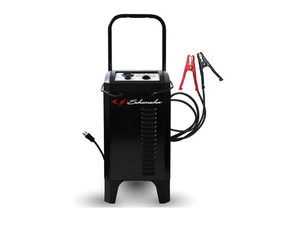 | Schumacher Electric SC1446 6V/12V 200A Manual Battery Charger | Check Price |
Second Best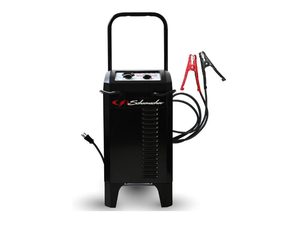 | Schumacher Electric SC1445 6V/12V 250A Manual Battery Charger | Check Price |
Third Choice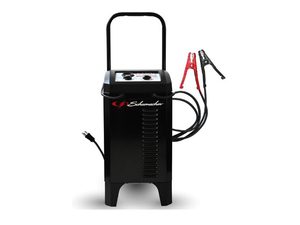 | Schumacher Electric SC1437 12V 150A Manual Battery Charger | Check Price |
 | Associated Equipment 6002B Heavy-Duty Fleet Battery Charger | Check Price |
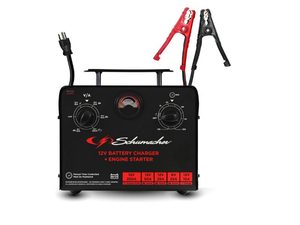 | Schumacher Electric SC1667 250A 6V/12V Timer-Controlled Battery Charger | Check Price |
1. Schumacher Electric SC1446 6V/12V 200A Manual Battery Charger and Engine Starter – Best Overall

Key Features
- 6V and 12V lead-acid battery support
- 200A 12V engine-start mode
- Up to 40A boost charging
- 10A normal 12V charging
- Manual 135-minute timer
- Analog ammeter
- Standard, AGM, gel, and deep-cycle compatibility
- 6-foot output cables
- Wheeled steel construction
The Schumacher SC1446 is my first choice because it gives experienced users the manual control they are usually looking for without moving all the way into expensive professional fleet equipment.
Instead of deciding the entire charging process internally, the SC1446 lets you select the appropriate charging or starting function and control charging duration with a 135-minute mechanical timer.
That is especially useful when dealing with a battery whose voltage has fallen too low for certain automatic chargers to recognize.
With a manual charger, the operator assesses battery voltage, battery type, capacity, condition, and desired charge rate rather than waiting for a smart charger to approve the connection.
For routine 12V charging, the SC1446 supplies 10 amps. That is a practical rate for ordinary automotive batteries and considerably faster than a 1A or 2A maintainer when meaningful capacity needs to be restored.
The charger also provides higher-current boost settings. A boost cycle can be useful when a battery is heavily discharged and you want to put energy back into it relatively quickly before attempting an engine start.
The 200A engine-start setting is another major benefit. It turns the SC1446 into more than a battery charger. When AC power is available, it can provide temporary starting assistance for cars, SUVs, pickups, and other compatible 12V vehicles.
Its physical construction feels appropriately traditional. A metal case, retractable handle, and wheels make it easy to roll between vehicles without carrying roughly 30 pounds of charger around the garage.
The six-foot output cables are also much more practical around vehicles than the very short leads included with some compact chargers.
Battery compatibility includes common standard flooded, AGM, gel, and deep-cycle lead-acid designs.
Manual control does introduce responsibility, however. You need to select appropriate voltage and current, monitor charging progress, and avoid leaving the charger operating indefinitely.
What I Like
The biggest advantage is control. You decide what the charger does rather than having an automatic detection system make every decision.
The 200A engine-start mode also gives it enough versatility for a wide range of normal automotive work.
I also like the analog ammeter. Digital displays are convenient, but an analog needle provides immediate visual feedback about how charging current changes as the battery accepts energy.
What I Do Not Like
This is not a set-it-and-forget-it maintainer. Proper manual charging requires more attention and battery knowledge.
At roughly 30 pounds, the unit also takes up much more garage space than a compact smart charger.
Verdict
The Schumacher SC1446 is the best manual car battery charger for most experienced home mechanics. It combines useful 6V/12V versatility, manual timer control, strong boost charging, 200A engine-start assistance, and a proven wheeled design.
2. Schumacher Electric SC1445 6V/12V 250A Manual Battery Charger and Engine Starter – Best High-Power Pick

Key Features
- 6V and 12V operation
- 250A 12V engine-start mode
- 50A 12V boost mode
- 25A boost options
- 10A 12V regular charging
- Manual 135-minute timer
- Analog charging meter
- Standard, AGM, gel, and deep-cycle battery support
- Wheeled housing
The Schumacher SC1445 is closely related to my first choice but raises maximum engine-start capability to 250 amps.
That additional starting reserve makes the SC1445 particularly attractive if your garage includes full-size pickups, large SUVs, older vehicles with high-displacement engines, marine batteries, or equipment that occasionally needs stronger starting assistance.
Normal charging remains appropriately controlled.
The 10A 12V charge setting handles ordinary battery recovery, while intermediate boost settings let you supply considerably more charging current when time is limited.
The 50A 12V boost mode is especially useful with a battery that is deeply discharged but still capable of accepting charge.
Rather than immediately relying on engine-start mode, you can put meaningful energy back into the battery first.
Like the SC1446, this model uses a mechanical timer that can run for up to 135 minutes. Manual control lets experienced users select the charging duration based on battery capacity and state of charge.
The analog ammeter gives you visual feedback instead of simply displaying a generic charging icon.
Another advantage is 6V support. While modern cars are normally 12V, older vehicles, tractors, motorcycles, and other equipment may still use 6V batteries.
That makes the SC1445 useful in a workshop containing more than just modern passenger cars.
Its heavy-duty clamps work with common top- and side-post battery configurations, and the six-foot output cables provide useful working reach.
What I Like
The SC1445 has noticeably more engine-start headroom than many home chargers.
Its combination of 10A normal charging, multiple boost rates, and 250A starting assistance makes it flexible enough for both routine maintenance and difficult starting situations.
What I Do Not Like
More power does not automatically make it better for every battery.
Owners who only maintain small automotive or powersports batteries may never use the 250A engine-start capability.
It is also a large wheeled charger rather than a compact shelf unit.
Verdict
Choose the SC1445 if you like the manual operation of the SC1446 but want stronger engine-start output and a 50A boost setting for larger vehicles and more demanding garage work.
3. Schumacher Electric SC1437 12V 150A Manual Battery Charger and Engine Starter – Best for Everyday 12V Vehicles

Key Features
- 12V operation
- 150A engine-start mode
- 25A boost charge
- 6A regular charging
- Manual 135-minute timer
- Analog ammeter
- Standard, AGM, gel, and deep-cycle support
- Wheeled steel construction
- 6-foot output cables
The Schumacher SC1437 is a simpler manual charger aimed primarily at normal 12V automotive applications.
Its lower 6A regular charging rate is suitable for owners who do not need the faster 10A recovery available from the larger models.
The 25A boost mode provides a useful middle ground between ordinary charging and engine starting.
If a battery is weak after sitting for several weeks, a period of higher-current charging may restore enough capacity to allow the battery itself to contribute more strongly during the next crank.
For a more urgent situation, the SC1437 offers a 150A engine-start setting.
That is enough assistance for many passenger cars, crossovers, SUVs, and light trucks, although owners of larger engines may prefer the 200A or 250A alternatives ranked above it.
The 135-minute timer is central to the manual design.
You determine how long the charger operates rather than relying on automatic termination.
This gives knowledgeable users more control, but it also means you should calculate an appropriate charging period and monitor the process.
The analog ammeter helps you watch current flow. As a conventional lead-acid battery approaches a higher state of charge, current behavior can provide useful information to an experienced user.
One reason I like the SC1437 is simplicity.
If everything you own uses 12V batteries, paying extra for 6V capability and maximum engine-start output may be unnecessary.
What I Like
The SC1437 is easier to justify for an ordinary residential garage.
It retains true manual control and an engine-start mode without pushing specifications into professional-shop territory.
Battery-type compatibility is also broad for a traditional manual charger.
What I Do Not Like
It does not support 6V batteries.
The 6A regular charge rate is also slower than the 10A settings on the SC1445 and SC1446.
Verdict
The SC1437 is the manual charger I would choose for a garage focused on conventional 12V cars, SUVs, light trucks, and marine batteries.
4. Associated Equipment 6002B Heavy-Duty Fleet Battery Charger – Best Professional Manual Charger

Key Features
- 6V, 12V, 18V, and 24V operation
- 100A, 80A, 50A, and 40A charging outputs
- 400A 12V cranking assist
- Heavy-duty manual controls
- Automatic timer
- 500A insulated clamps
- Fan-cooled transformer design
- Polarity indication system
- Wheeled commercial chassis
The Associated Equipment 6002B is in a completely different class from the typical home battery charger.
It is designed for automotive shops, fleet maintenance, truck repair, diesel service, and other professional environments where chargers may be used repeatedly and on different battery systems.
Voltage flexibility is exceptional.
The 6002B supports 6V, 12V, 18V, and 24V systems, making it useful well beyond normal passenger cars.
That includes fleet vehicles, trucks, buses, equipment, and specialty electrical systems.
Charging output is similarly substantial, with rates reaching as high as 100 amps, depending on the selected voltage and mode.
For engine assistance, it provides up to 400A cranking assist at 12V.
The charger uses a large transformer, fan cooling, substantial clamps, and a rugged wheeled frame.
This old-school architecture is one reason professional technicians still seek out manual commercial chargers.
There are fewer layers of automation between the operator and the battery.
The operator controls what the charger is doing and can apply significant charging current when the situation calls for it.
Associated also uses a polarity-indication system to help identify an incorrect connection before operation.
This is welcome because manual control should never mean abandoning basic safety features.
The obvious downside is size and cost.
This is not the appropriate purchase for someone who charges one sedan battery twice a year.
Its capabilities make sense when the charger earns its floor space through frequent use.
What I Like
The 6002B offers serious professional capability, unusually broad voltage support, and very high charging and starting output.
Its serviceable, heavy-duty construction is also attractive for workshops that prefer equipment designed for years of use rather than disposable consumer electronics.
What I Do Not Like
It is expensive, heavy, and excessive for typical home users.
Its high-current manual operation also demands significantly more knowledge than a small automatic smart charger.
Verdict
The Associated Equipment 6002B is my choice for professional garages and fleet environments where manual control, multi-voltage compatibility, and heavy-duty charging capability matter more than portability or price.
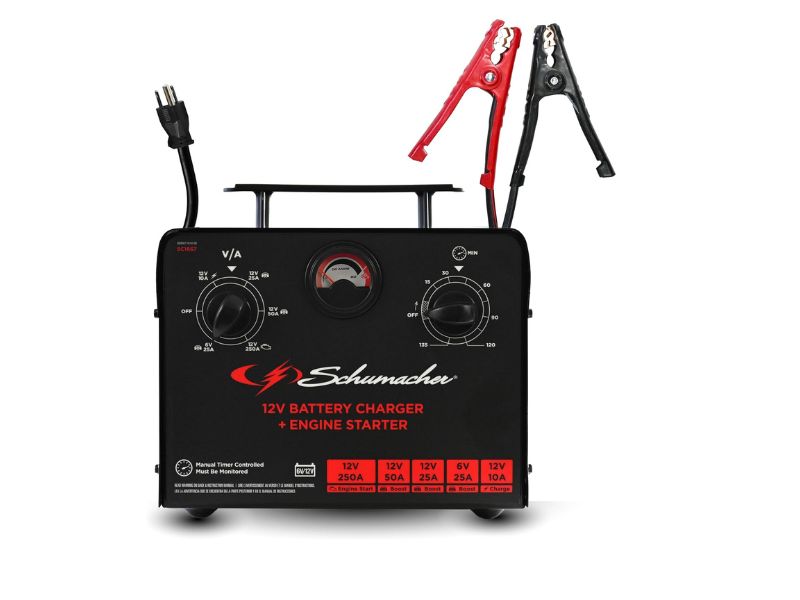
5. Schumacher Electric SC1667 250A 6V/12V Timer-Controlled Battery Charger and Jump Starter – Best Newer Manual Design
Key Features
- 6V and 12V operation
- 250A 12V engine-start output
- 50A 12V boost
- 25A 6V boost
- 25A 12V boost
- 10A 12V charging
- 135-minute timer
- Built-in analog ammeter
- 6-gauge booster cables
- Standard, AGM, and gel battery support
The Schumacher SC1667 takes the final position because it is a newer manual charger with a smaller feedback history than the established models above, but its specifications are particularly appealing.
Unlike the older wheeled models, the SC1667 packages substantial manual charging capability into a more compact metal enclosure.
It provides a 250A 12V engine-start setting, putting starting capability on par with the larger SC1445.
It also offers three useful boost configurations: 50A at 12V, 25A at 12V, and 25A at 6V.
For ordinary charging, there is a 10A 12V setting.
The mechanical 135-minute timer keeps the operating philosophy traditional.
Set the desired charging mode, determine the appropriate time, and monitor the analog ammeter as the battery charges.
One detail I particularly like is the use of 6-gauge booster cables. High-current engine-start functions are only as useful as the electrical path between the charger and battery.
Substantial cable conductors help reduce unwanted resistance during high-current operation.
The cables are also designed to remain flexible in cold conditions, making the SC1667 useful in garages and workshops that experience winter temperatures.
The compact metal case makes storage somewhat easier than a traditional upright wheeled charger, although it is still a substantial transformer-based machine.
What I Like
The SC1667 combines the straightforward manual operation experienced mechanics appreciate with strong 250A engine-start capability.
Its heavier booster cables are another meaningful advantage.
What I Do Not Like
It has a shorter buyer-feedback history than the older SC1445 and SC1446.
The product is also still heavy compared with modern electronic smart chargers.
Verdict
The SC1667 is an excellent choice for buyers who specifically want a newer timer-controlled manual charger with high engine-start output and substantial cables.
Best Manual Car Battery Charger Comparison
| Product | Voltage | Normal Charge | Boost | Engine Start | Manual Timer | Best For |
| Schumacher SC1446 | 6V/12V | 10A | Up to 40A | 200A | 135 min | Best overall |
| Schumacher SC1445 | 6V/12V | 10A | Up to 50A | 250A | 135 min | Trucks and larger engines |
| Schumacher SC1437 | 12V | 6A | 25A | 150A | 135 min | Everyday 12V vehicles |
| Associated Equipment 6002B | 6V/12V/18V/24V | Up to 100A | High-current charging | 400A at 12V | Yes | Professional fleet work |
| Schumacher SC1667 | 6V/12V | 10A | Up to 50A | 250A | 135 min | Newer manual design |
Quick Comparison
For the majority of experienced DIY users, I would choose the Schumacher SC1446. It provides enough charging and engine-start capability for a broad range of automotive work without reaching the size, cost, or output of professional fleet equipment.
The SC1445 is better when 250A engine-start power and a 50A boost setting are useful.
The SC1437 is the simpler choice if you only work with 12V batteries.
Professional technicians should look closely at the Associated Equipment 6002B, while the SC1667 appeals to buyers who want a newer manual design with substantial engine-start cables.
What Is a Manual Car Battery Charger?
A manual car battery charger gives the operator direct control over part or all of the charging process.
On a traditional manual unit, you may need to select:
- Battery voltage
- Charging amperage
- Boost setting
- Engine-start setting
- Charging duration
Many manual chargers use a mechanical timer rather than electronic automatic shutoff.
They usually include an analog ammeter so you can observe charging current.
This is very different from a modern automatic charger that detects battery voltage, estimates battery condition, selects a charging profile, and reduces or stops current automatically.
Why Do Some People Prefer Manual Battery Chargers?
Automatic chargers are safer and easier for most people, so why do experienced mechanics still look for manual models?
The biggest reason is control.
Automatic chargers normally need to detect a valid battery voltage before they begin charging.
If the battery voltage is extremely low, the smart charger may interpret the connection as:
- No battery
- Incorrect battery
- Damaged battery
- Unsafe connection
It may therefore refuse to provide output.
A manual charger can often apply charging current even when the battery is extremely depleted.
That does not mean every deeply discharged battery should be charged.
A battery can be too damaged, frozen, shorted, or deteriorated to safely recover.
The difference is that a manual charger lets a knowledgeable operator make the decision rather than relying entirely on electronic detection.
Manual vs Automatic Car Battery Charger
Manual Charger
A manual charger gives you greater authority over charging current and duration.
Advantages include:
- Can work with some extremely low-voltage batteries
- Direct control of charge rate
- Clear analog current monitoring
- Often includes powerful engine-start modes
- Straightforward transformer-based construction
- Popular with experienced mechanics
The disadvantages are equally important:
- Requires battery knowledge
- Can overcharge a battery if misused
- Needs active monitoring
- Incorrect settings can damage batteries
- Usually larger and heavier
Automatic Charger
Automatic chargers use electronic controls to manage charging.
They are excellent for:
- Beginners
- Long-term maintenance
- Seasonal storage
- AGM-specific charging
- Unattended smart maintenance
- Users who want minimal interaction
Their biggest limitation is that protective electronics can sometimes prevent operation with an extremely depleted battery.
Who Should Buy a Manual Charger?
A manual charger makes the most sense for someone who already understands basic battery charging.
Good candidates include:
- Experienced DIY mechanics
- Automotive technicians
- Classic-car owners
- Farm-equipment owners
- Fleet technicians
- Restoration shops
- People who regularly work with deeply discharged lead-acid batteries
If this is your first time charging an automotive battery, an automatic charger is usually easier and safer.
Manual control is useful because it provides freedom—but freedom means the operator has to make correct decisions.
Understanding Charging Amps
The charging-current setting determines how quickly electrical energy is returned to the battery.
2A to 6A
Low charging rates are gentle and useful for smaller batteries or slower charging.
They can require many hours on a large automotive battery.
10A
Ten amps is an excellent general-purpose charging rate for many normal car batteries.
It offers reasonable recovery time without moving into aggressive fast charging.
20A to 25A
This range is commonly used as a faster boost setting.
It can restore meaningful charge more quickly but generates more heat.
40A to 50A
These are strong boost rates.
They are useful for getting energy into a heavily discharged large battery before an engine-start attempt.
They generally should not be treated as a normal long-duration charging rate unless specifically permitted by the battery and charger manufacturer.
100A and Higher
At these outputs, the charger is usually operating in engine-start mode.
The current is intended for a short cranking event rather than battery charging.
How Long Should You Charge a Car Battery Manually?
There is no single correct charging time.
You need to consider:
Battery capacity: A large 100Ah battery requires more energy than a 45Ah battery.
State of charge: A battery at 60% charge needs much less energy than one at 10%.
Charging rate: A 10A charger recovers energy faster than a 2A charger.
Battery age: An old battery may accept current differently.
Battery chemistry: Flooded, AGM, and gel batteries have different charging characteristics.
A rough charging estimate can be calculated from the amount of capacity that needs to be restored.
For example, imagine a 60Ah battery that is approximately 50% discharged.
Roughly 30Ah needs to be replaced.
At a theoretical constant 10A, 30Ah divided by 10A equals three hours.
Real charging takes longer because charging is not 100% efficient and battery behavior changes as state of charge rises.
This is why an analog ammeter, voltmeter, charging chart, and battery manufacturer’s recommendations are useful when using a manual charger.
Why a Manual Timer Matters
The mechanical timer on chargers such as the SC1446 is an important safety and convenience feature.
Without a timer, forgetting a manual charger could leave the battery receiving current far longer than intended.
A 135-minute timer automatically ends the selected charging session after a predetermined period.
It does not make the charger fully automatic.
The timer does not know:
- Battery capacity
- Battery temperature
- State of charge
- Battery health
- Correct chemistry setting
You still have to choose an appropriate charging strategy.
Think of the timer as an operator-controlled limit rather than an intelligent charging computer.
How to Read an Analog Ammeter
Many traditional chargers have an analog current meter.
When a discharged battery is first connected at a suitable charging rate, the current reading may be relatively high.
As the battery charges, current behavior often changes.
The exact reading depends on:
- Charger design
- Battery voltage
- Internal resistance
- Battery capacity
- Charge setting
Do not use the ammeter as your only indication of battery condition.
A proper digital multimeter or battery tester provides additional useful information.
Experienced users often evaluate the ammeter together with battery voltage, charging time, temperature, and known battery capacity.
6V vs 12V Charging
Modern passenger cars overwhelmingly use 12V batteries, but 6V systems still exist.
You may encounter 6V batteries in:
- Antique cars
- Classic tractors
- Vintage motorcycles
- Older farm equipment
- Specialty equipment
A dual-voltage manual charger is valuable if you work on mixed equipment.
The SC1445, SC1446, and SC1667 all provide 6V/12V flexibility.
The SC1437 is more straightforward but limited to 12V.
Never select 12V charging for a 6V battery.
Always verify nominal battery voltage before energizing a manual charger.
What Is Boost Mode?
Boost mode is a higher charging-current setting intended to add battery energy faster than the normal charge rate.
Suppose a battery is heavily discharged but not damaged.
A normal 6A or 10A charge may eventually recover it, but you may not want to wait several hours.
A 25A, 40A, or 50A boost can return more energy over a shorter period.
Boost mode is particularly useful before attempting an engine start.
Instead of asking the charger to do all the cranking work, you allow the battery to regain some capacity first.
Higher current also creates more heat, so boost settings should only be used within the specified duty cycle and battery limits.
What Is Engine-Start Mode?
Engine-start mode supplies a temporary burst of high current while the vehicle’s starter motor operates.
The products in this guide provide between 150A and 400A of starting assistance, depending on the model.
That current is not intended for continuous charging.
Engine-start modes normally require:
- Correct battery connection
- AC power
- Proper voltage selection
- A short crank attempt
- A cool-down interval before repeated attempts
Repeatedly operating a high-current start setting without respecting the duty cycle can overheat the charger.
Can a Manual Charger Charge a Completely Dead Battery?
This is one of the main reasons people still seek manual chargers.
A battery showing extremely low voltage may be rejected by some automatic chargers.
A manual charger can often begin supplying current anyway.
However, “completely dead” does not always mean safely rechargeable.
A battery should not be charged normally if it is:
- Frozen
- Cracked
- Leaking
- Severely swollen
- Shorted internally
- Excessively hot
- Producing an unusual odor
A 12V lead-acid battery measuring extremely low voltage may also have one or more failed cells.
Manual charging should only be attempted after determining that the battery is physically safe and appropriate for recovery.
Can You Overcharge a Battery With a Manual Charger?
Yes.
This is the central disadvantage of manual chargers.
An automatic charger reduces or stops charging when its control system determines the battery has reached the appropriate state.
A manual charger continues doing what the operator tells it to do.
Excessive charging can cause:
- Electrolyte loss
- Excessive gassing
- Battery heating
- Plate damage
- Reduced battery life
- Dangerous pressure buildup
This is why manual charging requires monitoring.
The ability to keep charging an extremely low-voltage battery is useful, but the same lack of automation means you are responsible for knowing when to stop.
Can You Charge an AGM Battery With a Manual Charger?
Several manual chargers in this guide list compatibility with AGM batteries, but compatibility should not be treated casually.
AGM batteries can be more sensitive to excessive voltage than a basic flooded battery.
Follow both:
- The battery manufacturer’s charging specifications.
- The charger’s instructions for AGM use.
Do not assume that because a charger can physically send current into an AGM battery, every current setting is appropriate.
For routine unattended AGM maintenance, I generally prefer a high-quality automatic AGM-specific smart charger.
A manual charger makes more sense when hands-on control is specifically required.
What About Gel Batteries?
Gel batteries also require appropriate voltage limits.
Several Schumacher models list gel compatibility, but high-voltage overcharging can damage gelled electrolyte batteries.
Select only settings permitted by both manufacturers.
If you routinely maintain expensive gel batteries, an automatic charger with a dedicated gel profile may be easier to use safely.
Can Manual Chargers Charge Lithium Batteries?
Do not use these conventional manual lead-acid chargers on lithium batteries unless both the battery and charger manufacturer explicitly approve the combination.
Lithium-ion and LiFePO4 batteries use different charging requirements and typically depend on a battery-management system.
The manual chargers in this guide are primarily intended for traditional automotive lead-acid battery families.
For lithium starter batteries, use an appropriate lithium-specific charger.
Manual Charger Safety Guide
A manual charger can supply significant current, so safety deserves extra attention.
Inspect the Battery First
Do not connect a visibly damaged battery.
Watch for cracks, swelling, leakage, or signs of freezing.
Work in a Ventilated Area
Lead-acid batteries can produce hydrogen during charging.
Keep flames, cigarettes, sparks, and ignition sources away from the battery.
Wear Eye Protection
Battery acid can cause serious injury.
Eye protection is a simple precaution whenever working around lead-acid batteries.
Confirm Voltage
Check the battery label.
A wrong voltage setting can seriously damage a battery.
Select the Charge Rate Before Beginning
Know which charging rate you intend to use and why.
Do not simply turn the selector to the highest setting because it seems faster.
Monitor Battery Temperature
Stop charging if the battery becomes unusually hot.
Excessive heat can indicate overcharging or internal failure.
Respect the Timer
Calculate a reasonable charging interval and check the battery when that interval ends.
Do not continually reset the timer without evaluating charging progress.
Manual Charger vs Portable Jump Starter
These products solve different problems.
A manual battery charger:
- Requires AC electricity
- Recharges the battery
- Can operate for hours
- May provide engine-start assistance
- Is usually kept in a garage
A portable lithium jump starter:
- Contains its own battery
- Works away from AC power
- Provides short starting bursts
- Does not normally restore the vehicle battery to full charge
- Can remain in the vehicle
For someone who works on vehicles regularly, owning both is useful.
Keep the manual charger in the garage and the portable jump starter in the vehicle for roadside emergencies.
Manual Charger vs Battery Maintainer
A manual charger is not the ideal tool for leaving connected to a stored vehicle for several months.
A smart battery maintainer is designed to monitor the battery and supply small amounts of current when needed.
It can automatically adjust its output as battery conditions change.
Manual chargers are better suited to hands-on charging sessions.
If you own a classic car that sits all winter, I would use a manual charger when deliberate recovery is needed and a proper automatic maintainer for long-term storage.
What Size Manual Charger Is Best for a Car?
For ordinary passenger-car batteries, I like a charger with approximately:
- 6A to 10A regular charging
- 20A to 50A boost capability
- 100A to 200A engine-start assistance
This combination covers most home-garage situations without moving into extremely heavy professional equipment.
That is precisely why the SC1446 ranks first.
Its 10A regular charge is practical, 40A boost provides faster recovery, and 200A starting assistance gives it useful reserve.
Best Manual Charger for Trucks
For full-size pickups and large SUVs, I would choose the Schumacher SC1445 from this group.
Its 250A engine-start output and 50A boost mode provide additional headroom over smaller models.
If you maintain commercial trucks or fleet equipment regularly, the Associated Equipment 6002B is a much more serious machine.
Best Manual Charger for Classic Cars
Classic-car owners may appreciate manual chargers because older electrical systems can behave differently from modern electronically managed vehicles.
A 6V/12V charger is particularly useful if your collection includes older 6V vehicles.
The SC1446 and SC1445 both provide dual-voltage versatility.
However, be especially careful with vintage vehicles that use unusual grounding or electrical configurations.
Follow the vehicle’s service documentation instead of assuming it follows modern negative-ground conventions.
Best Manual Charger for a Completely Discharged Battery
The SC1446 and SC1445 are strong choices because they do not depend entirely on automatic battery-voltage detection.
A skilled operator can begin with an appropriate low or moderate manual charge and observe battery behavior.
But before attempting recovery, test the battery.
A battery at extremely low voltage may be deeply discharged—or it may have a failed cell.
A manual charger gives you control, not the ability to repair physical battery damage.
How to Maintain a Manual Battery Charger
Manual transformer chargers are fairly simple machines, but basic care still matters.
Keep the unit dry.
Inspect the AC cord regularly.
Check charging cables for cracked insulation.
Keep clamps clean.
Make sure the wheel and handle hardware remain secure.
Avoid wrapping cables sharply around the unit.
Do not use a charger with damaged clamps or exposed conductors.
Keep ventilation openings unobstructed, particularly on high-output chargers.
Store the charger somewhere protected from rain and excessive moisture.
Common Manual Charger Buying Mistakes
Buying Manual When You Really Need Automatic
Manual chargers are not inherently better.
They are better for users who specifically need direct control.
If you want unattended maintenance, choose an automatic maintainer.
Choosing the Largest Amp Number
A 400A professional charger is unnecessary for one compact sedan.
Match output to your actual workload.
Ignoring 6V Requirements
If you maintain classic equipment, verify whether 6V charging will be needed before buying a 12V-only model.
Expecting Roadside Portability
These chargers require AC power.
A wheeled 30-pound charger will not replace a rechargeable jump pack in a parking lot.
Leaving a Manual Charger Unattended
Mechanical timer control is useful, but it is not a substitute for monitoring battery condition.
Ignoring Battery Chemistry
Always confirm that your charger is appropriate for flooded, AGM, gel, or other battery types before connecting it.
Frequently Asked Questions
What is the best manual car battery charger?
The Schumacher SC1446 is my preferred manual charger for most home garages.
It provides 6V/12V compatibility, 10A normal charging, up to 40A of boost charging, 200A engine-start assistance, an analog ammeter, and a 135-minute manual timer. The combination gives an experienced user meaningful control without requiring professional fleet equipment.
Are manual battery chargers better than automatic chargers?
Manual chargers provide more control, while automatic chargers are easier and safer for most users.
A manual charger is particularly useful when a deeply discharged battery is below the detection threshold of a smart charger. An automatic unit is generally better for routine maintenance because it can adjust output and stop or reduce charging without constant operator supervision.
Why won’t an automatic charger charge a dead battery?
The battery voltage may be below the charger’s minimum detection threshold.
Smart chargers use voltage detection as a safety feature. If they cannot confirm that a valid battery is connected, they may refuse to energize the clamps. Some automatic models include an override or force mode, while a traditional manual charger lets the operator initiate charging directly.
Can I leave a manual battery charger on overnight?
I would not leave a traditional manual charger operating unattended overnight.
The operator is responsible for selecting appropriate charging current and duration. Unlike a fully automatic maintainer, a manual charger may continue supplying current after the battery reaches a high state of charge. Monitor the process and follow the battery and charger manufacturer’s guidance.
How many amps should I use to charge a car battery?
Around 6A to 10A is a practical normal charging range for many automotive batteries.
Battery capacity and chemistry still matter. High-current boost settings are intended for faster short-term recovery rather than routine prolonged charging. Always follow the battery manufacturer’s recommended maximum charging current.
Is 10 amps too much for a car battery?
Ten amps is suitable for many normal automotive lead-acid batteries when used correctly.
It is considerably higher than maintenance current but still common for general automotive charging. Small powersports batteries may require a lower rate, while large truck batteries can comfortably accept higher charging current within manufacturer specifications.
Can a manual charger bring a dead battery back to life?
It can recover some deeply discharged batteries that an automatic charger will not initially recognize.
It cannot repair a battery with a failed cell, severe sulfation, internal short, cracked case, freezing damage, or major capacity loss. Test questionable batteries instead of assuming every low-voltage battery can be saved.
Can I use a manual charger on an AGM battery?
Yes, if the charger explicitly supports AGM batteries and you follow the correct charging limits.
The SC1445, SC1446, SC1437, and SC1667 list support for common AGM applications. AGM batteries can be sensitive to excessive voltage, so manual charging deserves close monitoring.
What is the best manual battery charger for a truck?
The Schumacher SC1445 is my preferred home-garage option for larger trucks.
Its 250A engine-start output and 50A boost setting provide useful additional power compared with smaller chargers. For frequent commercial truck work, the Associated Equipment 6002B is substantially more capable.
Do manual car battery chargers shut off automatically?
Traditional manual chargers generally rely on the operator or a mechanical timer rather than battery-controlled automatic shutoff.
The timer can stop a charging session after the selected interval, but it does not determine whether the battery is actually full. You must monitor charging progress and choose an appropriate duration.
What does the meter on a manual charger show?
The analog meter generally indicates charging current flowing into the battery.
Its behavior can help an experienced user evaluate the charging process. However, use a proper voltmeter or battery tester when accurate battery voltage or health information is needed.
Can a manual charger start a car immediately?
Models with an engine-start mode can provide high-current cranking assistance when connected to AC power.
The SC1437 provides 150A, the SC1446 provides 200A, and the SC1445 and SC1667 provide 250A starting modes. Follow required boost times, crank limits, and cool-down intervals.
Is a manual charger good for winter?
Yes, particularly if its heavy output cables remain flexible in cold conditions.
Winter batteries can require more starting assistance because battery output decreases while engine cranking resistance increases. A manual boost or engine-start mode can be useful, but never attempt to charge a frozen battery.
Can I charge a lithium battery with a manual car charger?
Not unless both the charger and battery manufacturer explicitly approve that charging method.
Traditional manual automotive chargers are primarily intended for lead-acid battery technologies. Lithium and LiFePO4 batteries require appropriate charging profiles and battery-management protection.
What manual charger should a professional mechanic buy?
The Associated Equipment 6002B is the strongest professional option in this group.
Its 6V/12V/18V/24V capability, very high charging rates, 400A cranking assistance, heavy clamps, fan cooling, and commercial wheeled design make it far more appropriate for fleet and repair-shop duty than a basic residential charger.
Conclusion
A manual car battery charger remains useful even in an era dominated by automatic smart chargers. The key advantage is not that manual technology is newer or inherently safer—it is that an experienced operator retains direct control over charging current and duration and can work with certain deeply discharged batteries that automatic chargers may refuse to recognize.
My primary recommendation is the Schumacher SC1446. Its 6V/12V support, 10A normal charging, 40A boost capability, 200A engine-start mode, analog ammeter, wheeled chassis, and manual timer give it the best balance for an experienced home mechanic.
The Schumacher SC1445 is the better option when you want additional starting and boost power for pickups, SUVs, and larger batteries.
For a simpler 12V garage setup, the Schumacher SC1437 provides the core manual functions without unnecessary voltage options.
Professional shops and fleet operators should consider the Associated Equipment 6002B, which offers significantly higher output and multi-voltage flexibility.
Finally, the Schumacher SC1667 provides a newer approach to the traditional manual charger, combining a compact metal case with 250A engine-start capability and substantial booster cables.
For most DIY users specifically searching for hands-on manual charging rather than automatic battery management, I would start with the Schumacher SC1446.