A full-size automotive charger can be unnecessary when your main goal is keeping a car battery healthy during storage, topping up a lightly discharged battery, or maintaining a second vehicle that spends most of its time parked.
The best mini car battery charger should take up very little garage or toolbox space while still giving you automatic charging, overcharge protection, dependable battery connections, and the correct charging profile for the battery in your vehicle.
Charging output matters too: most ultra-small chargers are better suited to maintenance and slow charging than rapid recovery of a completely discharged automotive battery.
Modern mini chargers are much smarter than traditional fixed-output trickle chargers. Many automatically progress through several charging stages before switching into float or maintenance mode, allowing the charger to remain connected to an appropriate healthy battery for extended storage. Battery chemistry is equally important. Conventional flooded, AGM, gel, EFB, and lithium batteries do not all require identical charging profiles, so choosing a charger that matches your actual battery is more important than simply buying the smallest unit available.
My primary recommendation is the NOCO GENIUS1 1A 6V/12V Smart Battery Charger. It is genuinely tiny, supports several lead-acid battery types plus compatible lithium batteries, automatically compensates for temperature, maintains batteries after charging, and provides a manual Force Mode for certain extremely discharged batteries. For most drivers who value portability and versatility, it offers the best overall balance.
For straightforward long-term storage, I also like the Battery Tender Junior 12V 750mA Battery Charger and Maintainer. Its low-current output, automatic multi-stage charging, float maintenance, long connection reach, and permanent ring-terminal option make it especially useful for weekend cars, seasonal vehicles, motorcycles, and other batteries that sit unused.
Another strong low-cost choice is the MOTOPOWER MP00205A 12V 800mA Automatic Battery Charger and Maintainer. It is simple, lightweight, compact, and particularly well suited to drivers who mainly need a dedicated 12V lead-acid battery maintainer without paying for higher charging output or advanced display features.

Best Mini Car Battery Charger
| Image | Product Name | Check Price |
|---|---|---|
Best Choice | NOCO GENIUS1 1A 6V/12V Smart Battery Charger – Best Overall | Check Price |
Second Best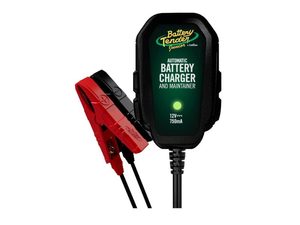 | Battery Tender Junior 12V 750mA Battery Charger and Maintainer | Check Price |
Third Choice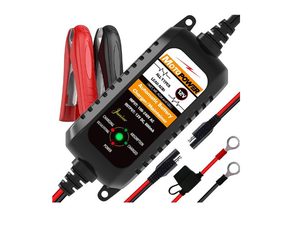 | MOTOPOWER MP00205A 12V 800mA Automatic Battery Charger | Check Price |
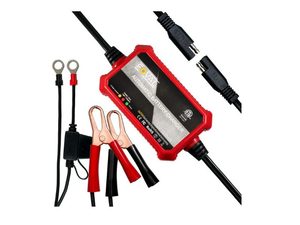 | FOVAL 12V 1000mA Automatic Trickle Battery Charger | Check Price |
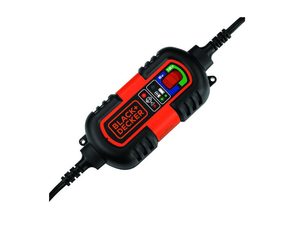 | BLACK+DECKER BM3B 6V/12V Automatic Battery Maintainer | Check Price |
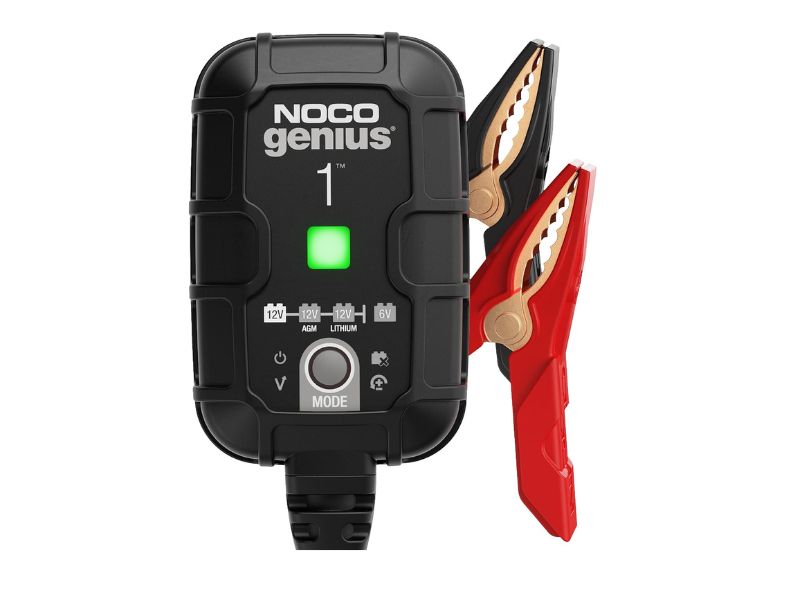
1. NOCO GENIUS1 1A 6V/12V Smart Battery Charger – Best Overall
Key Features
- 1A charging output
- 6V and 12V operation
- Flooded lead-acid compatibility
- AGM charging mode
- EFB and gel support
- Compatible lithium charging mode
- Automatic battery maintenance
- Automatic temperature compensation
- Low-voltage charging capability
- Manual Force Mode
- Reverse-polarity protection
- Spark-resistant connection system
- Compact, lightweight housing
The NOCO GENIUS1 earns my first position because it packs an unusually broad range of battery-management features into an extremely small body.
At roughly 3.62 inches tall, 2.32 inches wide, and 1.26 inches deep, the charger can easily fit inside a small toolbox, garage cabinet, drawer, or vehicle-equipment container. It weighs well under a pound, so there is little inconvenience in keeping it available throughout the year.
More importantly, the small size does not restrict it to one basic battery type.
The GENIUS1 supports several common 6V and 12V lead-acid batteries, including wet/flooded, AGM, gel, EFB, maintenance-free, and calcium designs. It also offers a dedicated 12V lithium setting for compatible lithium-ion batteries equipped with an appropriate battery-management system.
That versatility matters increasingly as modern vehicles move away from basic flooded starting batteries. Many cars with automatic start-stop systems now use AGM or EFB batteries, while specialty and performance applications sometimes use lithium technology.
Another feature I consider particularly valuable is automatic temperature compensation.
Battery charging requirements change with temperature. In cold conditions, a lead-acid battery behaves differently than it does in a hot garage during summer. The GENIUS1 uses thermal sensing to modify its charging behavior so it can reduce undercharging in cold conditions and unnecessary charging voltage in heat.
Its low-voltage capability is also useful.
Smart battery chargers normally need to detect some voltage before they begin charging. If a battery becomes extremely discharged, ordinary automatic detection may fail. The GENIUS1 can automatically work with very low-voltage batteries and also provides Force Mode for situations where normal detection is no longer sufficient.
Force Mode should not be treated as an everyday setting. Because you are manually overriding normal detection, verify battery voltage, chemistry, condition, and polarity before using it.
The primary limitation is charging speed.
One amp is excellent for maintenance but slow for recovering a large discharged automotive battery. If a 60Ah battery needs approximately 30Ah restored, the theoretical bulk-charging portion alone could take around 30 hours at 1A, and real charging normally takes longer because current tapers as the battery approaches full charge.
For a vehicle that sits parked, however, this is exactly the kind of charger I prefer. It can slowly replenish normal storage losses and then maintain the battery automatically.
What I Like
- Extremely small and lightweight
- Broad battery compatibility
- 6V and 12V support
- Dedicated AGM charging
- Compatible lithium charging
- Automatic temperature compensation
- Excellent long-term maintenance capability
- Useful low-voltage recovery
- Force Mode available
- Strong safety protections
- Permanent connection capability
What I Do Not Like
- One-amp charging is slow for a substantially discharged car battery.
- LED indicators provide less detail than a numerical display.
- Drivers who only maintain a basic flooded battery may not need every available mode.
Verdict
The NOCO GENIUS1 is my best mini car battery charger overall.
I would choose it for a driver who wants the smallest practical charger without giving up modern battery compatibility, automatic maintenance, temperature compensation, or low-voltage recovery capability.
2. Battery Tender Junior 12V 750mA Battery Charger and Maintainer – Best for Long-Term Storage

Key Features
- 12V charging
- 750mA output
- Automatic four-stage charging
- Float maintenance
- Standard flooded battery support
- AGM compatibility
- Gel battery compatibility
- Sealed lead-acid support
- Spark-safe connection design
- Reverse-polarity protection
- Long connection reach
- Alligator clips
- Ring-terminal connection harness
Battery Tender Junior is one of the easiest models to recommend when the goal is storage maintenance rather than fast charging.
Its 750mA charging rate is intentionally modest. That means a large discharged car battery may take a long time to recharge, but maintaining a healthy battery does not require a large charging current.
Once connected to an appropriate 12V lead-acid battery, the charger automatically progresses through its charging cycle and eventually enters float maintenance.
This is much better suited to extended storage than an old-fashioned charger that simply sends the same low current into the battery continuously.
One feature I especially like is the included ring-terminal harness.
If you have a classic car, weekend car, convertible, motorcycle, or seasonal vehicle, you can install the ring terminals at appropriate battery connection points and leave the quick connector accessible.
Then maintaining the battery becomes easy:
Park the vehicle, connect the charger, and disconnect it again when the car is ready to be driven.
The long connection reach also helps when the closest garage outlet is not directly beside the vehicle.
Battery Tender Junior works with common flooded, AGM, gel, and sealed maintenance-free lead-acid batteries. However, this particular version is not the charger I would choose for someone whose primary vehicle uses an unsupported lithium starter battery.
Battery capacity is another consideration.
Its low-current architecture makes it particularly appropriate for smaller starting batteries and maintenance applications. It can maintain larger automotive batteries, but substantially recharging them requires patience.
If you frequently encounter dead or half-discharged batteries, consider a higher-amperage smart charger instead of expecting a mini maintainer to perform like a full-size garage charger.
What I Like
- Excellent long-term storage option
- Small and lightweight
- Automatic charging operation
- Float maintenance
- Long connection reach
- Permanent ring-terminal option
- Straightforward LED status indication
- Spark protection
- Reverse-polarity protection
- Simple enough for occasional users
What I Do Not Like
- 750mA charging is very slow for large discharged batteries.
- More maintenance-focused than recovery-focused.
- Battery chemistry support is narrower than the NOCO GENIUS1.
- No numerical voltage or charging-current display.
Verdict
The Battery Tender Junior is my preferred mini charger for vehicles that spend weeks or months parked.
If your battery begins storage in healthy condition and you simply want to keep it ready, its gentle automatic charging approach is extremely practical.
3. MOTOPOWER MP00205A 12V 800mA Automatic Battery Charger – Best Budget Pick

Key Features
- 12V operation
- 800mA charging output
- Automatic charging
- Battery maintenance
- Trickle-charging functionality
- Desulfation function
- Flooded lead-acid support
- AGM compatibility
- Gel battery support
- Sealed battery compatibility
- Reverse-polarity protection
- Short-circuit protection
- Quick-connect accessories
The MOTOPOWER MP00205A is an appealing option when you want a small dedicated charger for a stored vehicle without paying for a long list of advanced features.
Its 800mA output positions it between a traditional low-current maintainer and a slow charger.
For long-term storage, that is usually enough. A healthy battery does not require several amps continuously. The maintainer primarily needs to replace energy lost through normal self-discharge and small parasitic electrical loads from the vehicle.
Those loads can include:
- Alarm systems
- Clocks
- Memory circuits
- Immobilizers
- Keyless-entry receivers
- Telematics
- Control modules
If the car sits for several weeks, those tiny electrical demands accumulate.
The MOTOPOWER helps counter those losses while automatically maintaining the battery rather than relying on you to periodically connect and disconnect a manual charger.
Its desulfation function is another selling point.
Lead sulfate forms naturally during battery discharge. If a lead-acid battery stays partially discharged for a long time, some sulfate can harden and reduce effective plate area.
Appropriate charging strategies can sometimes improve mild recoverable sulfation, but I would not buy any charger expecting it to restore a physically failed battery.
A charger cannot realistically repair a battery with:
- A shorted cell
- Severe plate shedding
- A broken internal connection
- A cracked housing
- Serious electrolyte loss
- Major internal corrosion
The MP00205A is best considered preventive equipment.
Its compact body and simple indicator system make it easy to use, and the SAE-style connection allows you to choose between temporary battery clamps and a more permanent ring-terminal installation.
One issue some buyers may encounter is cable positioning. Because the unit is designed to remain small, you should check where your outlet and vehicle charging points are located before deciding whether additional approved cable reach is necessary.
What I Like
- Very compact construction
- Lightweight
- Simple automatic operation
- Good for storage maintenance
- 800mA output
- Desulfation functionality
- Multiple lead-acid battery types supported
- Useful quick-connect arrangement
- Basic electrical protections
- Good dedicated-maintainer option
What I Do Not Like
- Too slow for rapid automotive battery recovery.
- 12V-only operation limits versatility.
- Limited status information.
- Not my first choice if lithium-battery charging is required.
Verdict
The MOTOPOWER MP00205A is my budget mini charger pick for ordinary 12V lead-acid battery maintenance.
It makes the most sense for a second vehicle, motorcycle, lawn tractor, or seasonal car whose battery is normally healthy but spends long periods without regular driving.
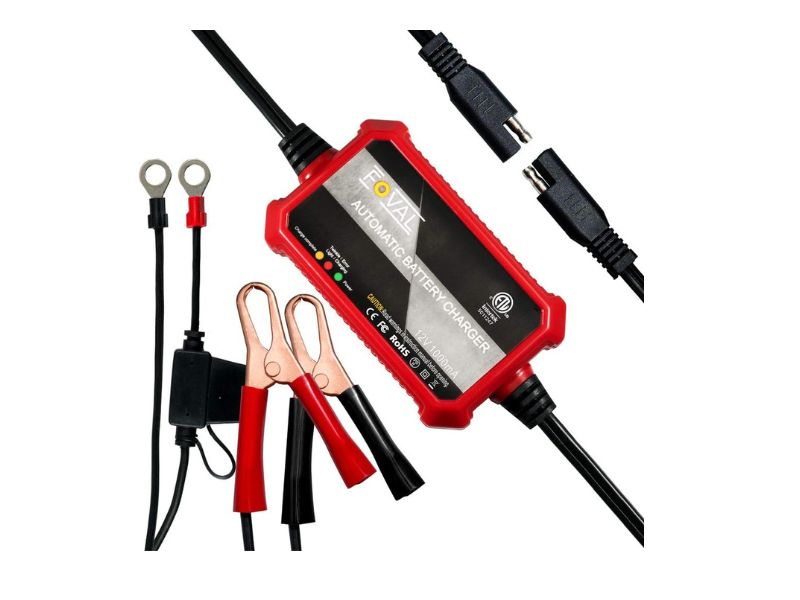
4. FOVAL 12V 1000mA Automatic Trickle Battery Charger – Best Ultra-Compact 1A Pick
Key Features
- 12V 1A charging
- Automatic charging
- Float maintenance
- Multi-stage charging behavior
- Common lead-acid battery compatibility
- Alligator-clip connection
- Ring-terminal connection
- Quick-disconnect lead
- Reverse-polarity protection
- Short-circuit protection
- Compact 3.9 x 2.4-inch-class housing
- Lightweight design
The FOVAL charger is particularly interesting for this keyword because it is genuinely mini.
The body is roughly four inches long and a little over two inches wide, making it easy to place near a stored vehicle without dedicating meaningful garage space.
Output is rated at 1 amp, giving it slightly more charging capability than the 750mA Battery Tender Junior and 800mA MOTOPOWER.
That still makes it primarily a maintenance and slow-charging tool rather than a rapid battery charger.
For a car that sits unused, however, that can be ideal.
If the battery begins fully charged, the charger does not need to replace dozens of amp-hours. It only needs to compensate for relatively small storage losses.
The included connection choices add versatility.
Alligator clips are convenient when you move the charger between different batteries. Ring terminals are better when the charger stays dedicated to one vehicle.
For example, a weekend sports car could have the quick-connect harness permanently installed. When you park it Sunday evening, connecting the maintainer requires only a few seconds.
The automatic charging system eventually transitions into maintenance rather than continuing full charging indefinitely.
This is why I would choose it over an old uncontrolled trickle charger for extended storage.
The FOVAL’s biggest weakness is also predictable: a 1A unit can require days to recharge a severely depleted large automotive battery.
That is not necessarily a problem if you understand what you are buying.
If your goal is preventing a healthy battery from going flat, it makes sense.
If your goal is regularly reviving large discharged batteries before work the next morning, purchase a higher-output charger.
What I Like
- Truly compact housing
- Lightweight
- Useful 1A output
- Automatic maintenance
- Simple status indication
- Ring-terminal option
- Battery clamps included
- Appropriate for seasonal storage
- Easy to dedicate to one vehicle
- Straightforward operation
What I Do Not Like
- Slow for heavily discharged car batteries.
- No detailed LCD information.
- Primarily focused on 12V lead-acid applications.
- Less chemistry versatility than the NOCO.
Verdict
The FOVAL 1A charger is an excellent mini maintenance option when physical size and simplicity are the main priorities.
Its tiny body makes it particularly appealing for motorcycles, classic cars, seasonal vehicles, and garages where storage space is limited.
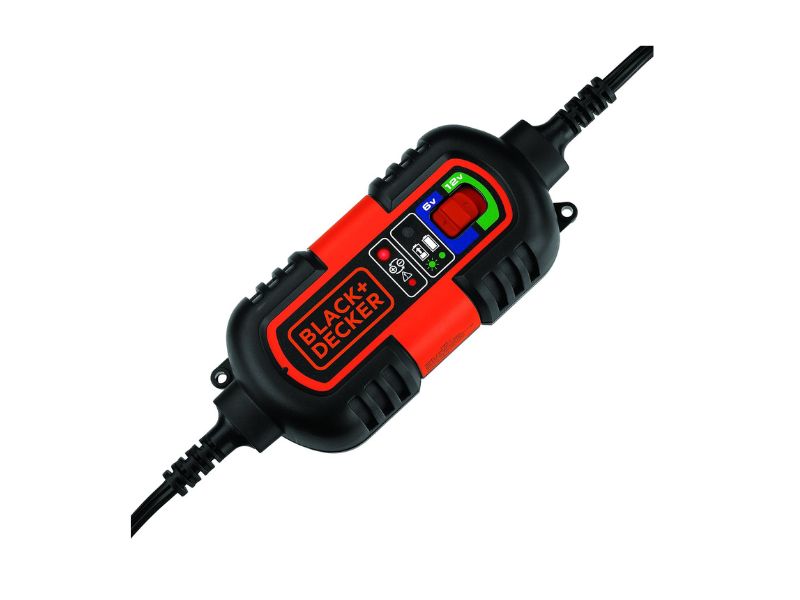
5. BLACK+DECKER BM3B 6V/12V Automatic Battery Maintainer – Best Connection Versatility
Key Features
- 6V and 12V operation
- Approximately 1.2A maximum output
- Automatic high-frequency charging
- Automatic float maintenance
- Wet lead-acid battery support
- AGM compatibility
- Gel battery compatibility
- Battery clamps
- Ring-terminal connections
- DC accessory-plug connection option
- Reverse-polarity protection
- Short-circuit protection
- Mountable compact housing
The BLACK+DECKER BM3B takes a somewhat different approach from the first four products.
Its biggest advantage is connection flexibility.
You can use traditional battery clips for temporary charging or ring terminals for a permanent vehicle connection. On vehicles with the appropriate electrical configuration, the accessory-socket connector can offer another convenient charging method.
That last option requires some caution.
Not every car leaves its 12V accessory socket electrically connected when the ignition is off.
Some vehicles switch the socket off immediately.
Others keep it powered temporarily and then disconnect it when modules enter sleep mode.
A charger connected to a dead accessory socket obviously cannot reach the battery.
Check the vehicle owner’s manual before depending on this connection method.
The BM3B supports both 6V and 12V batteries, making it useful for people with vintage equipment in addition to modern vehicles.
It also works with common wet, AGM, and gel lead-acid battery designs.
Its automatic operation means it can transition into float maintenance after charging rather than continuously supplying maximum current.
This makes it more suitable for long-term connection than a basic manual charger.
Output remains relatively modest, so I still view the BM3B mainly as a maintainer and slow charger.
Its compact form factor and built-in mounting provisions can be useful if you want a permanent charging location near a garage workbench.
What I Like
- 6V and 12V compatibility
- Compact form factor
- Several connection methods
- Battery clamps included
- Ring-terminal option
- Accessory-socket connection capability
- Automatic float maintenance
- AGM and gel compatibility
- Easy garage installation
What I Do Not Like
- Accessory-socket charging will not work on every vehicle.
- Still slow compared with full-size high-amperage chargers.
- No lithium charging mode.
- Limited charging-status information.
Verdict
The BLACK+DECKER BM3B is my favorite mini option when connection flexibility matters most.
Its ability to work with 6V and 12V lead-acid batteries also makes it useful for garages containing several types of vehicles or equipment.
Best Mini Car Battery Charger Comparison
| Product | Output | Voltage | Battery Types | Maintenance Mode | Low-Voltage Feature | Connection Options | Best For |
| NOCO GENIUS1 | 1A | 6V/12V | Flooded, AGM, EFB, Gel, compatible lithium | Yes | Force Mode | Clamps / eyelets | Best overall |
| Battery Tender Junior | 750mA | 12V | Flooded, AGM, Gel, sealed lead-acid | Yes | Automatic charging | Clips / ring terminals | Long-term storage |
| MOTOPOWER MP00205A | 800mA | 12V | Common lead-acid types | Yes | Desulfation | Clips / ring terminals | Budget maintenance |
| FOVAL Automatic Charger | 1A | 12V | Common lead-acid types | Yes | Smart charging | Clips / ring terminals | Ultra-compact use |
| BLACK+DECKER BM3B | Approx. 1.2A | 6V/12V | Wet, AGM, Gel | Yes | Automatic charging | Clips / rings / compatible 12V socket | Flexible connection |
The NOCO GENIUS1 provides the strongest overall combination of mini dimensions and advanced battery support. Its temperature compensation and compatible lithium mode also give it more flexibility than the other maintenance-focused products.
For long-term 12V lead-acid storage, the Battery Tender Junior remains extremely easy to use. MOTOPOWER and FOVAL are particularly attractive when you want a small dedicated maintainer, while BLACK+DECKER provides the most varied connection options.
How I Selected These Mini Car Battery Chargers
A charger needed more than a small body to qualify.
I focused on products that can genuinely maintain or charge automotive-type batteries while remaining easy to store.
My main evaluation factors included:
- Physical size
- Weight
- Customer popularity
- Charging output
- 12V automotive compatibility
- 6V capability where available
- AGM support
- EFB support
- Lithium support where applicable
- Automatic float maintenance
- Temperature compensation
- Low-voltage recovery
- Electrical safety
- Permanent connection options
- Ease of use
- Long-term storage suitability
I also considered what each charger is realistically designed to do.
A miniature 750mA charger should not be criticized simply because it cannot recharge a deeply discharged 80Ah automotive battery in a few hours. That is not its intended job.
What Is a Mini Car Battery Charger?
A mini charger is a physically compact charger designed to supply relatively modest charging current to automotive, motorcycle, powersports, lawn-equipment, marine, or similar batteries.
Most models in this category produce approximately 0.75A to 2A.
Their small size makes them ideal for:
- Maintaining stored vehicles
- Charging motorcycle batteries
- Maintaining classic cars
- Weekend vehicles
- Seasonal convertibles
- Lawn tractors
- ATVs
- Backup vehicles
- Battery storage
The best models are automatic, meaning they do not simply provide full current indefinitely.
Mini Charger vs. Full-Size Car Battery Charger
A full-size charger is usually better when speed matters.
A mini charger is better when:
- Storage space matters.
- The vehicle spends long periods parked.
- Charging speed is not urgent.
- You mainly need maintenance.
- You want one charger permanently assigned to a vehicle.
A larger 10A or 15A charger can restore a depleted car battery much faster.
However, if the battery is already full and you simply want to keep it that way over winter, the additional charging capacity provides relatively little benefit.
Mini Charger vs. Battery Maintainer
Many mini battery chargers are actually charger-maintainer combinations.
A charger restores energy that has been removed from the battery.
A maintainer monitors a charged battery and replaces only the energy it loses during storage.
Modern smart units can do both.
They may begin with bulk charging, transition into absorption charging, and eventually reach float or maintenance mode.
Low-current mini products naturally spend much of their working life as maintainers.
Mini Charger vs. Trickle Charger
Traditional trickle charging refers to continuously supplying a small charging current.
The problem is that a fixed-output charger may keep pushing current even after the battery is full.
Modern smart maintainers are more sophisticated.
They monitor battery condition and reduce charging when appropriate.
For long-term vehicle storage, I prefer an automatic charger-maintainer rather than an old uncontrolled trickle charger.
What Charging Amperage Do You Need?
Charging output should match your intended use.
0.75A to 1A
Excellent for:
- Storage maintenance
- Motorcycles
- Small batteries
- Classic cars
- Weekend vehicles
- Overnight top-ups of lightly discharged batteries
Not ideal for rapid recovery.
2A to 5A
A useful compromise for:
- Medium automotive batteries
- Faster overnight charging
- AGM batteries
- Cars that occasionally become moderately discharged
10A or Higher
Better for:
- Deeply discharged car batteries
- Larger trucks and SUVs
- Users who need fast charging
- Multi-vehicle garage work
Higher output does not automatically make a charger better for storage.
How Long Will a Mini Charger Take to Charge a Car Battery?
Charging time depends on:
- Battery capacity
- Initial state of charge
- Charger amperage
- Battery temperature
- Battery age
- Battery chemistry
- Charging efficiency
- Automatic current tapering
Consider a simplified example.
Suppose a 60Ah battery is approximately 50% charged.
Roughly 30Ah needs to be replaced.
With a 750mA Charger
30Ah ÷ 0.75A = approximately 40 hours theoretically.
Real charging takes longer.
With an 800mA Charger
30Ah ÷ 0.8A = approximately 37.5 hours theoretically.
With a 1A Charger
30Ah ÷ 1A = approximately 30 hours theoretically.
Again, actual charging generally takes longer because the charger tapers current near full charge.
This illustrates why mini chargers are especially effective when used before the battery goes dead.
Is a 1-Amp Charger Enough for a Car Battery?
Yes, for maintenance and slow charging.
One amp is easily capable of replacing normal battery self-discharge and typical small storage losses.
It becomes less convenient when you need to restore a deeply discharged battery.
Think of a mini 1A charger as preventive battery care rather than an emergency rapid-charging tool.
What Battery Types Can Mini Chargers Support?
Flooded Lead-Acid
Traditional flooded batteries remain common in passenger vehicles.
They contain liquid electrolyte and normally use the charger’s standard 12V lead-acid program.
AGM
Absorbent Glass Mat batteries are increasingly common.
They are used in many:
- Start-stop vehicles
- Luxury cars
- Performance cars
- Vehicles with high electrical loads
A charger with a dedicated AGM program is preferable when specified by the battery manufacturer.
EFB
Enhanced Flooded Batteries are another common start-stop technology.
The NOCO GENIUS1 specifically provides broad modern lead-acid compatibility that makes it particularly useful in garages containing newer vehicles.
Gel
Gel batteries require compatible charging voltage.
Do not assume an AGM setting is automatically correct for a gel battery.
Lithium
Lithium automotive and powersports batteries require a charger designed specifically for their chemistry and battery-management system.
The NOCO GENIUS1 offers the broadest chemistry range among my five selections.
How Do I Know What Battery My Car Has?
Read the battery label.
Look for terms such as:
- AGM
- EFB
- GEL
- WET
- Flooded
- SLA
- VRLA
- LiFePO4
If the information is unclear, check the battery model number or vehicle owner’s manual.
Never guess battery chemistry based only on the shape or color of the battery case.
Why Temperature Compensation Matters
Battery charging voltage changes with temperature.
Cold lead-acid batteries behave differently from hot batteries.
A smart charger with automatic temperature compensation can alter the charging profile as environmental conditions change.
This is especially valuable when a charger stays connected in an unconditioned garage.
A winter garage in Minnesota may routinely reach temperatures far below freezing.
A garage in Phoenix may become extremely hot during summer.
The NOCO GENIUS1 is particularly useful across those varying conditions because temperature correction is integrated into its charging strategy.
Best Mini Charger for Winter Storage
My first choice is the NOCO GENIUS1.
Its automatic maintenance and temperature compensation make it particularly suitable for seasonal vehicles in colder climates.
The Battery Tender Junior is another excellent choice when the vehicle uses a compatible 12V lead-acid battery and begins storage fully charged.
Before winter storage:
- Fully charge the battery.
- Inspect the terminals.
- Confirm battery condition.
- Connect the maintainer properly.
- Route cables safely.
- Verify that maintenance mode activates normally.
A maintainer works best when it is preserving a healthy battery rather than attempting to revive one that was already nearly dead.
Best Mini Charger for AGM Batteries
I would choose the NOCO GENIUS1 because it has a dedicated AGM mode and automatic temperature compensation.
Battery Tender Junior also supports AGM batteries, making it a strong choice for maintenance when faster charging is unnecessary.
Always follow the battery manufacturer’s recommended charging specification.
Best Mini Charger for Classic Cars
Classic vehicles create two special considerations.
First, some older cars use 6V electrical systems.
Second, collector vehicles often spend months without regular driving.
The NOCO GENIUS1 and BLACK+DECKER BM3B both provide 6V and 12V capability, making them useful when you maintain a mix of vintage and modern equipment.
For a 12V classic car, Battery Tender Junior is another excellent long-term maintenance option.
Permanent Ring Terminals vs. Battery Clamps
Battery Clamps
Clamps are best when one charger is used on several batteries.
Advantages include:
- No installation
- Easy transfer
- Familiar operation
- Fast temporary connection
Ring Terminals
Ring terminals are better for a dedicated storage vehicle.
Advantages include:
- Secure permanent connection
- No repeated clamp installation
- Quick charger hookup
- Easier access when battery terminals are inconvenient
Make sure the permanent cable is fused where appropriate and routed away from heat, moving parts, and sharp edges.
Can I Charge Through the 12V Accessory Socket?
Sometimes.
The BLACK+DECKER BM3B provides an accessory-socket connection option, but the vehicle must keep that socket connected to the battery with the ignition off.
Many modern vehicles do not.
If the socket shuts down with the ignition, the charger cannot reach the battery.
Check your owner’s manual before depending on this method.
Can I Charge the Battery Without Removing It?
Usually yes when using an appropriate modern smart charger.
Many vehicles are specifically designed to allow external maintenance charging with the battery installed.
However, some modern cars have:
- Battery-monitoring sensors
- Remote positive terminals
- Dedicated chassis-ground points
- Battery-management modules
Follow the charging procedure in the owner’s manual.
How to Connect a Mini Battery Charger
Start with the charger disconnected from household power unless its instructions specify otherwise.
Confirm:
- Battery voltage
- Battery chemistry
- Correct charger mode
- Battery physical condition
Locate the proper positive and negative charging points.
Connect the positive lead to the designated positive connection.
Attach the negative connection exactly as specified by the vehicle and charger manufacturers.
Plug the charger into power.
Select the appropriate battery mode.
Confirm that charging begins normally.
After charging, follow the manufacturer’s recommended shutdown and disconnection sequence.
Battery Charger Safety
Automotive batteries contain large amounts of stored electrical energy.
Lead-acid batteries can also release flammable hydrogen gas under certain charging conditions.
Never charge a battery that is:
- Cracked
- Leaking
- Swollen
- Frozen
- Severely overheated
- Physically damaged
Keep flames, smoking materials, and sparks away.
Wear appropriate eye protection when working around lead-acid batteries.
Keep metal tools from bridging battery terminals.
Electrical protection built into a charger is useful, but it does not replace safe handling.
Can a Mini Charger Fix a Dead Battery?
It depends on what “dead” means.
A healthy battery that simply became discharged during storage may recharge successfully.
A mildly sulfated battery may improve through an appropriate charging cycle.
A deeply discharged battery may need a charger with low-voltage recovery.
However, a battery with internal physical failure may not recover regardless of charging time.
Signs replacement may be necessary include:
- Battery will not hold charge.
- Voltage drops rapidly after charging.
- Engine cranks slowly despite full charging.
- Case is swollen.
- Electrolyte is leaking.
- Battery fails a proper load or conductance test.
Why Does My Battery Keep Dying?
Repeated discharge can have several causes.
Common possibilities include:
- Old battery
- Abnormal parasitic drain
- Alternator problems
- Loose terminals
- Corrosion
- Short-trip driving
- Vehicle sitting unused
- Extreme temperatures
- Electrical accessories remaining active
A maintainer can prevent storage-related discharge, but it should not be used to hide a genuine vehicle electrical problem.
If your daily driver becomes dead after one or two nights, diagnose the cause.
Common Mistakes When Using Mini Chargers
Expecting Fast Charging
A 0.75A or 1A charger may require more than a day to restore a substantially discharged automotive battery.
Choosing the Wrong Battery Mode
Using an inappropriate AGM, lithium, or standard lead-acid setting can produce incorrect charging behavior.
Connecting to the Wrong Vehicle Point
Modern cars may specify designated charging terminals instead of direct battery access.
Using Repair Mode Unnecessarily
Special recovery modes are not intended as everyday normal charging modes.
Ignoring Cable Routing
Do not route permanent leads near:
- Exhaust components
- Radiator fans
- Belts
- Pulleys
- Sharp metal edges
Waiting Until the Battery Is Completely Dead
Maintenance works best when started while the battery is still healthy and charged.
Frequently Asked Questions
What is the best mini car battery charger?
The NOCO GENIUS1 is my best overall mini car battery charger.
Its tiny body, 1A output, 6V/12V operation, broad lead-acid support, compatible lithium mode, automatic temperature compensation, Force Mode, and maintenance capability make it unusually versatile for its size.
What is the smallest practical car battery charger?
The NOCO GENIUS1 and FOVAL 1A are both exceptionally compact.
The GENIUS1 measures only a few inches in each direction while still providing sophisticated battery-management functions. FOVAL is another strong choice when you primarily want basic 12V maintenance.
Is a mini battery charger powerful enough for a car?
Yes for battery maintenance and slow charging.
Most mini chargers provide less than 2A, which is enough to maintain a normal automotive battery but considerably slower than a 10A or 15A charger when the battery is deeply discharged.
Can a 1A charger fully charge a car battery?
Yes, provided the battery is healthy and you allow enough time.
A large discharged battery may require well over 24 hours. The charger will normally slow further as the battery approaches full charge.
Is 750mA enough to maintain a car battery?
Yes, when the battery is already healthy and nearly full.
Maintenance requires much less current than recovering a discharged battery. This is why low-current products such as Battery Tender Junior work well for seasonal storage.
Can I leave a mini charger connected overnight?
Yes when the charger is specifically designed for automatic charging and maintenance.
Follow the manufacturer instructions and verify that the charger enters its appropriate maintenance stage.
Can I leave a battery maintainer connected for months?
Many automatic maintainers are specifically designed for extended storage connection.
The battery should be healthy, the charger correctly configured, and the installation compliant with manufacturer safety instructions.
Which mini charger is best for AGM batteries?
The NOCO GENIUS1 is my first choice for AGM battery maintenance.
It provides a dedicated AGM program plus temperature compensation and automatic maintenance.
Can I use these chargers on a lithium battery?
Only use a charger with an explicitly compatible lithium program.
Among these picks, the NOCO GENIUS1 offers the clearest multi-chemistry flexibility. Do not use a lead-acid-only mode on a lithium battery.
Is a mini charger better than a trickle charger?
A smart mini charger is generally preferable to an old unregulated trickle charger.
Modern models can monitor battery condition and transition into maintenance mode instead of supplying the same current continuously.
Is a battery maintainer the same as a charger?
Not exactly, although many modern devices perform both functions.
A charger restores lost energy. A maintainer primarily preserves the battery after charging is complete.
Can a mini charger revive a completely dead battery?
Some can recover deeply discharged batteries, but success depends on battery condition.
The NOCO GENIUS1 includes a low-voltage Force Mode. No charger can reliably restore a battery with severe internal physical damage.
Should I disconnect my car battery before charging?
Usually not when using an appropriate smart charger, but follow your vehicle manual.
Some cars specify dedicated under-hood charging points or grounding locations because of battery-monitoring electronics.
Can I use a mini charger in cold weather?
Yes when its operating-temperature range permits it.
A charger with temperature compensation is particularly useful because lead-acid charging requirements change in cold conditions.
Will a mini charger overcharge my battery?
A properly functioning automatic maintainer is designed to prevent continuous overcharging.
It should reduce charging or move into float maintenance once the battery reaches the appropriate charge level.
Can I use one charger for a car and motorcycle?
Yes if both batteries use voltages and chemistries supported by the charger.
Mini chargers are particularly useful for mixed car, motorcycle, ATV, and lawn-equipment battery maintenance.
How often should I use a battery maintainer?
For a vehicle that will sit for weeks or months, connecting the maintainer at the beginning of storage is usually best.
Keeping a lead-acid battery appropriately charged is generally better than repeatedly allowing it to become deeply discharged.
Is NOCO GENIUS1 good for a full-size car battery?
Yes for maintenance and slow charging.
Its 1A output can maintain batteries of many sizes, but owners needing fast recovery of a large discharged battery should choose a higher-amperage smart charger.
Why does my charger say full but the car will not start?
A battery can reach normal charging voltage yet still lack sufficient cranking capacity.
Internal battery deterioration, poor terminals, wiring faults, starter problems, or other vehicle issues can prevent starting even after charging.
Conclusion
Choosing the best mini car battery charger is mostly about understanding what a small charger does well.
If your vehicle spends weeks parked, a compact 0.75A to 1A automatic charger can keep the battery healthy without taking up the space of a conventional garage charger. If you routinely need to recharge deeply discharged batteries quickly, however, moving to a higher-output model is the better solution.
My primary recommendation is the NOCO GENIUS1 1A 6V/12V Smart Battery Charger. It combines exceptionally small dimensions with broad battery compatibility, automatic temperature compensation, low-voltage recovery, automatic maintenance, and strong safety features. That combination makes it the most complete mini charger for most drivers.
The Battery Tender Junior is my preferred alternative for pure long-term storage. Its 750mA output and automatic float maintenance are particularly well suited to a vehicle that begins storage with a healthy battery.
The MOTOPOWER MP00205A provides a simple and affordable 800mA solution for ordinary 12V lead-acid maintenance, while the FOVAL 1A Automatic Charger offers an especially small package for drivers who want a charger they can easily dedicate to one vehicle.
Finally, the BLACK+DECKER BM3B is worth considering when 6V/12V capability and multiple connection methods matter.
For most drivers, I would start with the NOCO GENIUS1. It is genuinely mini, easy to store, and sophisticated enough to remain useful even if your battery type or vehicle changes later.