
A tonneau cover is easier to choose when you measure the truck bed from the inside, check its width and rail setup, and match those details to your truck’s exact year, make, model, and bed style. Start with the bed length, but don’t order from that number alone.
Have you ever found two different “short bed” measurements for what looks like the same truck? Or worried that a bed liner, rail cap, or unusual tailgate might throw off a cover fit?
I once measured from the outside of a tailgate instead of between the bed’s inside walls, then had to redo the job after the number didn’t match the fitment guide. The tape caught on a rough bed liner, which didn’t help. It’s a common mistake, not a dumb one.
I wrote this to make the measuring part simple and useful, especially if you’re choosing your first cover or replacing one that never fit quite right. You’ll get a repeatable way to measure and a better sense of which details matter when you check compatibility.
Get the measurements right, and you’re less likely to waste money on a cover that sits crooked, blocks the tailgate, or can’t attach to your bed rails. Skip the model and rail checks, and a good measurement can still lead you to the wrong product.
This takes about 9 minutes to read. By the end, you’ll know how to:
- Measure your bed length and inside width without guessing.
- Record the details a tonneau cover fitment guide needs.
- Spot liner, tailgate, and rail issues before ordering.
- Check a confusing measurement against your truck’s fitment details.
How to Measure Truck Bed for Tonneau Cover
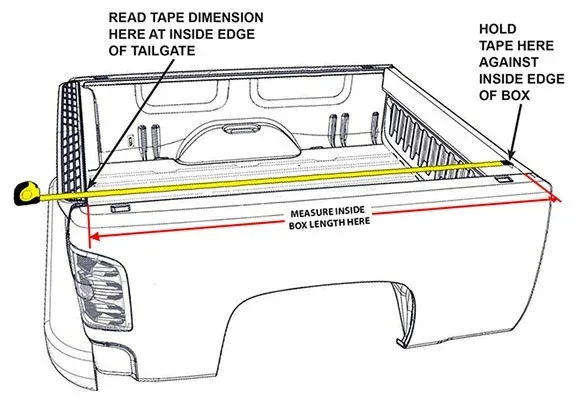
Measure the bed length inside the bed, from the front wall to the inside edge of the closed tailgate, then measure the inside width between the bed rails. Use those numbers to confirm the exact truck and bed configuration in the cover maker’s fitment guide; don’t rely on a length label alone.
You’ll need a tape measure, a notepad or phone, and, ideally, a second person to hold the tape. Park on level ground and remove loose cargo so the tape can lie straight.
- Close the tailgate. A closed tailgate gives you the right end point for the bed’s usable length. Keep the tailgate shut while you measure, not extended behind the bed.
- Measure the inside length. Start at the front bed wall, also called the bulkhead, and run the tape along the bed floor to the inside edge of the tailgate. Keep the tape straight and parallel to the bed sides.
- Measure the inside width. Stretch the tape across the bed from the inner face of one rail to the inner face of the other. Take the measurement near the front and near the tailgate, since bed shape and accessories can affect the available space.
- Write down your truck details. Note the model year, make, model, cab style, bed style, and whether the truck has a factory or aftermarket bed liner. Add the bed length and width you measured.
- Match the result to the cover maker’s fitment guide. Confirm the specific truck configuration and cover style, then check the maker’s instructions for any rail, liner, or tailgate restrictions.
The bulkhead is the front wall of the bed, closest to the cab. Measuring from that wall to the inside of the tailgate gives you a useful physical measurement, but manufacturers may list a bed size by a rounded or commonly used name.
| What to measure or record | Where to measure or look | Why it matters |
|---|---|---|
| Inside bed length | Bulkhead to inside edge of closed tailgate | Helps identify the bed-length category |
| Inside bed width | Inner face of rail to inner face of rail | Shows the space between the rails |
| Truck year, make, and model | Vehicle paperwork or truck information | Helps narrow the product fitment |
| Cab and bed style | Truck configuration or owner’s manual | Similar trucks can have different bed options |
| Rail and liner setup | Bed rails and liner edges | Can affect clamps, rails, and cover clearance |
If your tape reads a little differently from a product’s listed “5-foot” or “6.5-foot” bed size, don’t panic. Those names are often rounded categories, and the fitment guide for your specific truck is more useful than trying to make the label match your tape to the inch.
Pro Tip: Take each measurement twice, then write down both the measurement and where you took it. “Inside length, floor” is much more useful later than a lone number on your phone.
Is a tape measure reading enough to pick a cover? No. It’s a helpful check, but the truck’s year, model, cab, bed configuration, and cover’s mounting system all matter.
Use the tape to spot a mismatch, not to replace the fitment details.
When comparing products, use a guide to choose a tonneau cover that suits your truck and the way you use the bed. A hard folding cover and a soft roll-up cover can attach differently, so matching the truck alone doesn’t settle every fit question.
Which Measurements and Truck Details Matter Most
The most useful measurements are the inside bed length and inside width, but the truck’s exact configuration carries just as much weight. A fitment guide is designed to match a cover to the vehicle, not merely to a number on a tape.
A truck’s bed length is commonly grouped into a size category, such as short, standard, or long. Those labels aren’t universal across brands, so don’t assume that “short bed” means the same thing on every truck.
If you’re asking, “What size tonneau cover fits my truck?” start with the year, make, model, cab style, and bed style, then verify the product listing’s fitment details. The measured length helps confirm the category, while the vehicle details help distinguish between beds that are close in size.
Your measurement can differ from a catalog number because the tape starts and ends at different points, or because a liner changes the accessible space. That doesn’t automatically mean the fitment guide is wrong. Check where the product maker defines its measurement, then match the truck configuration listed for the cover.
Check the bed rails, the long upper edges along both sides of the bed. A cover may use clamps that grip those rails, or rails that attach to the bed, and the available space can change with rail caps, cargo racks, utility tracks, or an existing cover system.
Also look closely at the front and rear of the bed. A toolbox, bed extender, tailgate cap, or aftermarket accessory may interfere with the cover even if the length and width seem right.
- Note if the truck has a drop-in liner, which is a molded plastic liner that sits inside the bed.
- Note if it has a spray-in liner, a coating applied to the bed surfaces.
- Check for rail caps or bed-rail tracks that could affect clamp placement.
- Look for a toolbox or other item that sits above the bed rails.
- Confirm whether the tailgate has a special shape, cap, or built-in accessory.
A cover’s fitting instructions may specify what to do with a liner or accessory. Don’t trim a liner or remove a rail part just to make a cover fit unless the manufacturer’s instructions call for that change.
Important Tip: If the fitment guide offers multiple bed configurations for your truck, match the cab and bed style exactly. Choosing a nearby length because it sounds close can leave the cover too short, too long, or incompatible with the rails.
I’ve had to pause a cover install when an accessory near the front rail left too little room for the mounting hardware. The cover itself looked like a match, but the clamps needed clear rail space. Checking the bed before ordering would have saved me the extra setup and a lot of head-scratching.
Common Measurement Mistakes and How to Fix Them
Most measurement problems come from using the wrong start or end point, measuring over an obstruction, or treating a rounded bed label like an exact measurement. A quick recheck from the correct surfaces can usually clear things up.
| What went wrong | Why the number can mislead | What to do |
|---|---|---|
| Measured with the tailgate open | The tape includes space beyond the bed | Close the tailgate and measure to its inside edge |
| Measured the outside of the truck | Body width isn’t the same as space between bed rails | Measure from the inner face of each rail |
| Followed a diagonal path | A diagonal is longer than the straight bed length | Keep the tape parallel to the bed sides |
| Started on top of a liner | The tape may sit at the wrong height or catch on an edge | Measure consistently and follow the cover maker’s fitment notes |
| Used only a short, standard, or long label | Bed-size names can vary by truck | Match the exact year, model, cab, and bed style |
| Measured over a toolbox or cargo | The obstruction can shift or bend the tape | Clear loose items before measuring |
A bed liner can change how easy it is to measure and how a cover mounts, but it doesn’t change the truck’s factory bed configuration. Keep those two facts separate: record the truck’s fitment details, then report the liner as an added feature.
If the tape hooks on a liner edge, don’t pull it tight around the obstruction. Clear the bed if you can, or measure along a straight path that stays on the bed floor. If an accessory can’t be removed, make a note and ask the cover maker how it affects that product’s fit.
A crooked measurement can be especially tempting when you’re working alone. If the tape sags or shifts, repeat the measurement with another person holding the far end, or use a straight, firm point at the tailgate edge.
Does a mismatch of a few inches mean the tape is wrong? Not necessarily. A product listing may use a rounded bed-size name, while your tape records the actual distance between the surfaces you measured.
Confirm the truck configuration in the fitment guide before deciding there’s a problem.
If the truck’s details or the fitment guide still don’t line up, stop before ordering. Check the owner’s manual or truck documentation for the bed configuration, and ask the cover maker to confirm compatibility using the measurements and accessory notes you recorded.
FAQs About How to Measure Truck Bed for Tonneau Cover
Do I measure the truck bed with the tailgate open or closed?
Measure the truck bed with the tailgate closed. Start at the inside of the front bed wall and measure to the inside edge of the closed tailgate, keeping the tape straight along the bed floor. An open tailgate adds length that isn’t part of the bed.
Should I measure the inside or outside of the truck bed?
Measure the inside length and inside width for a practical check, not the truck’s outside body dimensions. The cover sits over the bed and attaches around its rails, so exterior body width won’t tell you how much space lies between the rails or whether mounting hardware has clearance.
Does a bed liner change which tonneau cover fits?
A bed liner can affect how a tonneau cover mounts, though it doesn’t change the truck’s year, model, or factory bed configuration. Record the liner type and check the product instructions for any fit limits. If the instructions don’t address your liner, ask the manufacturer before modifying it.
Why doesn’t my measurement match the bed size in a product listing?
A tape measurement can differ from a product listing because bed-size names may be rounded categories and measurement points may differ. Compare the truck’s exact year, make, model, cab, and bed style with the fitment guide. Don’t choose a cover based on a similar number alone.
Can I use a cover made for a different truck with the same bed length?
Not safely by length alone. Two trucks with similar bed lengths can have different rail shapes, tailgates, or mounting layouts. Check the cover’s fitment details for your exact truck configuration, and confirm accessory or liner restrictions before ordering.
Take Your Measurements, Then Check the Fitment
Measuring your truck bed is straightforward once you use the same start and end points each time: the inside of the bulkhead to the inside edge of the closed tailgate, plus the inner width between the rails. Those numbers help you check a fit, but the truck’s exact configuration and the cover’s mounting requirements finish the job.
I’d trust the cover maker’s fitment guide over a guess based on “short bed” or a tape number that seems close. That’s the simplest way to avoid a cover that binds at the tailgate or leaves you staring at hardware that has nowhere to go.
Your next step is easy: write down the measurements, truck details, liner, and rail accessories, then compare them with the specific cover’s fitment instructions before you buy.